ISE Cryptography — Reference
Quantum Algorithms for Cryptography
Quantum Computing in 5 Minutes
Just enough to understand Grover and Shor.
Classical Bits vs Qubits
- A classical bit is 0 or 1. That’s it. Pick one.
- A qubit can be in a superposition of both 0 and 1 simultaneously
- Analogy: a coin on a table is heads or tails. A spinning coin is “both” until it lands.
- When you measure a qubit, it collapses to 0 or 1 (the coin lands)
- The probabilities of each outcome are controlled by amplitudes
- An amplitude is a number whose square gives the probability
- For a fair superposition: amplitude \(1/\sqrt{2}\) for each, probability \(1/2\) each
- The qubit is not “secretly” 0 or 1 before measurement
- It genuinely exists in both states at once. This is quantum mechanics, not randomness.
Superposition and Parallelism
- With \(n\) qubits in superposition, you represent \(2^n\) states simultaneously
- 10 qubits: 1024 states. 265 qubits: more states than atoms in the observable universe.
- A quantum operation (gate) acts on all \(2^n\) states at once
- This is quantum parallelism: one operation, \(2^n\) inputs processed
- The catch: you can only read one outcome when you measure
- All that parallelism collapses to a single answer
- The trick: use interference to make the right answer more probable and wrong answers less probable
- This is what makes quantum algorithms hard to design and powerful when they work
Interference: The Quantum Trick
- Amplitudes can be positive or negative (unlike probabilities, which are always positive)
- When two paths to the same outcome have opposite-sign amplitudes, they cancel out (destructive interference)
- When two paths have the same sign, they reinforce (constructive interference)
- Quantum algorithms are about engineering interference patterns:
- Wrong answers: paths cancel, probability drops toward 0
- Right answer: paths reinforce, probability rises toward 1
- Classical analogy: noise-cancelling headphones use destructive interference to remove unwanted sound
Reading Quantum Notation
- Quantum computing uses Dirac notation (also called bra-ket notation)
- The symbol \(|x\rangle\) is called a ket (read aloud: “ket x” or “ket zero” for \(|0\rangle\))
- The \(|\) and \(\rangle\) are just brackets, like parentheses. The label inside names the state.
- \(|0\rangle\): “ket zero”, the qubit in state 0
- \(|1\rangle\): “ket one”, the qubit in state 1
- \(|\text{correct}\rangle\): “ket correct”, whatever state we’ve labelled “correct”
- A superposition is a weighted sum of kets:
- \(|+\rangle = \frac{1}{\sqrt{2}}|0\rangle + \frac{1}{\sqrt{2}}|1\rangle\), read “ket plus equals one-over-root-two ket zero plus one-over-root-two ket one”
- The \(1/\sqrt{2}\) factors are the amplitudes. Square to get probability: \((1/\sqrt{2})^2 = 1/2\)
Dirac Notation: Quick Reference
| Notation | Read aloud | Meaning |
|---|---|---|
| \(\lvert 0 \rangle\) | “ket zero” | Qubit in state 0 |
| \(\lvert 1 \rangle\) | “ket one” | Qubit in state 1 |
| \(\lvert + \rangle\) | “ket plus” | Equal superposition of 0 and 1 |
| \(\lvert - \rangle\) | “ket minus” | Equal superposition with a phase flip |
| \(\lvert 01 \rangle\) | “ket zero-one” | Two qubits: first is 0, second is 1 |
| \(\lvert \psi \rangle\) | “ket psi” | An arbitrary quantum state |
- We use this notation throughout the rest of this deck
- Wherever you see \(|\text{something}\rangle\), it’s just a label for a quantum state
- The maths around it (addition, coefficients) describes superpositions
Quantum Circuits
- A quantum algorithm is a sequence of gates applied to qubits, drawn as a circuit:
- H (Hadamard) gate: puts a qubit into equal superposition (\(|0\rangle \to |+\rangle\))
- CNOT gate: flips the target qubit if the control qubit is \(|1\rangle\)
- Together, H + CNOT can create entanglement (correlations between qubits that have no classical analogue)
- A quantum algorithm is just a sequence of these gates, then a measurement at the end
- Like a classical program is a sequence of instructions
- The art is choosing gates so that interference amplifies the correct answer
Oracles
- An oracle is a black-box function you can query: “is this the item I’m looking for?”
- In Grover’s algorithm: the oracle checks “is this the correct key?”
- It flips the sign of the amplitude for the correct item (marks it)
- You don’t need to know how the oracle is built internally
- Classically, checking one key takes one AES evaluation
- Quantumly, the oracle evaluates AES on all \(2^{128}\) keys simultaneously in one call
- This isn’t magic: the oracle is a quantum circuit that computes AES reversibly, and quantum parallelism does the rest
- “But surely building the oracle takes ages?” Building the circuit takes effort (proportional to the cost of one AES evaluation), but once built, each call processes all keys at once
- The oracle is the interface between the quantum algorithm and the real-world problem
Grover’s Algorithm
Finding a needle in a haystack, quantumly.
The Search Problem
- You have \(N\) items. Exactly one is “marked” (the correct key). Find it.
- Classically: check one at a time. On average, \(N/2\) checks. No way around it.
- Quantumly: Grover’s algorithm finds the marked item in \(\approx \sqrt{N}\) checks
- For AES-128: \(N = 2^{128}\), so \(\sqrt{N} = 2^{64}\). A quadratic speedup.
- How? Not by checking faster. By checking smarter, using interference.
Grover’s Idea: Amplitude Amplification
- Step 0: put all \(N\) items in equal superposition
- Each item has amplitude \(1/\sqrt{N}\), probability \(1/N\)
- “Wait, doesn’t creating \(N\) states take \(N\) steps?” No! Apply an H gate to each of \(n\) qubits (\(N = 2^n\)). That’s \(n\) operations, not \(N\). For AES-128: just 128 gates to create \(2^{128}\) states.
- Step 1 (Oracle): flip the sign of the marked item’s amplitude
- It goes from \(+1/\sqrt{N}\) to \(-1/\sqrt{N}\)
- Every other item stays at \(+1/\sqrt{N}\)
- The oracle runs on the entire superposition in one call. It doesn’t check items one at a time.
- Step 2 (Diffusion): reflect all amplitudes about the average
- The average is now slightly below \(1/\sqrt{N}\) (because one item is negative)
- Items above average get pushed down, items below average get pushed up
- The marked item (far below average, negative) gets a big boost
- Repeat Steps 1-2. Each iteration, the marked item’s amplitude grows.
The Geometry: Rotation on a Circle
- The state of the system lives in a 2D plane:
- One axis: \(|\text{correct}\rangle\) (the marked item)
- Other axis: \(|\text{wrong}\rangle\) (everything else)
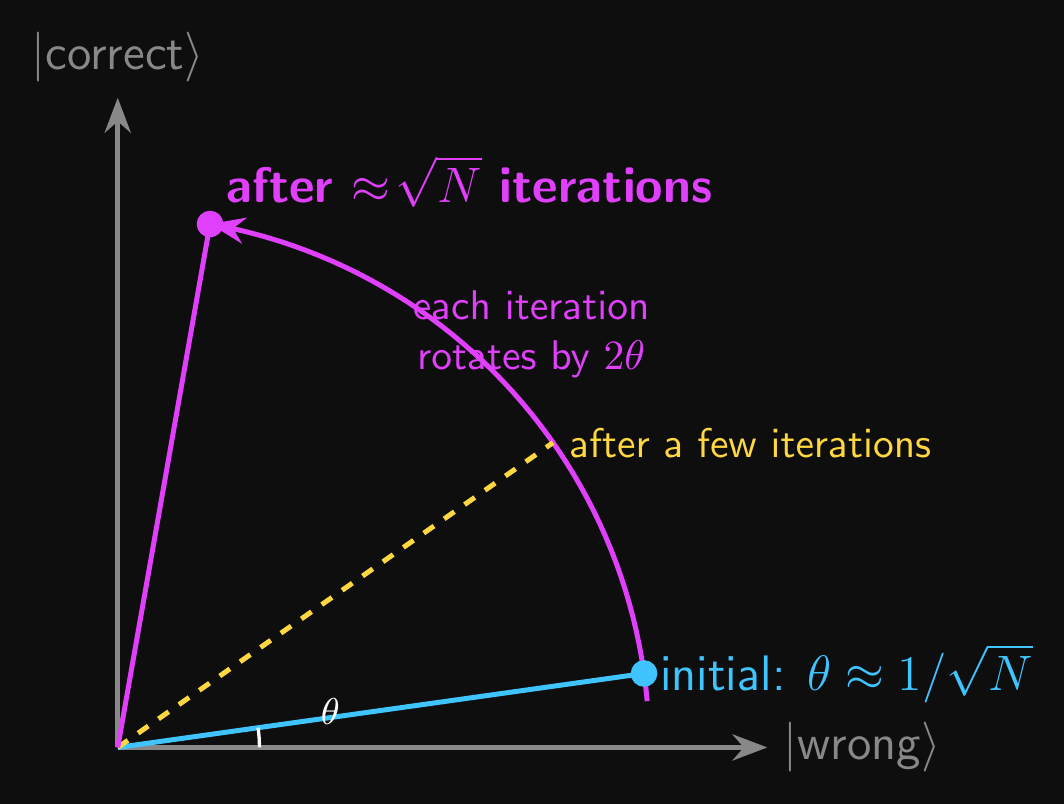
- Each Grover iteration rotates the state by \(2\theta\) toward \(|\text{correct}\rangle\)
- After \(\approx \sqrt{N}\) rotations, the state is aligned with \(|\text{correct}\rangle\)
Why Exactly \(\sqrt{N}\)?
- The initial angle \(\theta \approx 1/\sqrt{N}\) (for large \(N\), the state is almost entirely \(|\text{wrong}\rangle\))
- Each iteration rotates by \(2\theta \approx 2/\sqrt{N}\) radians
- To rotate from \(\theta\) to \(\pi/2\) (fully aligned with \(|\text{correct}\rangle\)):
- Number of iterations \(\approx \frac{\pi/2}{2/\sqrt{N}} = \frac{\pi \sqrt{N}}{4} \approx \sqrt{N}\)
- Important: more iterations overshoot!
- The state rotates past \(|\text{correct}\rangle\) and the probability drops
- You have to stop at the right time
- The \(\sqrt{N}\) is not a design choice. It’s a geometric consequence of the rotation angle.
Grover’s Applied to AES
- The oracle: given a known plaintext-ciphertext pair \((m, c)\), check if \(E(k, m) = c\)
- For AES-128: \(N = 2^{128}\) possible keys
- Classical exhaustive search: \(2^{128}\) evaluations
- Grover’s: \(\sqrt{2^{128}} = 2^{64}\) evaluations
- For AES-256: \(N = 2^{256}\) possible keys
- Grover’s: \(\sqrt{2^{256}} = 2^{128}\) evaluations
- That’s still 128-bit security. Safe.
- The fix for symmetric crypto is simple: double the key size
- AES-256 and ChaCha20 (256-bit keys) are already quantum-safe
Grover’s Limitations
- Grover’s gives a quadratic speedup, not exponential
- \(\sqrt{N}\) vs \(N\), not \(\log N\) vs \(N\)
- This is a fundamental limit proved by Bennett et al. (1997): no quantum algorithm can search faster than \(\sqrt{N}\)
- Only works for unstructured search (no exploitable structure)
- If the problem has structure (like factoring), specialised algorithms (like Shor’s) can do much better
- Current quantum hardware: \(\approx\) 1,000-1,200 noisy physical qubits on leading systems (IBM Condor, Atom Computing, Google Willow)
- AES-128 would need a few thousand error-corrected logical qubits, which translates to millions of physical qubits after error-correction overhead
- We’re decades away from this being a practical threat
- Bottom line: Grover’s is a threat to plan for (use AES-256), not a threat to panic about today
Shor’s Algorithm
The one that breaks public-key cryptography.
The Problem Shor Solves
- Given \(N = p \times q\) (product of two large primes), find \(p\) and \(q\)
- This is the integer factorisation problem. RSA depends on this being hard.
- Also: given \(g\) and \(g^\alpha \bmod p\), find \(\alpha\)
- This is the discrete logarithm problem. DH and ECDH depend on this being hard.
- Classically: best factoring algorithm (number field sieve) is sub-exponential
- Hard enough for 2048-bit RSA to be safe (for now)
- Shor’s algorithm (1994): solves both problems in polynomial time on a quantum computer
- This is an exponential speedup, not just quadratic like Grover’s
Factoring = Period Finding
- The key insight is entirely classical (no quantum needed!):
- Pick a random \(a < N\)
- The sequence \(a^1 \bmod N,\; a^2 \bmod N,\; a^3 \bmod N,\; \ldots\) is periodic
- It repeats with some period \(r\): \(a^r \equiv 1 \pmod{N}\)
- If \(r\) is even and \(a^{r/2} \not\equiv -1 \pmod{N}\):
- Then \(\gcd(a^{r/2} - 1,\; N)\) gives a non-trivial factor of \(N\)
- (This works because \(a^r - 1 = (a^{r/2} - 1)(a^{r/2} + 1) \equiv 0 \pmod{N}\))
- The hard part: finding the period \(r\)
- Classically, you’d need up to \(r\) modular multiplications to detect the cycle, and \(r\) can be as large as \(N\) itself, so the cost is exponential in \(\log N\)
- Quantumly, this is where the magic happens
Quantum Period Finding
- Create a superposition of all exponents: \(\sum_{x=0}^{Q-1} |x\rangle\,|a^x \bmod N\rangle\)
- The second register now has a periodic structure (period \(r\))
- Apply the Quantum Fourier Transform (QFT) to the first register
- The QFT converts periodic time-domain data into frequency-domain peaks
- Like the classical FFT, but on quantum amplitudes
- Measuring the first register gives a value close to a multiple of \(Q/r\)
- From a few measurements, extract \(r\) using continued fractions (classical math)
- The QFT runs in \(O(n^2)\) gates on \(n\) qubits
- This is exponentially faster than classical period-finding on \(2^n\) values
- This is where the exponential speedup comes from
The Quantum Fourier Transform (Intuition)
- Classical analogy: tuning a guitar with a tuner
- The tuner “hears” a vibrating string (periodic signal) and finds its frequency
- The FFT does this mathematically: periodic input \(\to\) sharp frequency peak
- The QFT does the same thing, but on quantum amplitudes instead of sound waves
- A state with period \(r\) produces a sharp peak at frequency \(1/r\) after QFT
- Interference amplifies the peak (constructive) and suppresses noise (destructive)
- Why it’s fast:
- Classical FFT on \(2^n\) data points: \(O(n \cdot 2^n)\) operations
- Quantum QFT on \(n\) qubits (representing \(2^n\) amplitudes): \(O(n^2)\) gates
- The exponential data is “already there” in superposition; the QFT just transforms it
Shor’s Algorithm: Putting It Together
- Step 1: pick random \(a\), compute \(\gcd(a, N)\). If \(> 1\), you got lucky (done)
- Step 2: use quantum period-finding to get \(r\) (the order of \(a \bmod N\))
- Step 3: if \(r\) is even and \(a^{r/2} \not\equiv -1 \pmod{N}\), compute \(\gcd(a^{r/2} - 1, N)\)
- Step 4: this gives a non-trivial factor of \(N\). Repeat with new random \(a\) if needed.
- Total complexity: polynomial in \(\log N\) (the number of digits of \(N\))
- Compare classical NFS: sub-exponential in \(\log N\)
- For RSA-2048: Shor’s would take hours on a quantum computer; NFS would take longer than the age of the universe
Shor’s Applied to RSA and DH
- RSA-2048: Shor’s needs \(\approx\) 4,000 logical qubits
- Each logical qubit needs \(\approx\) 5,000 physical qubits for surface-code error correction
- Total: \(\approx\) 20 million physical qubits (Gidney & Ekerå, 2021)
- Current state of the art: \(\approx\) 1,000 noisy physical qubits. Still a big gap.
- Discrete log (DH, ECDH): Shor’s solves this too via period-finding in \(\mathbb{Z}_p^*\)
- ECDLP needs fewer qubits than RSA factoring, but still millions
- Timeline estimates for “cryptographically relevant quantum computers” vary widely:
- Optimistic: 2030s. Conservative: 2040s+. Unknown unknowns: engineering breakthroughs could accelerate.
- The honest answer: nobody knows when, but the direction is clear
Why Shor’s is Different from Grover’s
- Grover’s: quadratic speedup (\(\sqrt{N}\) vs \(N\))
- Affects: symmetric crypto (AES, ChaCha20)
- Fix: double the key size (AES-256). Simple.
- Shor’s: exponential speedup (polynomial vs sub-exponential)
- Affects: asymmetric crypto (RSA, DH, ECDH, ECDSA)
- Fix: change the math entirely. Bigger keys won’t help.
- This asymmetry is why post-quantum cryptography exists:
- It replaces RSA/DH/ECDH with new hard problems (lattices, codes, hashes)
- These problems are believed to be hard even for quantum computers
- NIST standardised: ML-KEM (FIPS 203), ML-DSA (FIPS 204), SLH-DSA (FIPS 205)
What This Means for Cryptography
Connecting the algorithms to the real world.
The Quantum Threat Landscape
| Primitive | Classical security | Quantum threat | Mitigation |
|---|---|---|---|
| AES-128 | 128-bit | 64-bit (Grover) | Use AES-256 |
| AES-256 | 256-bit | 128-bit (Grover) | Already safe |
| ChaCha20 | 256-bit | 128-bit (Grover) | Already safe |
| RSA-2048 | \(\approx\) 112-bit | 0-bit (Shor) | ML-KEM (FIPS 203) |
| ECDH (P-256) | 128-bit | 0-bit (Shor) | ML-KEM (FIPS 203) |
| ECDSA (P-256) | 128-bit | 0-bit (Shor) | ML-DSA (FIPS 204) |
- Symmetric crypto: wounded but survivable (double the key)
- Asymmetric crypto: completely broken (must replace the math)
Harvest Now, Decrypt Later
- Adversaries don’t need a quantum computer today to benefit from one tomorrow
- Harvest now, decrypt later: record encrypted traffic now, store it, decrypt later when quantum hardware matures
- Data with long-term value is at risk today:
- Medical records (decades of relevance)
- State secrets and intelligence (decades of classification)
- Financial data (years of regulatory retention)
- Personal communications (privacy is forever)
- This is why the migration to post-quantum crypto is urgent
- Not because quantum computers exist, but because encrypted data is being stored now
The Migration Path
- Symmetric crypto: already safe with AES-256 and ChaCha20. No changes needed.
- Asymmetric crypto: replace RSA/DH/ECDH with lattice-based schemes
- ML-KEM (FIPS 203): post-quantum key encapsulation
- ML-DSA (FIPS 204): post-quantum digital signatures
- SLH-DSA (FIPS 205): hash-based signatures (stateless, conservative fallback)
- Transition strategy: hybrid schemes use both classical AND post-quantum
- Example: X25519MLKEM768 combines X25519 (classical ECDH) with ML-KEM-768 (post-quantum)
- If either holds, the scheme is secure. Belt and braces.
- Already deployed in production:
- TLS 1.3: Chrome and Firefox use X25519MLKEM768 by default (previously X25519Kyber768; Kyber was renamed to ML-KEM in FIPS 203)
- Signal: PQXDH protocol with Kyber-1024
- iMessage: PQ3 with Kyber-768
Notation Summary
| Concept | Meaning | Used in |
|---|---|---|
| Grover’s algorithm | Quantum search: \(O(\sqrt{N})\) | Block Ciphers (AES security) |
| Shor’s algorithm | Quantum period-finding: polynomial time | Public Key Crypto (RSA/DH/ECDH) |
| Amplitude amplification | Boost correct answer via interference | Grover’s algorithm |
| QFT | Quantum Fourier Transform: finds periods | Shor’s algorithm |
| Harvest now, decrypt later | Record today, decrypt with future QC | All asymmetric crypto |
| ML-KEM (FIPS 203) | Post-quantum key encapsulation (lattice-based) | Replacing RSA/ECDH |
| ML-DSA (FIPS 204) | Post-quantum signatures (lattice-based) | Replacing ECDSA |
| SLH-DSA (FIPS 205) | Post-quantum signatures (hash-based) | Conservative fallback |