ISE Cryptography — Reference
Probability and Security Definitions
Why Probability in Crypto?
Every security game is a probability experiment.
The Adversary is a Coin-Flipper
- What does it mean for a cipher to be “secure”? It means no efficient adversary can break it
- “No efficient adversary can distinguish PRG output from random with non-negligible advantage”
- Every attack game is a probability experiment:
- A challenger generates a secret (key, seed, random string)
- An adversary interacts with the challenger and outputs a guess
- We measure the probability that the guess is correct
- The advantage is how much better the adversary does than random guessing
- If the advantage is tiny (negligible), we call the scheme secure
- If the advantage is large, the scheme is broken
- See the Attack Games reference for diagrams of each game
Probability Refresher
- A sample space \(\Omega\) is the set of all possible outcomes of an experiment
- An event \(A \subseteq \Omega\) is a set of outcomes we care about
- \(\Pr[A]\) is the probability that event \(A\) occurs, always in \([0, 1]\)
- Key rules:
- Complement: \(\Pr[\overline{A}] = 1 - \Pr[A]\)
- Union bound: \(\Pr[A \text{ or } B] \leq \Pr[A] + \Pr[B]\)
- Independence: \(\Pr[A \text{ and } B] = \Pr[A] \cdot \Pr[B]\) if \(A, B\) are independent
- The union bound is the single most-used probability tool in this course
- “The probability that at least one bad thing happens is at most the sum of each bad thing’s probability”
- It’s an overestimate, but it’s simple and always valid
The Security Parameter
One number controls everything.
\(\lambda\): The Master Dial
- The security parameter \(\lambda\) is a positive integer that scales the entire system
- Keys are \(\lambda\) bits: \(k \in \{0,1\}^\lambda\)
- Key space: \(|\mathcal{K}| = 2^\lambda\)
- Brute-force search: \(2^\lambda\) operations
- As \(\lambda\) grows:
- Legitimate operations (encrypt, decrypt, sign) stay polynomial in \(\lambda\)
- Adversary’s work to break the scheme grows exponentially in \(\lambda\)
- This gap is what computational security relies on
- Typical values: \(\lambda = 128\) (AES-128), \(\lambda = 256\) (AES-256, ChaCha20)
- \(2^{128} \approx 3.4 \times 10^{38}\) – more than the number of atoms on Earth
Negligible Functions
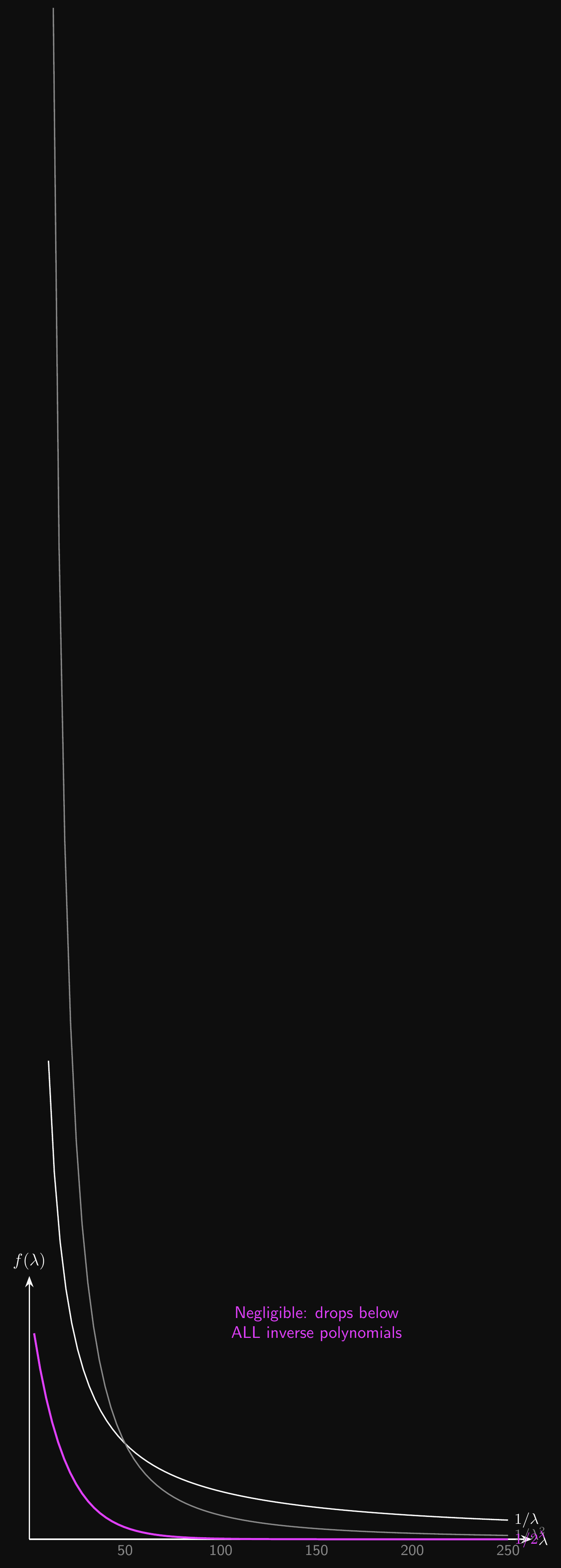
- A function \(f(\lambda)\) is negligible if it shrinks faster than any inverse polynomial
- Formally: for every positive integer \(d\), there exists \(\lambda_0\) such that for all \(\lambda > \lambda_0\): \(f(\lambda) < 1/\lambda^d\)
- Intuition: negligible means vanishingly small
- Smaller than \(1/\lambda\), smaller than \(1/\lambda^2\), smaller than \(1/\lambda^{100}\)
- Eventually smaller than \(1/\lambda^d\) for ANY \(d\) you pick
- Examples:
- \(1/2^\lambda\) is negligible (exponential decay)
- \(1/\lambda^{100}\) is NOT negligible (it’s an inverse polynomial)
- \(2^{-\sqrt{\lambda}}\) is negligible (sub-exponential still beats any polynomial)
Super-Polynomial Functions
- \(Q(\lambda)\) is super-polynomial if it grows faster than any polynomial
- Formally: \(Q\) is super-poly if and only if \(1/Q\) is negligible
- Examples:
- \(2^\lambda\) is super-poly (exponential growth)
- \(\lambda^{100}\) is NOT super-poly (it IS a polynomial)
- Why this matters:
- The key space \(|\mathcal{K}| = 2^\lambda\) is super-poly, so brute-force probability \(1/2^\lambda\) is negligible
- An efficient adversary runs in polynomial time
- A super-poly key space means no efficient adversary can enumerate it
- The master security statement:
- “For all efficient adversaries \(\mathcal{A}\), \(\text{Game}_\text{adv}[\mathcal{A}, \text{Scheme}]\) is negligible in \(\lambda\)”
Concrete Security
What the numbers actually mean in practice.
\(b\)-Bit Security
- Saying “negligible” tells us security scales correctly as \(\lambda\) grows
- But we deploy at a fixed \(\lambda\), so we need concrete bounds
- \(b\)-bit security: the best known attack requires \(\approx 2^b\) operations
- For brute-force key search: \(T\) trials give advantage \(\approx T / 2^\lambda\)
- Calibration (for a 128-bit key):
| Attack effort | Example | Advantage |
|---|---|---|
| \(2^{56}\) operations | DES crack (1998) | \(2^{-72}\) |
| \(2^{64}\) operations | Feasible on modern hardware | \(2^{-64}\) |
| \(2^{80}\) operations | Well-funded adversary | \(2^{-48}\) |
| \(2^{128}\) operations | Beyond foreseeable classical computers | \(\approx 1\) |
- 128 bits is the minimum for new systems
Where Security Bits Come From
- Different constructions lose security bits in different ways:
- Key search: \(\lambda\)-bit key gives \(\lambda\)-bit security (1 operation per guess)
- Birthday attacks: \(n\)-bit output gives \(n/2\)-bit security (collisions at \(\sqrt{2^n}\))
- PRF/PRP switching: 128-bit block cipher loses security after \(2^{64}\) queries (birthday bound on \(2^{128}\) domain)
- The weakest link dominates:
- AES-128 in CTR mode: 128-bit key security, but PRF switching at \(2^{64}\) queries
- In practice: re-key before \(2^{64}\) blocks (\(\approx 256\) exabytes)
- Collision resistance of an \(n\)-bit hash: \(n/2\) bits of security
- SHA-256: 128-bit collision resistance
- SHA-1 (160-bit): theoretical 80 bits, practically broken at 63 bits
Why 128 Bits is the Minimum
- Grover’s quantum algorithm halves symmetric security: \(2^\lambda \to 2^{\lambda/2}\)
- AES-128: 128-bit classical, 64-bit quantum (below the threshold!)
- AES-256: 256-bit classical, 128-bit quantum (still safe)
- ChaCha20 uses a 256-bit key: 128-bit quantum margin built in
- Rule of thumb for new designs:
- \(\lambda \geq 128\) for classical security
- \(\lambda \geq 256\) for quantum margin (if using symmetric primitives)
- RSA/DH need much larger parameters (3072+ bits for 128-bit classical)
The Birthday Bound
The most useful collision formula in cryptography.
The Birthday Paradox
- In a room of 23 people, there’s a \(> 50\%\) chance two share a birthday
- Intuition: there are \(\binom{23}{2} = 253\) pairs to check, and only 365 days
- General result: \(Q\) samples from a domain of size \(N\)
- Collision probability \(\approx Q^2 / 2N\) (when \(Q \ll N\))
- 50% collision at \(Q \approx 1.2 \sqrt{N}\)
| Domain size \(N\) | 50% collision at \(Q\) | Security bits |
|---|---|---|
| \(2^{64}\) (DES block) | \(2^{32}\) | 32 |
| \(2^{96}\) (GCM nonce) | \(2^{48}\) | 48 |
| \(2^{128}\) (AES block) | \(2^{64}\) | 64 |
| \(2^{256}\) (SHA-256 output) | \(2^{128}\) | 128 |
Birthday Bound: PRF/PRP Switching
- A pseudorandom function (PRF) maps each input to an independent random output
- Two different inputs CAN map to the same output (with probability \(1/|\mathcal{Y}|\))
- A pseudorandom permutation (PRP) is a bijection: no two inputs share an output
- After \(Q\) queries, this difference becomes detectable (birthday bound)
- The PRF/PRP switching lemma (from the Block Ciphers lecture):
- \(\text{PRF}_\text{adv}[\mathcal{A}, E] \leq \text{BC}_\text{adv}[\mathcal{B}, E] + Q^2 / (2|\mathcal{X}|)\)
- For AES (\(|\mathcal{X}| = 2^{128}\)): the gap is negligible until \(Q \approx 2^{64}\) queries
- This is why 64-bit block ciphers (DES, 3DES) are insecure as PRFs in practice
- Only \(2^{32}\) queries before the birthday gap becomes detectable
Birthday Bound: Hash Collisions
- A hash function \(H : \{0,1\}^* \to \{0,1\}^n\) has \(2^n\) possible outputs
- Finding a collision requires \(\approx 2^{n/2}\) evaluations (birthday bound)
- SHA-256 (\(n = 256\)): 128-bit collision resistance
- SHA-1 (\(n = 160\)): theoretical 80 bits, broken in practice (\(2^{63}\) operations, 2017)
- This is why 256-bit output is the minimum for new hash functions
- It provides 128-bit collision resistance, matching AES-128
Birthday Bound: Nonce Collisions
- AES-GCM uses a 96-bit nonce. If nonces are chosen randomly:
- After \(Q\) messages, nonce collision probability \(\approx Q^2 / 2^{97}\)
- At \(Q = 2^{32}\) messages: probability \(\approx 2^{-33}\) (safe)
- At \(Q = 2^{48}\) messages: probability \(\approx 2^{-1}\) (50%… danger)
- A nonce collision in GCM is catastrophic (leaks the authentication key)
- This is why GCM has message-count limits, and why XChaCha20 uses a 192-bit nonce
- The birthday bound governs nonce-size decisions across all AEAD schemes
Advantage and Reductions
Reading and composing security statements.
Reading Advantage Expressions
- The general template: \(\text{Game}_\text{adv}[\mathcal{A}, \text{Scheme}]\)
- \(\mathcal{A}\): the adversary (a specific efficient algorithm)
- Scheme: the cryptographic construction being attacked
- Game: the security definition (SS, PRG, PRF, MAC, CCA, …)
- Examples from the course:
- \(\text{SS}_\text{adv}[\mathcal{A}, \mathcal{E}]\): how well \(\mathcal{A}\) breaks semantic security of cipher \(\mathcal{E}\)
- \(\text{PRG}_\text{adv}[\mathcal{A}, G]\): how well \(\mathcal{A}\) distinguishes PRG \(G\) from random
- \(\text{MAC}_\text{adv}[\mathcal{A}, \mathcal{I}]\): probability \(\mathcal{A}\) forges a valid MAC on \(\mathcal{I}\)
- \(\text{CCA}_\text{adv}[\mathcal{A}, \mathcal{E}]\): how well \(\mathcal{A}\) breaks CCA security of \(\mathcal{E}\)
- Secure means: “for all efficient \(\mathcal{A}\), the advantage is negligible in \(\lambda\)”
The Reduction Template
- A reduction proves security by showing: “if you can break Scheme, you can break Primitive”
- Structure: given any adversary \(\mathcal{A}\) attacking Scheme, build adversary \(\mathcal{B}\) attacking Primitive, with:
- \(\text{Scheme}_\text{adv}[\mathcal{A}] \leq \text{Primitive}_\text{adv}[\mathcal{B}]\)
- Since Primitive is assumed secure (right side negligible), Scheme must be secure too
- This pattern recurs throughout the course:
- Stream cipher security reduces to PRG security (Lecture 02)
- CBC-MAC security reduces to PRF security (Lecture 04)
- CCA security of encrypt-then-MAC reduces to CPA + MAC security (Lecture 06)
- The point: we never prove security “from scratch”… we always reduce to something we already trust
Composing Bounds
- Real security bounds often have multiple terms:
- \(\text{PRF}_\text{adv}[\mathcal{A}, E] \leq \text{BC}_\text{adv}[\mathcal{B}, E] + Q^2 / (2|\mathcal{X}|)\)
- Each term has a source:
- \(\text{BC}_\text{adv}\): the block cipher could be broken (assumed negligible)
- \(Q^2 / (2|\mathcal{X}|)\): the PRF/PRP switching gap (birthday bound)
- The weakest link dominates: security is only as good as the largest term
- For AES-128 (\(|\mathcal{X}| = 2^{128}\)) with \(Q = 2^{48}\) queries:
- Advantage \(\leq \epsilon + 2^{96}/2^{129} = \epsilon + 2^{-33}\)… still negligible
- When reading security theorems, identify each term and what degrades it
Notation Summary
| Notation | Meaning | Used in |
|---|---|---|
| \(\lambda\) | Security parameter (key length in bits) | All lectures |
| Negligible | Shrinks faster than any \(1/\lambda^d\) | Security definitions |
| Super-poly | Grows faster than any \(\lambda^d\) | Key space size |
| \(b\)-bit security | Best attack requires \(\approx 2^b\) operations | Concrete security |
| \(\text{Game}_\text{adv}[\mathcal{A}, S]\) | Advantage of \(\mathcal{A}\) in Game against \(S\) | All security proofs |
| Birthday bound | \(Q\) samples from \(N\): collision \(\approx Q^2/2N\) | PRF/PRP, hashing, nonces |
| Union bound | \(\Pr[A \cup B] \leq \Pr[A] + \Pr[B]\) | Proof technique |
| Reduction | “Break Scheme \(\Rightarrow\) break Primitive” | All security proofs |