ISE Cryptography — Reference
Galois Fields for Cryptography
Why Galois Fields?
What “GF” means and why cryptographers care.
What You’ll Get From This Deck
- Every time AES encrypts a byte, it computes an inverse in GF(\(2^8\))
- Every time GCM authenticates a block, it multiplies in GF(\(2^{128}\))
- Every time Poly1305 tags a message, it evaluates a polynomial over \(\mathbb{Z}_{2^{130}-5}\)
- These are all examples of finite field arithmetic
- This deck shows you how it works, starting from bits you already understand
- The punchline: all three are the same idea (polynomial evaluation over a field) with different performance tradeoffs
Groups (Recap)
- A group is a set with one operation satisfying: closure, associativity, identity, inverses
- See the Modular Arithmetic reference for the full treatment
- You already know several: \((\mathbb{Z}_n, +)\), \((\{0,1\}^n, \oplus)\), \((\mathbb{Z}_p^*, \times)\)
- A field needs TWO group operations that play nicely together…
From Groups to Fields
- A field is a set with two operations (addition and multiplication) where:
- Addition forms a group (associative, commutative, identity 0, every element has a negative)
- Multiplication forms a group on nonzero elements (associative, commutative, identity 1, every nonzero element has an inverse)
- Multiplication distributes over addition
- Familiar examples: \(\mathbb{Q}\) (rationals), \(\mathbb{R}\) (reals)
- \(\mathbb{Z}_p\) for prime \(p\) is also a field
- Every nonzero element has a multiplicative inverse (see the Modular Arithmetic reference)
- This is why polynomial MACs in Lecture 04 work over \(\mathbb{Z}_p\): the security proof needs division
- \(\mathbb{Z}_n\) for composite \(n\) is NOT a field
- Some nonzero elements lack inverses (e.g. \(2\) has no inverse in \(\mathbb{Z}_6\))
Finite Fields (Galois Fields)
- A Galois field GF(\(q\)) is a field with exactly \(q\) elements
- Named after Evariste Galois (1811–1832)
- Finite fields exist if and only if \(q = p^m\) for some prime \(p\) and positive integer \(m\)
- And for each such \(q\), the field is unique (up to relabelling)
- When \(m = 1\): GF(\(p\)) \(= \mathbb{Z}_p\), ordinary integers mod a prime
- The Modular Arithmetic deck covers this case
- When \(m > 1\): extension fields built from polynomial arithmetic
- GF(\(2^8\)): 256 elements, used in AES (SubBytes, MixColumns)
- GF(\(2^{128}\)): \(2^{128}\) elements, used in GCM (GHASH authentication)
- These are the focus of this deck
Why Binary Fields?
- GF(\(2\)) \(= \{0, 1\}\) with addition \(=\) XOR and multiplication \(=\) AND
- The simplest possible field, and the native language of digital hardware
- An \(m\)-bit string is naturally an element of GF(\(2^m\))
- A byte (8 bits) is an element of GF(\(2^8\)) – one AES state cell
- A 128-bit block is an element of GF(\(2^{128}\)) – one GCM authentication block
- Hardware can implement GF(\(2^m\)) arithmetic using bitwise operations
- Addition is just XOR (no carries, no overflow)
- Multiplication is shift-and-XOR (no integer multiplication needed)
- This is why AES and GCM chose binary extension fields over prime fields
- In Python: GF(\(2^8\)) addition is
a ^ b. Multiplication by \(X\) is(a << 1) ^ (0x1B if a & 0x80 else 0). No big-integer libraries needed.
Binary Polynomials
The building blocks of GF(\(2^m\)).
Polynomials over GF(2)
- A polynomial over GF(2) has coefficients that are either 0 or 1
- \(X^4 + X + 1\) has coefficients 1, 0, 0, 1, 1 (from \(X^4\) down to \(X^0\))
- This is just the bit pattern
10011
- Every \(m\)-bit string represents a polynomial of degree \(< m\):
- The byte
0x53\(=\)01010011represents \(X^6 + X^4 + X + 1\) - The byte
0x00represents the zero polynomial - The byte
0x01represents the constant polynomial 1
- The byte
- Elements of GF(\(2^m\)) are all polynomials of degree less than \(m\)
- GF(\(2^8\)) has \(2^8 = 256\) elements: all 8-bit strings, or equivalently all bytes
Three Ways to Write the Same Thing
- Every GF(\(2^8\)) element has three equivalent representations:
| Polynomial | Binary | Hex |
|---|---|---|
| \(0\) | 00000000 |
0x00 |
| \(1\) | 00000001 |
0x01 |
| \(X\) | 00000010 |
0x02 |
| \(X + 1\) | 00000011 |
0x03 |
| \(X^2 + X + 1\) | 00000111 |
0x07 |
| \(X^6 + X^4 + X + 1\) | 01010011 |
0x53 |
| \(X^4 + X^3 + X + 1\) (AES reduction constant) | 00011011 |
0x1B |
| \(X^7 + X^6 + \ldots + X + 1\) | 11111111 |
0xFF |
- In this deck, we move freely between these forms
- The underlying object is always the same: an element of GF(\(2^8\))
Adding Binary Polynomials
- Addition: XOR corresponding coefficients (because \(1 + 1 = 0\) in GF(2))
- \((X^4 + X + 1) + (X^4 + X^3 + 1) = X^3 + X\)
- In bits:
10011\(\oplus\)11001\(=\)01010
- Subtraction is identical to addition
- In GF(2), \(-1 = 1\), so \(a - b = a + b\)
- This is why XOR is its own inverse: \(a \oplus b \oplus b = a\)
- No carries ever propagate, and the result always has the same number of bits
- Addition in GF(\(2^m\)) is a single XOR instruction on modern hardware
- You already know this operation: XOR appears throughout the course as the stream cipher combiner, the OTP operation, and the CBC/CTR mode feedback
Multiplying Binary Polynomials
- Multiply like ordinary polynomials, but addition of coefficients is XOR
- \((X^2 + 1)(X + 1) = X^3 + X^2 + X + 1\)
- Each term in the first polynomial multiplies each term in the second
- In hardware, this is carryless multiplication (or polynomial multiplication)
- Shift and XOR instead of shift and add
- No carries propagate between bit positions
- The product of two degree-\((m-1)\) polynomials can have degree up to \(2(m-1)\)
- Two GF(\(2^8\)) elements can produce a degree-14 polynomial
- This exceeds 8 bits, so we need to reduce the result
Polynomial Multiplication: Worked Example
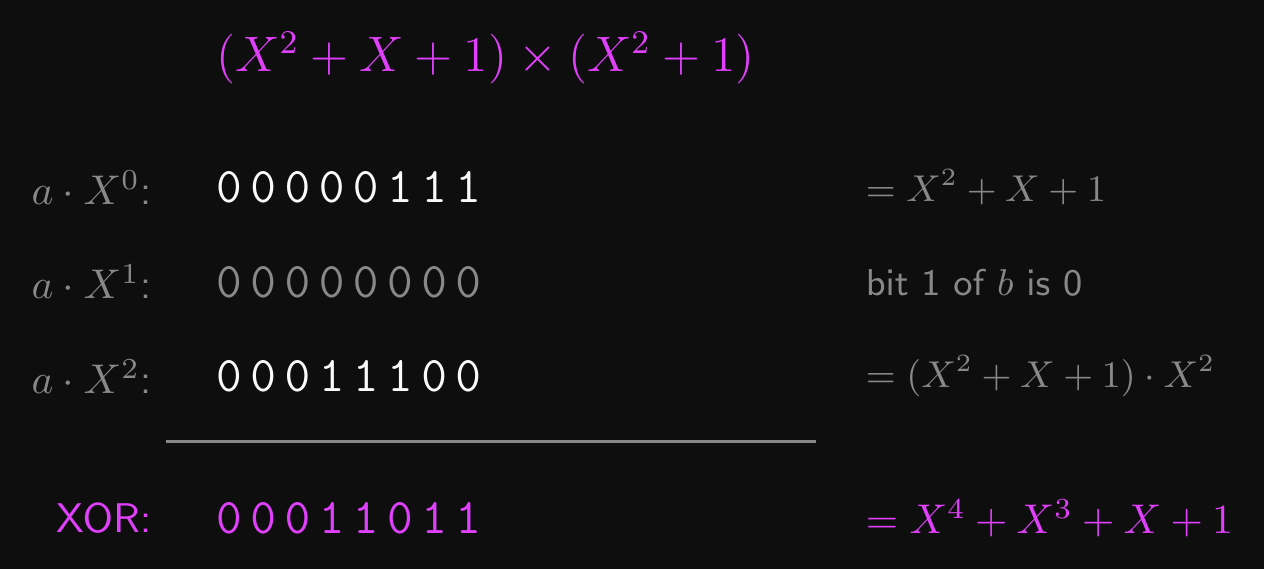
- Multiplying
0x07\(\times\)0x05in GF(\(2^8\)), i.e. \((X^2 + X + 1) \times (X^2 + 1)\):
Irreducible Polynomials and GF(\(2^m\))
The analogue of “mod a prime” for polynomials.
Irreducible Polynomials
- A polynomial is irreducible over GF(2) if it can’t be factored into lower-degree polynomials with GF(2) coefficients
- Analogous to prime numbers in \(\mathbb{Z}\)
- Example: \(X^2 + X + 1\) is irreducible over GF(2)
- Check: \(f(0) = 0 + 0 + 1 = 1 \neq 0\) and \(f(1) = 1 + 1 + 1 = 1 \neq 0\)
- No roots in GF(2), so no linear factors, so it’s irreducible (degree 2)
- Counterexample: \(X^2 + 1 = (X + 1)^2\) over GF(2)
- Because \(X^2 + 1 = X^2 + 2X + 1 = X^2 + 1\) (since \(2 = 0\) in GF(2))
- Check: \(f(1) = 1 + 1 = 0\), so \(X + 1\) is a factor
- Like primes, irreducible polynomials of every degree exist over GF(2)
Building GF(\(2^m\)) with an Irreducible Polynomial
- GF(\(2^m\)) = all polynomials of degree \(< m\) over GF(2), with arithmetic modulo an irreducible polynomial \(p(X)\) of degree \(m\)
- Exactly \(2^m\) elements: every possible \(m\)-bit string
- Addition: XOR (the sum of two degree-\(< m\) polynomials already has degree \(< m\))
- Multiplication: polynomial multiply, then reduce modulo \(p(X)\)
- Exactly analogous to \(\mathbb{Z}_p\) = integers mod \(p\)
- \(\mathbb{Z}_p\): multiply integers, reduce mod prime \(p\)
- GF(\(2^m\)): multiply polynomials, reduce mod irreducible \(p(X)\)
- Because \(p(X)\) is irreducible, every nonzero element has a multiplicative inverse
- Just like \(\mathbb{Z}_p\) works because \(p\) is prime
Reduction: Replacing \(X^m\)
When a product has degree \(\geq m\), we reduce it modulo \(p(X)\)
The key trick: since \(p(X) \equiv 0\) in our field, \(X^m \equiv\) (lower-degree terms of \(p(X)\))
Example in GF(\(2^4\)) with \(p(X) = X^4 + X + 1\):
- The relation \(X^4 \equiv X + 1\) lets us eliminate any power \(\geq 4\)
- Say we need to reduce \(X^5 + X^3 + X + 1\):
\[ \begin{aligned} X^5 + X^3 + X + 1 &= X \cdot X^4 + X^3 + X + 1 \\ &\equiv X \cdot (X + 1) + X^3 + X + 1 \\ &= X^2 + X + X^3 + X + 1 \\ &= X^3 + X^2 + 1 \end{aligned} \]
- In binary:
101011\(\to\)001101=0xDin GF(\(2^4\))
Inverses in GF(\(2^m\))
- Every nonzero element has a multiplicative inverse (because \(p(X)\) is irreducible)
- Two ways to compute \(a^{-1}\):
- Extended Euclidean algorithm for polynomials over GF(2)
- Fermat’s little theorem: \(a^{-1} = a^{2^m - 2}\) in GF(\(2^m\))
- The AES S-box (SubBytes) uses inversion in GF(\(2^8\)):
- Map each byte \(b\) to \(b^{-1}\) in GF(\(2^8\)) (with \(0 \mapsto 0\))
- Then apply a fixed affine transformation over GF(2)
- The inversion provides nonlinearity, making AES resistant to linear and differential cryptanalysis
- Inversion is the most algebraically “destructive” operation in a field
- Highly nonlinear: small input changes cause unpredictable output changes
- This is exactly the property a good S-box needs
GF(\(2^4\)): A Complete Tiny Field
- GF(\(2^4\)) with \(p(X) = X^4 + X + 1\) has exactly 16 elements (all 4-bit strings,
0throughF) - Addition: XOR. Multiplication: polynomial multiply, reduce using \(X^4 = X + 1\).
- Worked example:
0x7\(\times\)0x5in GF(\(2^4\)):- \((X^2 + X + 1)(X^2 + 1) = X^4 + X^3 + X + 1\)
- Reduce: \(X^4 = X + 1\), so $X^4 + X^3 + X + 1 = X^3 + X + 1 + X + 1 = X^3 = $
0x8
- Verify: every nonzero element has an inverse (e.g.
0x6\(^{-1}\) =0x7, because0x6\(\times\)0x7=0x1)- This is what makes it a field, not just a ring!
GF(\(2^4\)) Multiplication Table
- Partial multiplication table (hex digits, all arithmetic in GF(\(2^4\))):
| \(\times\) | 1 | 2 | 3 | 4 | 5 | 6 | 7 |
|---|---|---|---|---|---|---|---|
| 1 | 1 | 2 | 3 | 4 | 5 | 6 | 7 |
| 2 | 2 | 4 | 6 | 8 | A | C | E |
| 3 | 3 | 6 | 5 | C | F | A | 9 |
| 4 | 4 | 8 | C | 3 | 7 | B | F |
| 5 | 5 | A | F | 7 | 2 | D | 8 |
| 6 | 6 | C | A | B | D | 7 | 1 |
| 7 | 7 | E | 9 | F | 8 | 1 | 6 |
- Notice: each row and column contains each nonzero element exactly once (Latin square property)
- This proves every nonzero element has a unique inverse
- With 16 elements, you can verify the entire field by hand. With \(2^8\) (AES) or \(2^{128}\) (GCM), you can’t, but the algebra works the same way.
GF(\(2^8\)) – The AES Field
What AES is actually doing byte-by-byte.
GF(\(2^8\)) for AES
- AES uses GF(\(2^8\)) with the irreducible polynomial:
- \(p(X) = X^8 + X^4 + X^3 + X + 1\)
- In hex:
0x11B(the 9-bit pattern100011011)
- Each cell in the \(4 \times 4\) AES state matrix is one GF(\(2^8\)) element (one byte)
- Why this polynomial?
- It’s irreducible over GF(2) (verified by checking for factors up to degree 4)
- It’s a pentanomial (5 nonzero terms), making reduction efficient
- It was chosen by the Rijndael designers; any irreducible degree-8 polynomial would work algebraically
SubBytes: Inversion in GF(\(2^8\))
- The AES S-box is the only nonlinear component of AES
- SubBytes applies it independently to each of the 16 bytes in the state
- The S-box computation: \(b \mapsto A \cdot b^{-1} + c\) (over GF(\(2^8\)), with \(0 \mapsto c\))
- \(b^{-1}\): multiplicative inverse in GF(\(2^8\)), the nonlinear step
- \(A\): a fixed \(8 \times 8\) matrix over GF(2), the affine step
- \(c\): a fixed constant byte (
0x63)
- In practice, SubBytes is implemented as a 256-entry lookup table
- Pre-compute the S-box for all 256 input bytes
- One table lookup per byte, per round
- The inverse S-box (for decryption) reverses the affine transform, then inverts again
MixColumns: Matrix Multiplication in GF(\(2^8\))
- MixColumns treats each column of the state as a 4-element vector over GF(\(2^8\))
- It multiplies by a fixed \(4 \times 4\) MDS matrix:
\[ \begin{pmatrix} b_0 \\ b_1 \\ b_2 \\ b_3 \end{pmatrix} = \begin{pmatrix} 2 & 3 & 1 & 1 \\ 1 & 2 & 3 & 1 \\ 1 & 1 & 2 & 3 \\ 3 & 1 & 1 & 2 \end{pmatrix} \begin{pmatrix} a_0 \\ a_1 \\ a_2 \\ a_3 \end{pmatrix} \]
- The entries 1, 2, 3 are elements of GF(\(2^8\)), not ordinary integers
- \(1\) = identity, \(2\) = the
xtimeoperation (next slide), \(3\) =xtime\(\oplus\) original
- \(1\) = identity, \(2\) = the
- The MDS property: any two columns of the matrix are linearly independent
- Guarantees maximum diffusion: every output byte depends on all 4 input bytes
xtime: The Doubling Operation
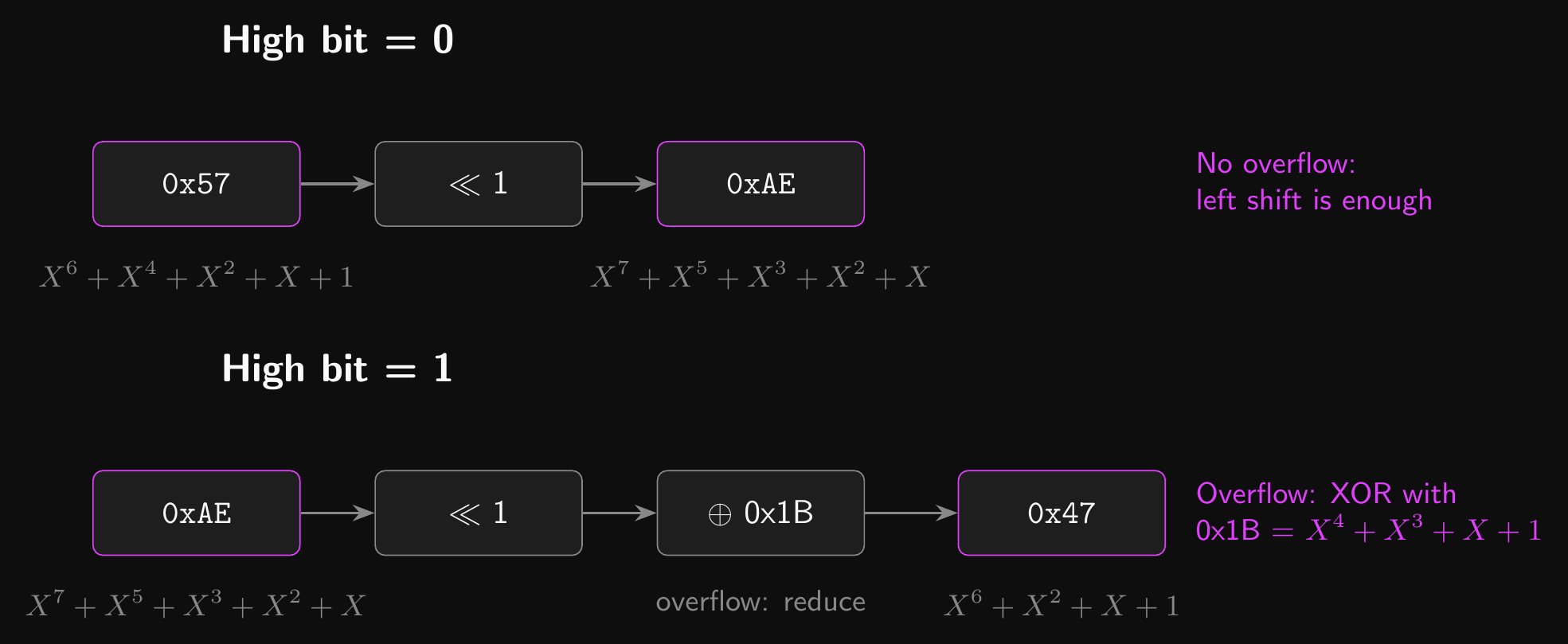
xtime\((a)\) multiplies \(a\) by \(X\) in GF(\(2^8\)), i.e. “multiply by 2”This is the fundamental building block: multiply by any constant via repeated
xtime+ XOR
GF(\(2^{128}\)) – The GCM Field
What GHASH is actually doing block-by-block.
GF(\(2^{128}\)) for GCM
- GCM authenticates data using GHASH, a polynomial hash over GF(\(2^{128}\))
- The irreducible polynomial:
- \(g(X) = X^{128} + X^7 + X^2 + X + 1\)
- A pentanomial: only 5 nonzero coefficients out of 129
- Each 128-bit block is one field element
- Addition: XOR two 128-bit blocks
- Multiplication: polynomial multiply mod \(g(X)\)
- The authentication key \(k_m = E(k, 0^{128})\) is an element of GF(\(2^{128}\))
- Derived by encrypting the all-zero block with the AES key
GHASH as Polynomial Evaluation
- GHASH(\(k, z\)) for input blocks \(z = (z_0, z_1, \ldots, z_{v-1})\):
- \(z_0 \cdot k^v + z_1 \cdot k^{v-1} + \ldots + z_{v-1} \cdot k\)
- All arithmetic is in GF(\(2^{128}\)): addition is XOR, multiplication is mod \(g(X)\)
- This is the same structure as the polynomial one-time MAC from Lecture 04
- The message blocks are coefficients, \(k\) is the evaluation point
- Two distinct messages define distinct polynomials
- They can agree on at most \(v\) values of \(k\) out of \(2^{128}\)
- Forgery probability: at most \(v / 2^{128}\) (negligible for reasonable message lengths)
- Evaluable incrementally via Horner’s method:
- \(h_0 = 0\), then \(h_i = (h_{i-1} \oplus z_i) \cdot k\) for each block
- One field multiplication per block, streaming
Why This Polynomial?
- \(g(X) = X^{128} + X^7 + X^2 + X + 1\) was chosen for performance
- A pentanomial with only 5 nonzero terms (out of 129)
- Sparse polynomials make reduction fast
- Reduction: when the product has degree \(\geq 128\), replace \(X^{128}\) with \(X^7 + X^2 + X + 1\)
- Then XOR the shifted low-order bits back into the result
- Only 4 XOR operations per overflow bit (vs up to 128 for a dense polynomial)
- This is the same trick as in GF(\(2^8\)) for AES, just at a larger scale
- AES: \(X^8 \equiv X^4 + X^3 + X + 1\), so overflow XOR is
0x1B - GCM: \(X^{128} \equiv X^7 + X^2 + X + 1\), so overflow XOR is
0x87
- AES: \(X^8 \equiv X^4 + X^3 + X + 1\), so overflow XOR is
Carryless Multiplication (PCLMULQDQ)
- Intel’s
PCLMULQDQinstruction performs 64-bit carryless (polynomial) multiplication- Input: two 64-bit values; output: one 128-bit product
- No carries between bit positions, just like GF(2) polynomial multiplication
- Full GF(\(2^{128}\)) multiplication in hardware:
- Four
PCLMULQDQoperations produce the 256-bit unreduced product - A short reduction sequence (shift + XOR) reduces mod \(g(X)\)
- Four
- Combined with AES-NI (hardware AES rounds), this makes AES-GCM extremely fast
- AES-GCM throughput on modern Intel: 1+ bytes per cycle
- Compare to software-only AES-GCM: roughly 10\(\times\) slower
- ARM has an equivalent:
PMULL/PMULL2(polynomial multiply long)
Poly1305: A Different Field
- ChaCha20-Poly1305 uses a polynomial MAC over a prime field, not an extension field
- Poly1305 works in \(\mathbb{Z}_p\) where \(p = 2^{130} - 5\)
- This is ordinary modular arithmetic, not polynomial arithmetic
- Same structure: polynomial evaluation at a secret point, masked with a one-time pad
- Coefficients are 128-bit message blocks (zero-padded to fit in \(\mathbb{Z}_p\))
- Security argument is identical: forgery probability \(\leq v/p\)
- The prime \(2^{130} - 5\) was chosen for speed:
- “Almost a power of 2” makes modular reduction fast (similar idea to Mersenne primes)
- Software-friendly: no need for hardware GF multiplication
- Poly1305 is the authentication half of ChaCha20-Poly1305 (RFC 7539)
Connecting It All
The same pattern, different fields.
The Common Pattern
- Three constructions, one idea: polynomial evaluation over a finite field
- Polynomial one-time MAC (Lecture 04): evaluate over \(\mathbb{Z}_p\) for a large prime \(p\)
- GHASH (Lecture 07): evaluate over GF(\(2^{128}\))
- Poly1305 (Lecture 07): evaluate over \(\mathbb{Z}_{2^{130}-5}\)
- The security argument doesn’t care which field you use
- Two distinct degree-\(v\) polynomials agree on at most \(v\) points
- This holds in any field with enough elements
- Forgery probability: at most \(v / |F|\), where \(|F|\) is the field size
- The choice of field is a performance decision, not a security one:
- \(\mathbb{Z}_p\): requires big-integer modular arithmetic (slow without hardware support)
- GF(\(2^{128}\)): fast with
PCLMULQDQ/PMULLhardware - \(\mathbb{Z}_{2^{130}-5}\): fast in software (almost-power-of-2 prime)
Notation Summary
| Notation | Meaning | Used in |
|---|---|---|
| GF(\(2\)) | \(\{0, 1\}\) with XOR and AND | Everywhere (bits) |
| GF(\(2^8\)) | Bytes with polynomial arithmetic mod \(X^8 + X^4 + X^3 + X + 1\) | Block Ciphers (AES) |
| GF(\(2^{128}\)) | 128-bit blocks with polynomial arithmetic mod \(X^{128} + X^7 + X^2 + X + 1\) | AEAD (GCM/GHASH) |
| Irreducible polynomial | Analogue of a prime number for polynomial rings | AES, GCM |
xtime |
Multiply by \(X\) in GF(\(2^8\)): left shift + conditional XOR 0x1B |
AES (MixColumns) |
PCLMULQDQ |
Hardware carryless (polynomial) multiplication | GCM performance |
| \(\mathbb{Z}_{2^{130}-5}\) | Prime field for Poly1305 (ordinary modular arithmetic) | ChaCha20-Poly1305 |