ISE Cryptography — Lecture 09
Post-Quantum Cryptography
The Threat
Why are we having this lecture? RSA still works.
Shor’s Algorithm
- Shor (1997) showed a quantum computer can solve integer factorisation and discrete logarithm in polynomial time
- Classical best: sub-exponential (number field sieve for factoring, index calculus for DL)
- Quantum: polynomial — Shor reduces factoring to period-finding, which a quantum Fourier transform solves efficiently, a categorical leap no classical speedup can match
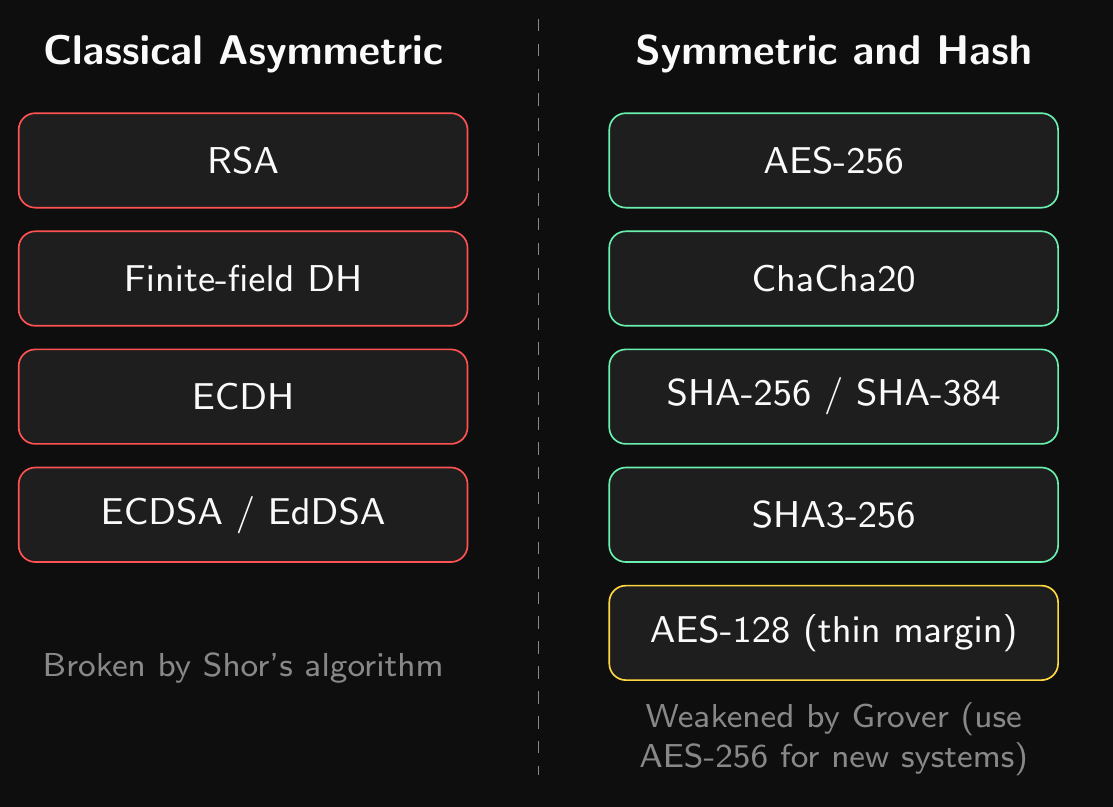
- If a sufficiently large fault-tolerant quantum computer (CRQC) is built, the following are broken:
- RSA (factoring), finite-field DH (discrete log), ECDH and ECDSA (elliptic-curve DL)
- Not a side-channel attack, not a protocol weakness: a direct attack on the underlying hard problem
- CRQCs do not exist today: the question is when, not if
What Survives a Quantum Adversary?
- Grover’s algorithm (1996) gives a quadratic speedup for unstructured search
- Against symmetric encryption:
- AES-128 drops to \(2^{64}\) (security margin halved; Grover is serial so this is not equivalent to classical \(2^{64}\), but the margin is thin — not recommended for new systems)
- AES-256 drops to \(2^{128}\) (comfortable margin)
- Against hash functions: preimage resistance loses half its bit-strength
- Against symmetric encryption:
- SHA-2 and SHA-3 under Grover:
- SHA-256: \(2^{128}\) quantum preimage security (usable), \(2^{128}\) is the accepted minimum
- SHA-384 / SHA-512: \(2^{192}\) / \(2^{256}\) (comfortable margins)
- SHA3-256: same \(2^{128}\) quantum security level as SHA-256, though a different construction
- Collision resistance is less exposed: without quantum RAM, the best known quantum collision attacks match the classical birthday bound
- SHA-256 collision resistance stays at \(2^{128}\) under realistic quantum threat models
- With quantum RAM (speculative hardware), the BHT algorithm achieves \(2^{n/3}\) collisions: \(2^{85}\) for SHA-256; a distant concern, but relevant in high-assurance threat models
- Practical guidance:
- Use AES-256, SHA-256, SHA-384
- Avoid AES-128
- The asymmetric primitives (RSA, DH, ECDH, ECDSA) are broken by Shor, not merely weakened
What Breaks and What Holds
Harvest Now, Decrypt Later (HNDL)
- An adversary can record encrypted traffic today and store it
- They cannot decrypt it now, but they do not need to
- When a CRQC arrives, they decrypt retrospectively
- The relevant question is not “when will CRQCs arrive?” but:
- “What is the confidentiality lifetime of my data?”
- Medical records, state secrets, intellectual property, key-exchange transcripts
- If your data needs to remain confidential for 10–20 years, and CRQCs may arrive in 10–20 years, the migration deadline is today
- Intelligence agencies have been collecting TLS traffic for years
- NIST IR 8547 (2024) identifies the migration deadline as the mid-2030s for critical systems
The Threshold Concept: Hardness Is Not a Fact
- We did not discover that factoring is hard
- We observed that no efficient classical algorithm has been found in 50 years of looking
- We built RSA on that empirical gap
- Shor’s algorithm does not prove RSA was wrong: it proves the adversary model changed
- The mathematical fact (factoring is in NP) did not change
- The assumption (no efficient algorithm exists in the relevant adversary model) did change
- Cryptographic hardness is a defended position in an ongoing argument with cryptanalysts, not a mathematical fact
Lattices and LWE, Intuitively
Where does asymmetric hardness come from, if not from groups?
What Is a Lattice?
- Start with basis vectors \(\mathbf{b}_1, \mathbf{b}_2 \in \mathbb{R}^2\): two linearly independent vectors pointing in different directions
- In \(n\) dimensions: \(n\) linearly independent vectors \(\mathbf{b}_1, \ldots, \mathbf{b}_n \in \mathbb{R}^m\)
- Scale each by any integer: \(a_1 \mathbf{b}_1\) for \(a_1 \in \mathbb{Z}\), \(a_2 \mathbf{b}_2\) for \(a_2 \in \mathbb{Z}\)
- Real multiples fill a continuous plane, while integer multiples give a discrete grid of points
- The lattice \(\Lambda\) is every point reachable by adding scaled basis vectors
- \(\Lambda(\mathbf{b}_1, \mathbf{b}_2) = \{ a_1 \mathbf{b}_1 + a_2 \mathbf{b}_2 \mid a_1, a_2 \in \mathbb{Z} \}\)
- Geometrically: tile the plane with copies of the parallelogram spanned by \(\mathbf{b}_1\) and \(\mathbf{b}_2\)
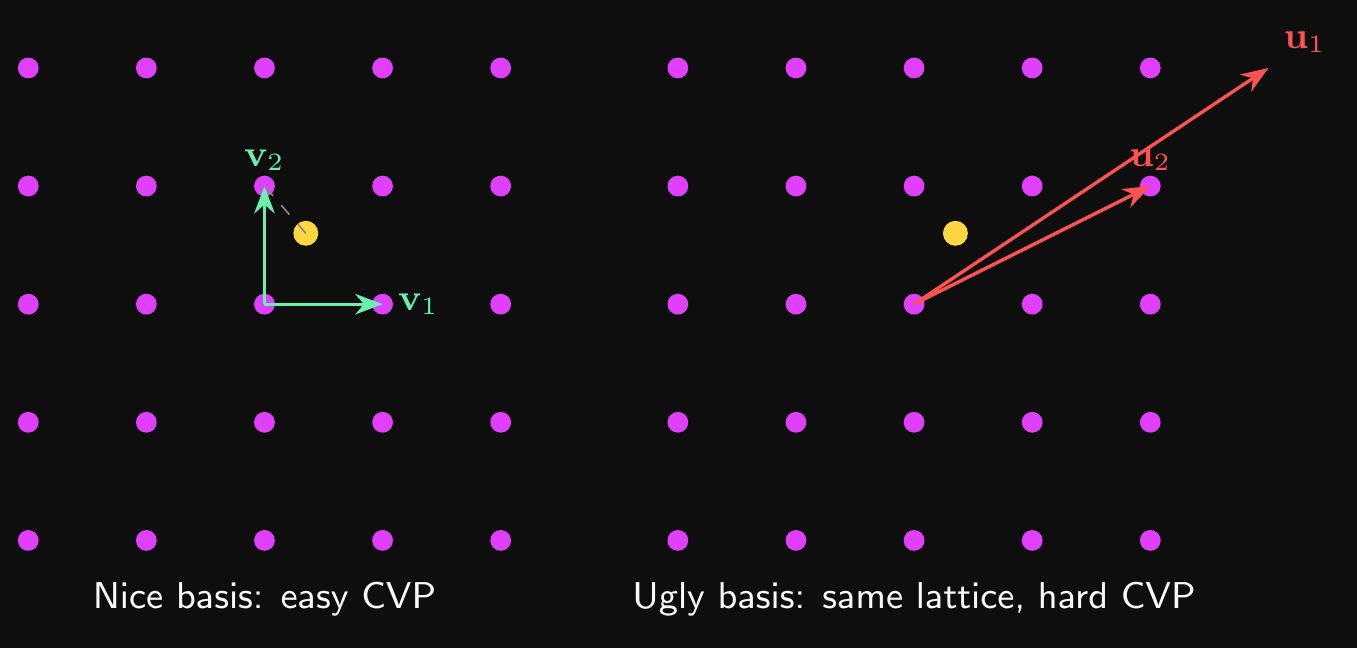
- The same set of lattice points can be described by infinitely many different bases
- \((\mathbf{b}_1, \mathbf{b}_2)\) and \((2\mathbf{b}_1 + \mathbf{b}_2,\; \mathbf{b}_1 + \mathbf{b}_2)\) generate the same lattice
- A nice basis (short, nearly orthogonal) makes the structure obvious, while an ugly basis (long, skewed) hides it
The Same Lattice, Two Different Bases
SVP and CVP
- Two canonical hard problems on lattices:
- Shortest Vector Problem (SVP): given a basis, find the shortest non-zero vector in the lattice
- Closest Vector Problem (CVP): given a basis and a target point, find the nearest lattice point
- With a nice (short, orthogonal) basis: both are easy, just round to the nearest combination
- With an ugly (long, skewed) basis: both are conjecturally hard, even for quantum adversaries
- No known quantum algorithm gives a polynomial speedup for worst-case lattice problems
- Best quantum algorithms for lattice problems: still exponential in the lattice dimension
- The curse of dimensionality: the number of candidate vectors grows exponentially with dimension: there is no known shortcut
- In 2 dimensions SVP is trivial by inspection
- In hundreds of dimensions even quantum search cannot navigate the space efficiently
- Unlike RSA or DH (empirical hardness: no efficient algorithm found in decades of looking), lattice hardness has a geometric explanation
- We choose the dimension as the security parameter: higher dimension means harder problems, at the cost of larger keys
- This is the trade-off seen in the ML-KEM parameter comparison
Learning With Errors (LWE), Intuitively
- Start with a system of linear equations: find \(\mathbf{s}\) given \(\mathbf{A}\) and \(\mathbf{b} = \mathbf{A}\mathbf{s}\)
- Straightforward: Gaussian elimination solves this in polynomial time
- Add small random noise to each equation: \(b_i = \langle \mathbf{a}_i, \mathbf{s} \rangle + e_i\)
- \(\langle \mathbf{a}_i, \mathbf{s} \rangle\) is the dot product: \(a_{i,1} s_1 + a_{i,2} s_2 + \cdots + a_{i,n} s_n\)
- Each \(e_i\) is a small integer sampled from a narrow distribution
- The noise destroys the linear structure that Gaussian elimination exploits
LWE: Hardness and Trapdoor
- The LWE problem: recover \(\mathbf{s}\) given many samples \((\mathbf{a}_i,\; \mathbf{b}_i)\) where \(\mathbf{b}_i = \langle \mathbf{a}_i, \mathbf{s} \rangle + e_i\)
- Regev’s reduction (2005): LWE is as hard as solving worst-case SVP on any \(n\)-dimensional lattice
- “Solving LWE would solve the hardest lattice problems” — not just an average-case assumption
- The original reduction is itself quantum; Peikert et al. later gave a classical reduction with different parameters
- No quantum algorithm is known to give a polynomial speedup for SVP — unlike Shor for factoring, lattice algorithms remain exponential
- Publish \((\mathbf{A},\; \mathbf{b} = \mathbf{A}\mathbf{s} + \mathbf{e})\) as your public key; keep \(\mathbf{s}\) and \(\mathbf{e}\) secret
- An observer sees a noisy linear system and faces the LWE problem to find \(\mathbf{s}\)
- An encryptor uses \((\mathbf{A}, \mathbf{b})\) to wrap a message; you decrypt by using \(\mathbf{s}\) to subtract the noise
- The trapdoor is \(\mathbf{s}\): LWE hardness makes the public key look random, but the private key makes it structured
From Fields to Rings
- You know two algebraic structures from earlier in the module:
- Group: one operation, e.g. \((\mathbb{Z}_p^*, \times)\) in Diffie-Hellman
- Field: add and multiply (every nonzero element has a multiplicative inverse), e.g. \(\mathbb{Z}_p\), \(\text{GF}(2^{128})\) in GCM
- In GCM you saw polynomial arithmetic mod an irreducible polynomial: bit coefficients, degree kept bounded by reduction
- The irreducible modulus ensures every nonzero element is invertible, making it a field
- A ring has the same two operations but no guarantee of multiplicative inverses
- The integers \(\mathbb{Z}\): you can add and multiply freely, but \(3^{-1} \notin \mathbb{Z}\)
- \(\mathbb{Z}_q[x]/(x^n+1)\): polynomials with coefficients in \(\mathbb{Z}_q\), reduced mod \(x^n+1\): over \(\mathbb{Z}_q\), the polynomial \(x^n+1\) factors (for ML-KEM’s \(q=3329\), \(x^{256}+1\) splits into 128 quadratic factors), creating zero divisors — so this is a ring, not a field
- Module-LWE works in this ring because:
- Arithmetic stays over integers: exact, no floating-point rounding
- Reals would corrupt the small noise values that carry the LWE hardness
- Key storage drops from \(O(n^2)\) (plain integer matrix) to \(O(n)\) (ring elements)
- Multiplication uses NTT (number-theoretic transform): the factorisation of \(x^n+1\) over \(\mathbb{Z}_q\) is exactly what makes the NTT decomposition efficient — exact integer arithmetic, analogous to FFT but without rounding errors
- Arithmetic stays over integers: exact, no floating-point rounding
Module-LWE: The Same Idea, More Efficient
- Module-LWE replaces plain integer vectors with vectors of elements from \(\mathbb{Z}_q[x]/(x^n+1)\)
- Same LWE problem structure, same hardness argument, now over ring elements
- The payoff: same security level with keys \(O(n)\) in size rather than \(O(n^2)\)
- The cost: a slightly stronger assumption (hardness of Module-LWE rather than plain LWE)
- Module-LWE has been extensively studied since 2012 (no structural weaknesses found)
- Both ML-KEM and ML-DSA rest on Module-LWE and Module-SIS hardness
ML-KEM
Can it actually replace ECDH in something I use?
The KEM Interface (Recall from HPKE, Lecture 07)
- A KEM \(\mathcal{K} = (G, \text{Encaps}, \text{Decaps})\):
- \(G()\): probabilistic key generation, outputs \((pk, sk)\)
- \(\text{Encaps}(pk)\): outputs \((k, c)\), a shared secret and its encapsulation
- \(\text{Decaps}(sk, c)\): outputs \(k\) or
reject
- Correctness: for all \((pk, sk) \leftarrow G()\), if \((k, c) \leftarrow \text{Encaps}(pk)\), then \(\text{Decaps}(sk, c) = k\)
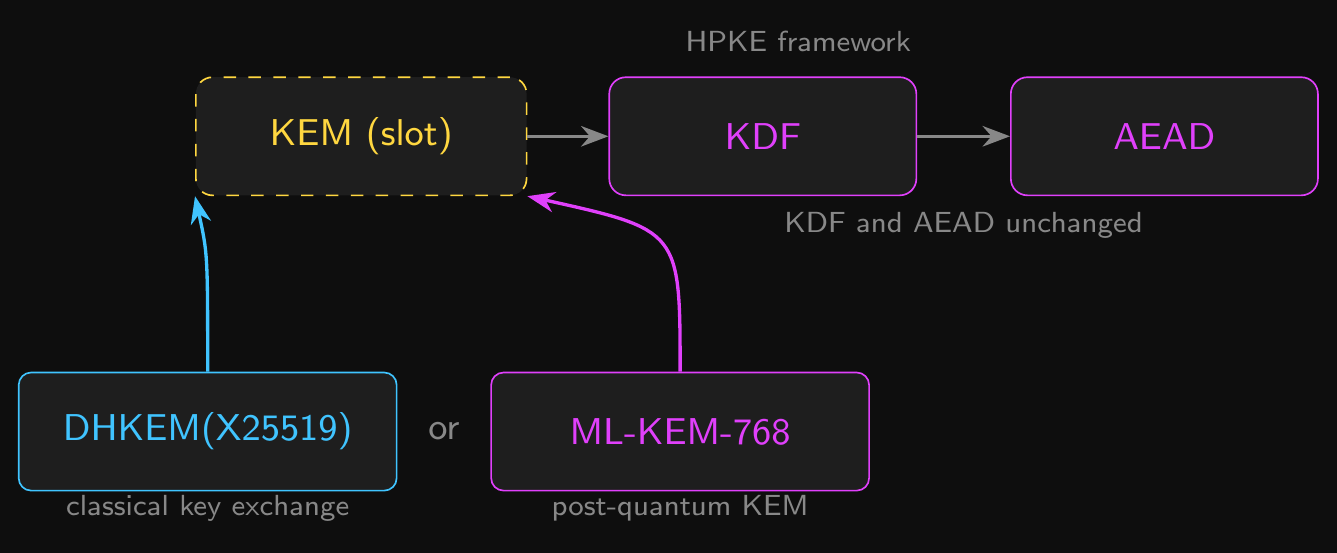
- This interface is unchanged for ML-KEM, only the math behind each function changes
ML-KEM: Structure
- ML-KEM (FIPS 203, formerly Kyber) is built on Module-LWE
- Without the algebra:
- KeyGen: sample a small secret \(\mathbf{s}\) and error \(\mathbf{e}\), compute a noisy linear combination as the public key, and keep \(\mathbf{s}\) as the private key
- Encaps: given \(pk\), produce a ciphertext that is a noisy linear function of the public key, and the shared secret is derived from the output
- Decaps: use the secret \(\mathbf{s}\) to subtract the noise, recover the encoded shared secret, and output \(k\)
- The noise is what makes the scheme hard to invert: without \(\mathbf{s}\), the ciphertext looks uniformly random
- The underlying PKE scheme is CPA-secure by reduction to Module-LWE hardness; the FO transform (next slide) lifts it to IND-CCA2
The Fujisaki-Okamoto Transform
- The PKE at the core of ML-KEM is IND-CPA secure but not IND-CCA2: given a decryption oracle, an attacker can exploit ciphertext malleability to recover key material
- The Fujisaki-Okamoto (FO) transform lifts the CPA-secure PKE to an IND-CCA2 KEM
- On decapsulation, re-encrypt the ciphertext using the recovered message and check consistency
- Any tampered ciphertext is rejected, making the decryption oracle useless
- FIPS 203 uses implicit rejection: a bad ciphertext returns a pseudorandom value instead of \(\bot\), preventing timing-based oracle leakage
- For the derivation: Boneh and Shoup §12
- FIPS 203 ML-KEM is IND-CCA2 secure under Module-LWE hardness
ML-KEM Parameter Sets
| Parameter set | NIST category | Classical security | Key (pk) | Ciphertext |
|---|---|---|---|---|
| ML-KEM-512 | Category 1 | \(\approx\) AES-128 | 800 B | 768 B |
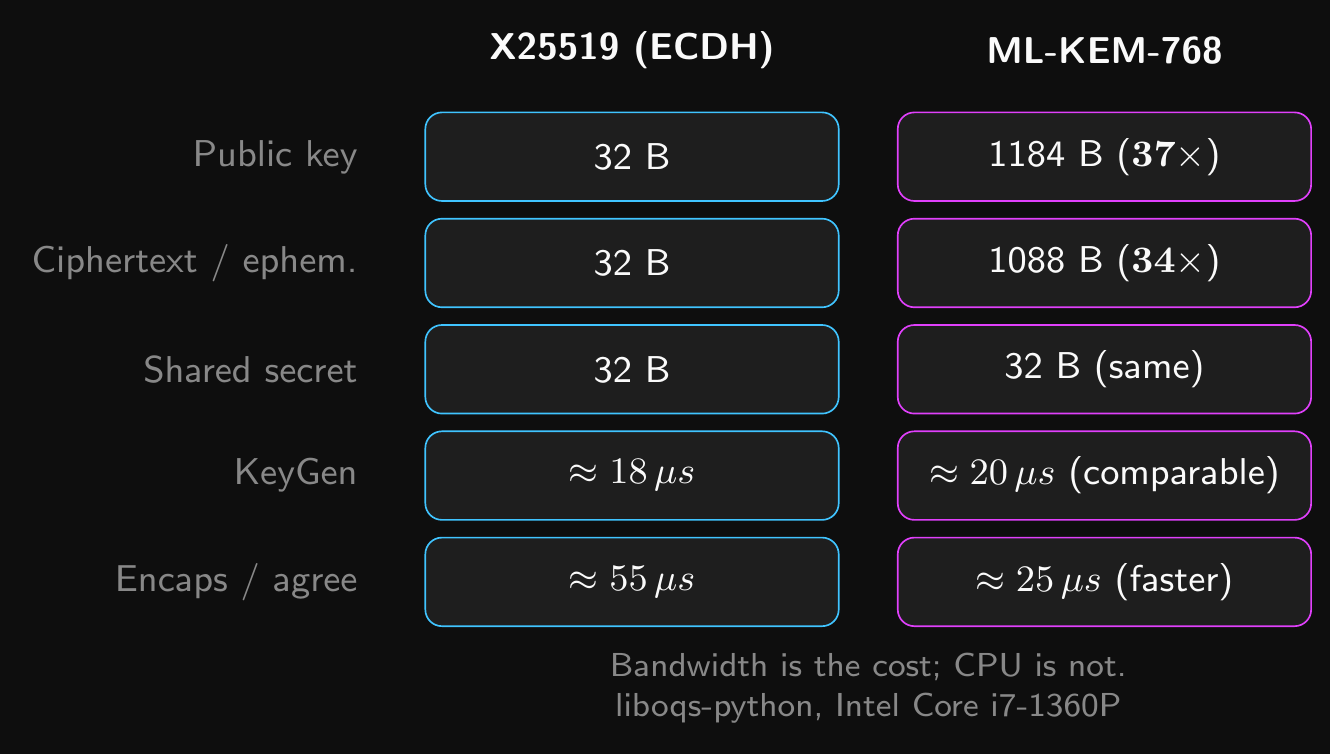
| ML-KEM-768 | Category 3 | \(\approx\) AES-192 | 1184 B | 1088 B |
| ML-KEM-1024 | Category 5 | \(\approx\) AES-256 | 1568 B | 1568 B |
- ML-KEM-768 is the deployment default (TLS hybrids, HPKE, etc.)
- NIST security categories: Category 1 ≈ AES-128 classical security, Category 3 ≈ AES-192, Category 5 ≈ AES-256; Category 2 ≈ SHA-256 collision resistance (appears in ML-DSA-44)
ECDH vs ML-KEM: Same Interface, Different Sizes
ML-KEM in HPKE: Drop-In Replacement
ML-DSA and SLH-DSA
What about signatures, and why are there two PQ signature standards?
ML-DSA: Structure
- ML-DSA (FIPS 204, formerly Dilithium) is built on Module-LWE and Module-SIS
- Module-SIS (Short Integer Solution): given a random matrix \(\mathbf{A}\), find a short non-zero vector \(\mathbf{z}\) such that \(\mathbf{A} \mathbf{z} = 0 \pmod{q}\)
- Conjectured hard for both classical and quantum adversaries
- ML-DSA uses a Fiat-Shamir with Aborts construction:
- Fiat-Shamir converts an interactive identification protocol to a signature by replacing the verifier’s random challenge with a hash of the commitment
- An interactive lattice-based protocol (Schnorr-style) is made non-interactive this way
- The “with aborts” twist: some signing attempts produce responses that would leak the secret key, so the signer rejects and retries
- Average number of retries per signature: roughly 4–6, a small and bounded constant
ML-DSA Parameter Sets
| Parameter set | NIST category | Public key | Signature |
|---|---|---|---|
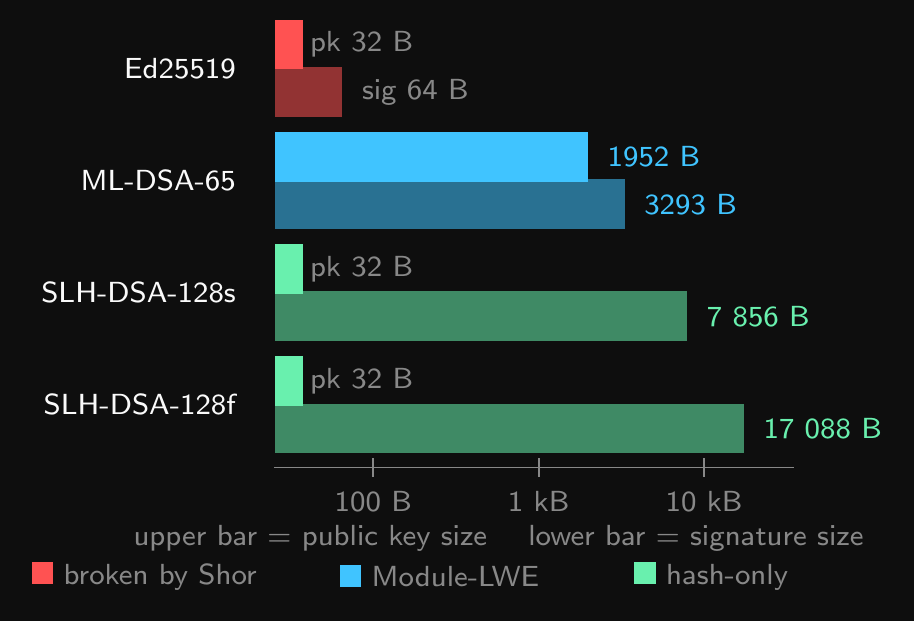
| ML-DSA-44 | Category 2 | 1312 B | 2420 B |
| ML-DSA-65 | Category 3 | 1952 B | 3293 B |
| ML-DSA-87 | Category 5 | 2592 B | 4595 B |
- Compare Ed25519: pk = 32 B, sig = 64 B
- ML-DSA-65 public key is \(\mathbf{61\times}\) larger, signature is \(\mathbf{51\times}\) larger
- Signing and verification are fast (sub-millisecond on modern hardware)
SLH-DSA: A Completely Different Foundation
- SLH-DSA (FIPS 205, formerly SPHINCS+) is built on hash functions alone
- No lattice assumption, no algebraic structure
- Security reduces to collision and preimage resistance of the underlying hash (SHA-2 or SHA-3 variants)
- Structural sketch:
- A Merkle tree (a hash tree where each parent node is the hash of its two children) of one-time signature (OTS) keys provides a large pool of signing keys
- Each signing operation consumes a one-time key from the tree
- The tree is large enough that this never repeats, and no state is needed to track which keys have been used
- The signing process traverses paths through the tree and produces authentication proofs, while verification re-hashes the path
- SLH-DSA is stateless: unlike the earlier hash-based schemes XMSS and LMS (NIST SP 800-208), no counter is needed to track spent one-time keys; XMSS and LMS are deployed in firmware signing today where stateful operation is acceptable
SLH-DSA Parameter Sets
| Parameter set | Public key | Signature | Focus |
|---|---|---|---|
| SLH-DSA-SHA2-128f | 32 B | 17 088 B | fast signing |
| SLH-DSA-SHA2-128s | 32 B | 7 856 B | small signature |
| SLH-DSA-SHA2-256f | 64 B | 49 856 B | fast signing |
| SLH-DSA-SHA2-256s | 64 B | 29 792 B | small signature |
- “f” variants: more tree layers, faster signing, larger signatures
- “s” variants: fewer layers, slower signing, smaller signatures
- Public key is tiny (32–64 B), important for root CA and firmware use cases
Why Three Signature Standards?
The threshold concept from Segment 1 in action: cryptographic hardness is a defended position, not a fact.
- ML-DSA gives reasonable sizes and fast operations
- The security assumption is Module-LWE/SIS: well-studied for roughly a decade
- SLH-DSA gives a fallback whose security rests on hash-function assumptions we have studied since the 1970s
- If every lattice assumption collapses tomorrow, SLH-DSA still stands
- The threshold concept revisited: we are not selecting the “best” signature scheme
- We are maintaining a defended position under the worst-case scenario
- Three standards because no single scheme dominates on all axes: speed, size, and assumption diversity trade off against each other
- A third standard, FN-DSA (FIPS 206, Falcon), completes the picture:
- Smaller signatures than ML-DSA (\(\approx\) 1280 B at Category 1, vs ML-DSA-44’s 2420 B) and fast verification
- The cost: a floating-point lattice Gaussian sampler that is hard to implement without timing side-channels
- When to pick which:
- ML-DSA: default for most applications (TLS certificates, code signing, authenticators)
- SLH-DSA: long-lived signatures where assumption diversity matters more than signature size (root CAs, firmware, archives)
- FN-DSA: only where signature size is the binding constraint and you can manage the constant-time implementation complexity
Signature Size Comparison
Hybrids: Combiners, X-Wing, X25519MLKEM768
Should we just deploy ML-KEM and hope?
The Trust Argument
- ML-KEM has been under public cryptanalytic scrutiny since Kyber’s NIST submission in 2017
- Roughly 8 years of analysis: no structural breaks, some parameter tightening
- X25519 (Curve25519 DH) has been under scrutiny since 2006 and in widespread deployment since ~2014
- 20 years of analysis, billions of connections per day
- A hybrid scheme combines both: if either component holds, the combined scheme holds
- Classical adversary: X25519 alone is sufficient
- ML-KEM adds nothing against current threats
- Quantum adversary: ML-KEM provides the post-quantum security
- X25519 still holds until Shor is realised
- Classical adversary: X25519 alone is sufficient
- Hybrid is strictly stronger than either alone under any adversary model we can construct today
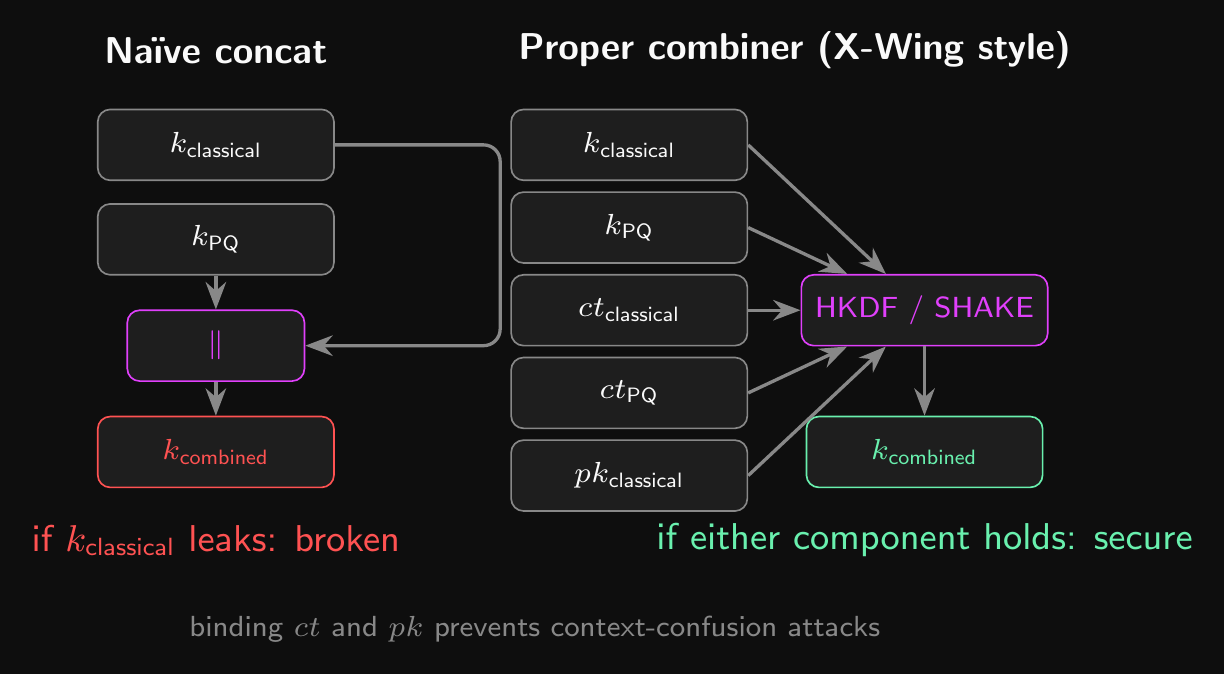
Combiner Design: Why Naïve Concatenation Fails
- A naïve combiner: \(k_\text{combined} = k_\text{X25519} \| k_\text{ML-KEM}\)
- Entropy is preserved as long as either component stays secret
- But the concatenation has no formal IND-CCA2 security reduction from the components’ individual guarantees
- Without binding ciphertexts and public keys into the derivation, an attacker can substitute one component’s ciphertext independently of the other (context-confusion attacks)
- The naïve combiner does not pass the secrets through a one-way function: the two keys are never mixed
- A robust combiner: \(k_\text{combined} = \text{KDF}(k_\text{X25519} \| k_\text{ML-KEM} \| ct_\text{X25519} \| ct_\text{ML-KEM} \| pk_\text{X25519} \| pk_\text{ML-KEM})\)
- The KDF (e.g. HKDF) is one-way and mixing: both secrets contribute to every output bit
- Binding the ciphertexts and public keys prevents context-confusion attacks
X25519MLKEM768: The Deployed Hybrid
- Specified in the IETF hybrid KEM framework, assigned TLS 1.3 group codepoint
- Structure: concatenate the X25519 and ML-KEM-768 shared secrets and feed through HKDF
- \(k \leftarrow \text{HKDF}(k_\text{X25519} \| k_\text{ML-KEM768} \| ct_\text{X25519} \| ct_\text{ML-KEM768})\)
- Deployed in production since 2024:
- Chrome (Google switched from Kyber768 draft to ML-KEM-768 hybrid in Chrome 131)
- Cloudflare, AWS KMS, Fastly
- OpenSSH (MLKEM768X25519 supported in 9.9+)
X-Wing: A Cleaner Construction
- X-Wing (2024, IACR ePrint 2024/039)
- A single fixed ciphersuite: X25519 + ML-KEM-768, no parameter negotiation
- Combiner: \(k \leftarrow \text{SHA3-256}(\text{label} \| k_\text{X25519} \| k_\text{ML-KEM768} \| ct_\text{X25519} \| pk_\text{X25519})\)
- Proven IND-CCA2 under hybrid assumptions with a tight reduction
- One hybrid KEM you deploy
- Unlike X25519MLKEM768, X-Wing is designed as a named primitive with a standalone security proof
- IETF draft in progress (draft-connolly-cfrg-xwing-kem)
Naïve Concat vs Proper Combiner
Libraries, Benchmarks, and EPIC Pathways
What does this look like in code, and is it realistic to try?
Library Tour
liboqs(Open Quantum Safe project): C library, multi-algorithm, the standard sandbox- ML-KEM-512/768/1024, ML-DSA-44/65/87, SLH-DSA variants, and more
- Python bindings:
liboqs-python(three lines for keygen/encaps/decaps) - Rust bindings:
oqscrate
- PQClean: clean, portable reference implementations, used as upstream by many language bindings
pq-crystalsreference C implementations: authoritative implementations from the ML-KEM and ML-DSA authors (Bos, Ducas et al.)- Python
cryptographypackage: ML-KEM landing in mainline post-v43, check current version - Recommendation: start with
liboqs-python, which covers all NIST schemes and has a stable Python API
Live Benchmark
Benchmark output (pre-recorded, modern x86_64):
                   keygen     encaps     decaps     pk       ct
X25519             18 µs      55 µs      54 µs      32 B     32 B
ML-KEM-768         20 µs      25 µs      28 µs      1184 B   1088 B
X25519+ML-KEM-768  39 µs      82 µs      83 µs      1216 B   1120 B
The CPU cost is negligible. Bandwidth is the cost.
A1 EPIC Pathway
A credible A1 PQ attempt is not “implement Kyber from scratch.” It is:
- Swap the KEM in your HPKE-based messaging app for a hybrid (X25519MLKEM768 via
liboqs-python) - Measure end-to-end latency and bandwidth impact on the wire
- Document the design trade-off in your Cryptographic Design Document (criterion 4 of the rubric)
- Defend the choice of hybrid vs pure-PQ at interview: why not just ML-KEM-768? (criterion 5)
Prepare to answer: - Why hybrid rather than pure ML-KEM? - What does the bandwidth cost look like, and is it acceptable? - Why did the HPKE interface stay the same? - What security assumptions does your design rest on?
Crypto Agility: The Transferable Principle
- The lesson of post-quantum cryptography is not “use ML-KEM”
- It is: design systems that can change which KEM they use
- HPKE’s algorithm-agility design (RFC 9180) was not theoretical cleanliness
- It was preparation for exactly this moment
- The same framework absorbs X25519, ML-KEM-768, and hybrids without changing the KDF or AEAD layers
- Every secure messaging protocol, every TLS stack, every key management system built with a fixed-primitive assumption is paying a migration tax right now
- Systems built with the KEM/KDF/AEAD separation absorb the transition cheaply
- Write code that does not care which KEM is at the KEM slot
Summary
The Two Things Worth Remembering
- Hardness is a defended position, not a mathematical fact
- Shor changed the adversary model; the math did not change
- We moved on from RSA because the threat model evolved, not because RSA was wrong
- Lattice cryptanalysis is younger than RSA cryptanalysis: hold both ML-KEM and SLH-DSA, not just the faster one
- Design for algorithm agility
- HPKE’s KEM slot is the architectural pattern: swap the primitive, keep the protocol
- The migration from classical to PQ asymmetric cryptography is the largest cryptographic transition since DES was retired
- Systems with clean abstraction boundaries survive this; systems with hard-coded primitives do not