ISE Cryptography — Lecture 08
The Signal Protocol: X3DH and the Double Ratchet
What Are We Protecting?
Four ways to lose a conversation.
The Scoreboard
| Attacker compromises… | Past messages | Current message | Future messages |
|---|---|---|---|
| Long-term identity key | ? | ? | ? |
| Signed prekey | ? | ? | ? |
| One message key | ? | ? | ? |
| Full ratchet state | ? | ? | ? |
- An attacker compromises a key. Which messages can they read?
- Let’s build Signal one mechanism at a time.
- We’ll need three mechanisms:
- X3DH, the symmetric-key ratchet, and the DH ratchet.
- We’ll come back to this table after every section!
A Note on Names
| Name | Meaning |
|---|---|
| Identity key \(IK\) | Per-user, never rotates |
| Signed prekey \(SPK\) | Rotated ~weekly, signed by \(IK\) |
| One-time prekey \(OPK\) | Used once, then destroyed |
| Ephemeral key \(EK\) | Fresh per session / per message |
| Root key \(RK\) | Seeds the next chain |
| Chain key \(CK\) | Advances per message |
| Message key \(MK\) | Encrypts exactly one message |
| \(\text{KDF}\) | HKDF, used everywhere below |
| AEAD | Encrypts with the header as associated data |
- Signal’s specs and Boneh & Shoup name the same objects differently.
- We use B&S terminology and gloss the Signal name on first use.
- This is the only slide with the full mapping. Worth keeping open in a new tab!
Going Asynchronous
Bob is asleep. Alice wants to text him anyway.
3DH Needs Both Parties Online
- Lecture 05 built 3DH: mutual authentication plus forward secrecy.
- It needs Alice and Bob online at the same time to swap ephemerals.
- What breaks? The online assumption!
- Bob is asleep, on a plane, out of battery.
- Alice still wants to send now.
- We can’t make Alice wait for Bob to wake up.
- We could, but that’s terrible UX.
- 3DH, as stated, is unusable here.
X3DH
E pluribus unum.
X3DH: Prepublish the Handshake
- Signal’s X3DH (Extended Triple DH) has Bob prepublish key material to a server.
- Bob’s published bundle:
- Identity key \(IK_B\) (long-term \(sk\)): never rotates.
- This key authenticates Bob.
- Signed prekey \(SPK_B\): semi-static, rotated weekly, signed by \(IK_B\).
- Why sign it? So Alice can verify it came from Bob, not an attacker.
- If you can trust \(IK_B\), then you can trust \(SPK_B\).
- One-time prekeys \(OPK_B^{(1)}, OPK_B^{(2)}, \ldots\): a stockpile, each used once.
- One per bundle. These can run out!
- Identity key \(IK_B\) (long-term \(sk\)): never rotates.
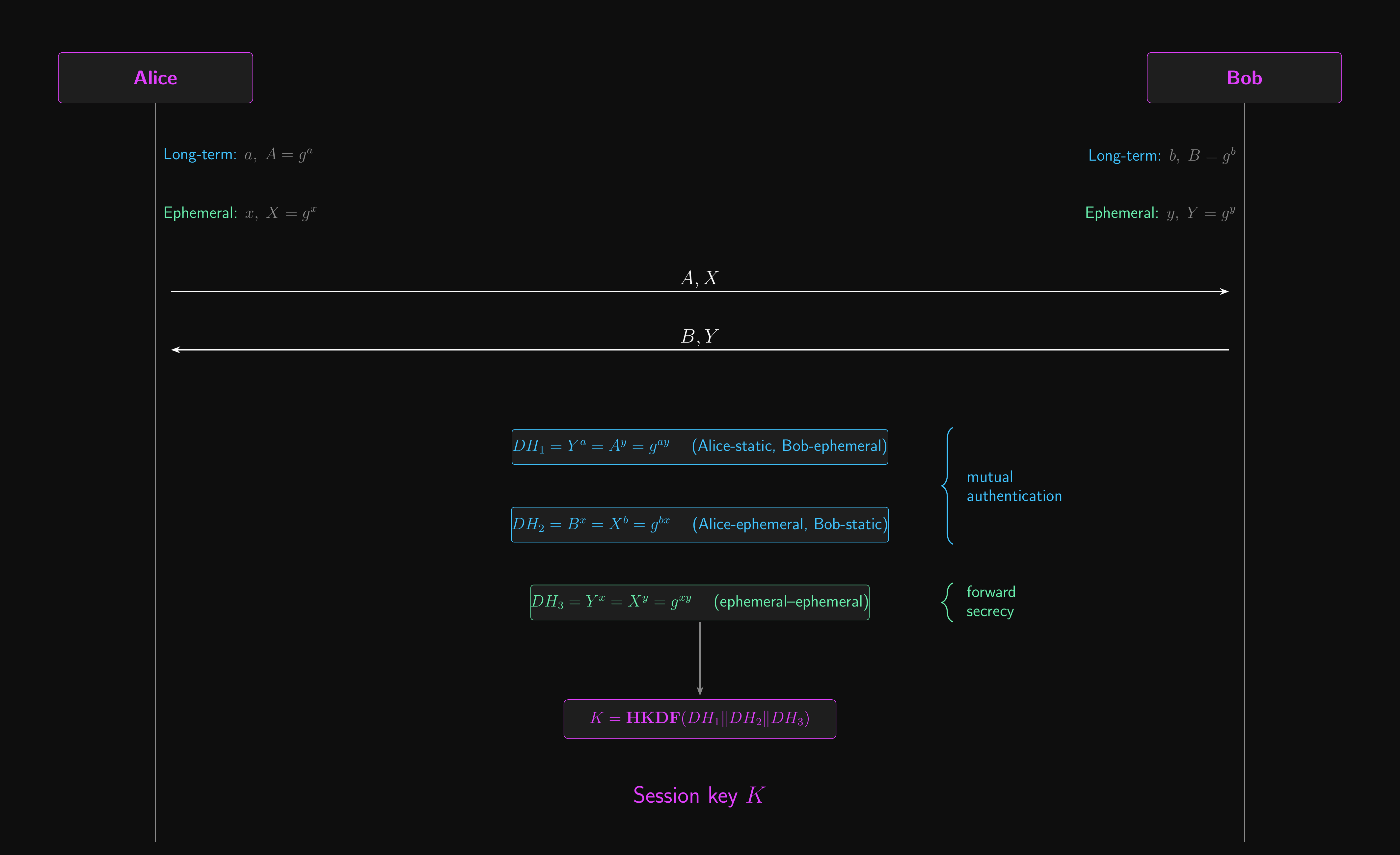
- Alice fetches a bundle, picks a fresh ephemeral \(EK_A\), and runs four DH operations.
X3DH: The Four DH Operations
\[ \begin{aligned} &DH_1 = \text{DH}(IK_A,\; SPK_B) \quad &&\text{identity meets signed prekey} \\ &DH_2 = \text{DH}(EK_A,\; IK_B) \quad &&\text{ephemeral meets identity} \\ &DH_3 = \text{DH}(EK_A,\; SPK_B) \quad &&\text{base forward secrecy} \\ &DH_4 = \text{DH}(EK_A,\; OPK_B) \quad &&\text{FS vs } SPK_B \text{ leak} \end{aligned} \]
\[ SK \leftarrow \text{KDF}(DH_1 \,\|\, DH_2 \,\|\, DH_3 \,\|\, DH_4) \]
- \(DH_1, DH_2\) provide authentication.
- \(DH_3, DH_4\) provide forward secrecy.
Why \(DH_4\) Exists
- \(SPK_B\) is semi-static.
- Stealing it from Bob’s device midweek gives an attacker a decent window for attacks!
- \(OPK_B\) is destroyed after a single use, so \(DH_4\) survives an \(SPK_B\) leak.
- If the one-time prekey pool runs dry, X3DH falls back to three DHs with weaker FS.
- Production deployments stockpile a few hundred \(OPK\)s and refill them in the background.
- If you do run out, it’s a good idea to warn the user that their security is degraded.
- Lying to users about security is a bad idea.
- Alice ships \(EK_A\) and \(IK_A\) in the first message header so Bob can replay the DHs offline.
Triple Diffie-Hellman (3DH)
The Scoreboard So Far
| Attacker compromises… | Past | Current | Future |
|---|---|---|---|
| Long-term identity key | safe | safe | safe |
| Signed prekey | safe | safe | safe |
| One message key | ? | ? | ? |
| Full ratchet state | ? | ? | ? |
- X3DH gives Alice and Bob one shared secret \(SK\) for the conversation.
- Compromise the long-term \(IK\) alone? Past messages stay safe: the ephemerals are gone.
- Two rows down. But \(SK\) is one key for the entire conversation.
One Key Is Not Enough
X3DH hands you one secret. Now send 5000 messages.
One Secret for the Whole Conversation
- \(SK\) encrypts message 1, message 2, …, message 5000.
- What breaks? Forward secrecy (again)!
- Compromise the device on message 5000…
- Recover \(SK\)…
- …and every message back to message 1 decrypts!
- A subpoena, a seized phone, a backup leak: one secret unlocks the whole history.
Ratchets
Ex uno plures.
The Symmetric-Key Ratchet
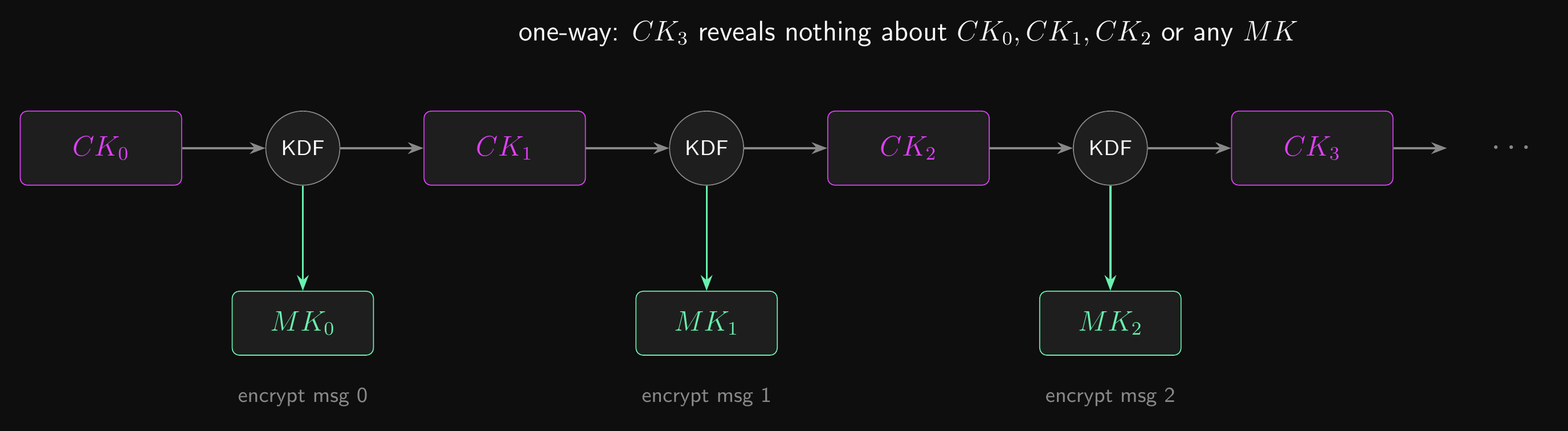
- Replace the single key with a chain.
- Kind of like key hierarchies (L07), but linear, not tree-structured.
- A chain key \(CK_i\) produces one message key \(MK_i\), then advances and forgets its past
- \((CK_{i+1},\; MK_i) \leftarrow \text{KDF}(CK_i)\)
- Encrypt message \(i\) under \(MK_i\)
- Erase \(MK_i\) and \(CK_i\)
- \(\text{KDF}\) is one-way
- Knowing \(CK_{i+1}\) reveals nothing about \(CK_i\) or \(MK_i\).
- What if you seize the phone at message 5000?
- The attacker has \(CK_{5000}\)
- But learns nothing about \(CK_1, CK_2, \ldots, CK_{4999}\)
The Symmetric-Key Ratchet
The Scoreboard So Far
| Attacker compromises… | Past | Current | Future |
|---|---|---|---|
| Long-term identity key | safe | safe | safe |
| Signed prekey | safe | safe | safe |
| One message key | safe | that message | ? |
| Full ratchet state | safe | exposed | ? |
- Compromise one message key, or the current chain key: the past is safe.
- Forward secrecy: done, same as L05’s ephemeral DH. Now look at the Future column.
Healing After Compromise
What if they steal the phone, then give it back?
You Can Never Break the Chain
- The symmetric ratchet is one-way. That protects the past.
- Forward secrecy!
- What breaks? The future.
- Steal \(CK_i\) and you can compute \(CK_{i+1}, CK_{i+2}, \ldots\) forever.
- A one-time compromise becomes permanent compromise!
- We want a new property: post-compromise security (PCS).
- L05 forward secrecy protects the past. PCS recovers the future.
Ratchets 2
Electric boogaloo.
The Diffie-Hellman Ratchet
- Another ratchet?
- This is why we call it a double ratchet.
- This one is asymmetric, not symmetric.
- Mix fresh DH output into the root every time the conversation turns around.
- That is, every time Alice sends after receiving, or Bob sends after receiving.
- Each party carries a ratchet key pair. On a reply it sends a new ratchet public key.
- Receiving a new ratchet public key triggers a DH ratchet step.
The DH Ratchet Step
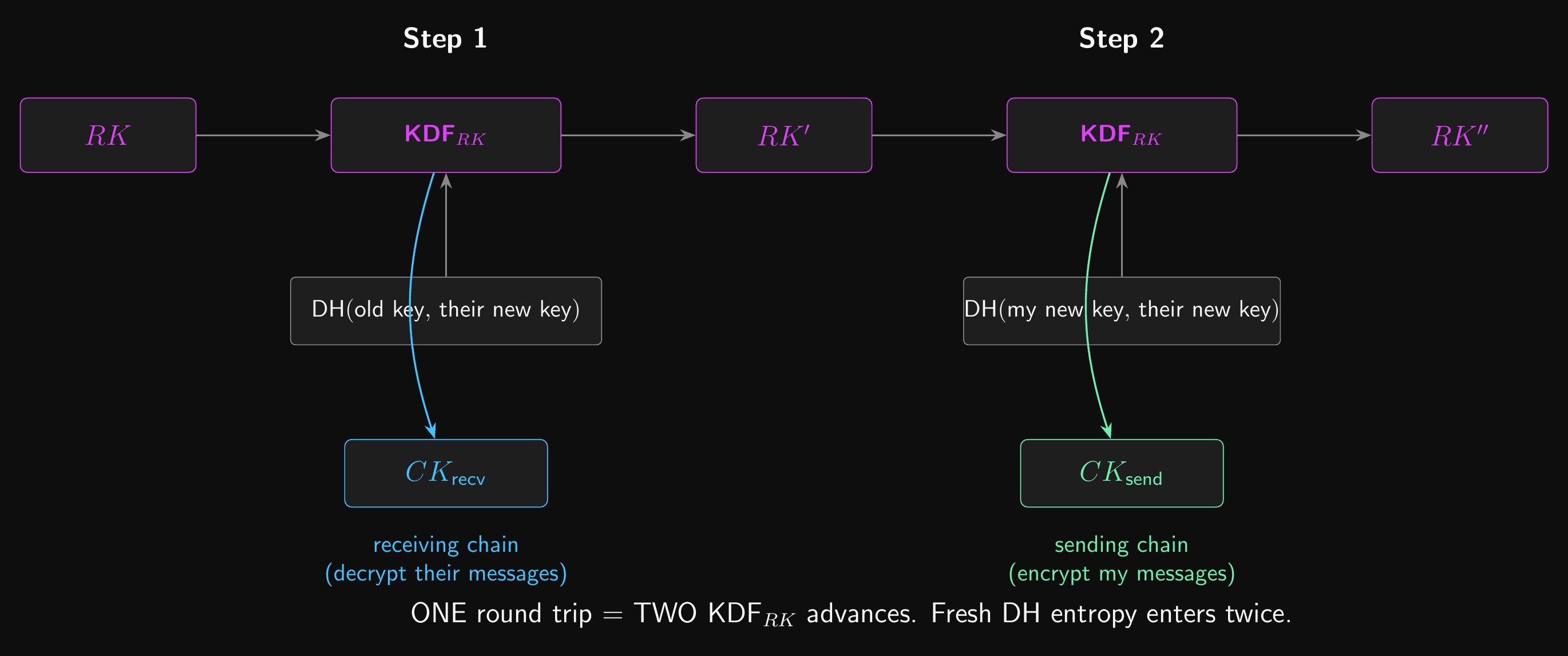
- A single turn of the conversation runs \(\text{KDF}_{RK}\) twice
- First \(\text{KDF}_{RK}\): derive the receiving chain from their new key.
- \((RK',\; CK_\text{recv}) \leftarrow \text{KDF}_{RK}\big(RK,\; \text{DH}(\text{my old key, their new key})\big)\)
- Second \(\text{KDF}_{RK}\): generate a fresh ratchet key, derive the sending chain.
- \((RK'',\; CK_\text{send}) \leftarrow \text{KDF}_{RK}\big(RK',\; \text{DH}(\text{my new key, their new key})\big)\)
- Two root advances per round trip.
- Both parties contribute fresh DH entropy, so both parties heal after compromise.
- Compromise the state, steal the phone, then give it back:
- After one round trip, the root is re-keyed with fresh DH entropy
- The attacker has no idea what that entropy is, so they can’t predict the new root, or the new chains it seeds.
- Post-compromise security achieved!
The DH Ratchet Step: Two Root Advances
The Scoreboard So Far
| Attacker compromises… | Past | Current | Future |
|---|---|---|---|
| Long-term identity key | safe | safe | safe |
| Signed prekey | safe | safe | safe |
| One message key | safe | that message | safe |
| Full ratchet state | safe | exposed | recovers after 1 round trip |
- Steal the full state now. After one undisturbed round trip, fresh DH entropy the attacker never saw re-keys the root.
- Table full! Forward secrecy and post-compromise security.
- That combination, run per message, is the Double Ratchet.
Ratchet (and Clank?)
Two ratchets. Who turns when?
Two Ratchets, Different Clocks
- The symmetric ratchet advances per message (cheap, no new DH).
- The DH ratchet advances per round trip (expensive, injects entropy, gives PCS).
- What breaks? Either extreme. Symmetric-only: no healing. DH every message: needless cost, and you can’t anyway, because new DH material only arrives when the other side replies.
The Double Ratchet
- A root chain sits on top. Its output seeds two symmetric chains:
- A sending chain (\(CK_\text{send}\)): encrypts your outgoing messages.
- A receiving chain (\(CK_\text{recv}\)): decrypts their incoming messages.
- Per message: advance the relevant symmetric chain. Per round trip: a DH ratchet step re-seeds both chains from the root.
- The trigger is purely local: a header carrying a new ratchet public key.
State of One Party
- This is the basic Double Ratchet (cleartext headers). Header encryption is a named variant we do not cover.
- Each party holds: \(RK\), \(CK_\text{send}\), \(CK_\text{recv}\), its own ratchet key pair, the peer’s ratchet public key, and counters \(N_s, N_r, PN\).
- Every message ships a header: \((\text{ratchet public key},\; PN,\; N)\).
- \(PN\) = length of the previous sending chain
- \(N\) = index in the current chain.
- The header is bound as AEAD associated data (L06): tampering is detected on decrypt.
Associated Data
\[ AD = \underbrace{IK_A \,\|\, IK_B}_{\text{from X3DH}} \,\|\, \underbrace{\text{ratchet pub} \,\|\, PN \,\|\, N}_{\text{the message header}} \]
- The AEAD call on each message is \(\text{AEAD}(MK,\, \text{plaintext},\, AD)\)
- Identity keys \(IK_A, IK_B\) get carried over from X3DH and stay fixed for the session.
- Each piece does a specific job; remove one and something breaks.
What Breaks?
- \(IK_A \,\|\, IK_B\) binds the ciphertext to who is talking.
- Drop it and a network attacker can reroute a ciphertext into a different session whose chain happens to land on the same \(MK\).
- AEAD verifies, message slots into the wrong conversation.
- This is the unknown key-share failure pattern.
- Ratchet public key binds the ciphertext to which DH epoch.
- Try to splice a message from one ratchet step onto the next?
- Different DH pub in the AD, AEAD tag fails, decrypt aborts.
What Breaks? (cont.)
- \(PN, N\) bind the ciphertext to where in the chain it sits.
- Reorder maliciously, replay, or rewrite a counter?
- AD changes, tag fails.
- Net effect: AEAD’s integrity guarantee extends to the routing metadata for free.
- The receiver can trust the header before acting on it.
- The header drives every state transition the receiver makes next (which key to use, whether to start a new DH ratchet step).
- If those bytes were unauthenticated, an attacker could steer those decisions.
When the Network Misbehaves
Message 5 before message 3. Now what?
Chains Assume In-Order Delivery
- To decrypt message 5 you need \(CK_5\), which needs \(CK_3, CK_4\).
- What breaks? Advancing the chain to 5 destroys \(MK_3, MK_4\). Messages 3 and 4 can now never be read.
- Mobile networks reorder and drop constantly. A naive chain desynchronises and the conversation dies.
Skipped Message Keys
- When a message jumps ahead, derive and store the skipped message keys.
- The store is keyed by (ratchet public key, message number), not message number alone.
- A bare \(N\) collides across a DH ratchet step; the public key disambiguates.
- On receive: try the skipped store first; else advance the chain, saving skipped keys.
- Bound the store by \(\text{MAX\_SKIP}\). Beyond it, reject.
- An attacker forcing unbounded skipping would exhaust memory: a denial of service. The bound is a security control, not just bookkeeping.
Worked Trace (symbolic)
\[ \begin{aligned} &\textbf{Alice} \to A_0:\; RK_0 \to CK^s_0 \to MK,\; \text{header }(P_A, 0, 0) \\ &\textbf{Alice} \to A_1:\; CK^s_0 \to CK^s_1 \to MK,\; \text{header }(P_A, 0, 1) \\ &\textbf{Bob recv } A_0, A_1:\; \text{DH ratchet on } P_A \Rightarrow RK_1,\; CK^r \\ &\textbf{Bob} \to B_0:\; \text{new } P_B \Rightarrow RK_2,\; CK^s \to MK,\; \text{header }(P_B, 2, 0) \\ &\textbf{Alice recv } B_0:\; \text{DH ratchet on } P_B \Rightarrow RK_2,\; CK^r \end{aligned} \]
- \(A_n,\; B_n\): Alice’s, Bob’s \(n\)-th outgoing message
- \(P_A,\; P_B\): Alice’s, Bob’s current ratchet public key
- \(RK_n\): Root key after the \(n\)-th DH ratchet step
- \(CK^s,\; CK^r\): The local party’s sending and receiving chain key
- \(CK^s_0, CK^s_1, \ldots\): Same chain, indexed when we want to show it advance
- \(MK\): One-shot message key drawn from a chain
- header \((P, PN, N)\): ratchet pub, previous-chain length, this-chain index
Deniability
Non-repudiation isn’t all it’s cracked up to be.
Non-Repudiation is a Footgun
- L06: a signature gives non-repudiation. You cannot deny you signed it.
- What breaks? Privacy!
- A signed transcript is courtroom evidence that you said a specific thing to a specific person.
- A whistleblower, a source, a dissident, an ISE meme account…
- They all may want to deny that they said something.
- Or even that they said anything at all!
- Provable authorship is a threat in these contexts.
- They all may want to deny that they said something.
Deniable Authentication via DH
- X3DH authenticates with DH between identity keys
- Not signatures over the transcript.
- \(\text{DH}(IK_A, \cdot)\) convinces Bob that Alice is on the other end.
- But Bob could have computed the same value himself!
- His DH computations are indistinguishable from Alice’s.
- He can’t prove to anyone else that Alice was involved!
- He could have faked the whole transcript.
- This is offline deniability: a stolen transcript proves nothing to a judge.
- Scope it precisely. The guarantee weakens under stronger models (an online judge, key-compromise scenarios). It is deniability against an offline transcript, not a universal disappearing act.
- Same DH primitive as L05, opposite goal to L06’s signatures.
Groupchats
How can we scale a double ratchet?
Pairwise Sessions
- Run a Double Ratchet between every pair in the group.
- A group of \(n\) members needs \(\binom{n}{2}\) sessions.
- To send one message to \(n-1\) recipients:
- Encrypt it \(n-1\) times, once per peer session.
- No savings whatsoever…
- What breaks? Scalability.
- You inherit every property of the Double Ratchet, per pair.
- But a 200-person group means 199 ciphertexts every time someone says “lol”.
- iMessage used to use this approach.
Sender Keys
- Each sender holds one symmetric chain for the whole group: a sender key.
- Distribute it once to every member via the pairwise Double Ratchets.
- The distribution is \(O(n)\), but amortises over the lifetime of the key.
- To send: advance the symmetric ratchet, encrypt under \(MK_i\), broadcast one ciphertext.
- \(O(1)\) work and ciphertext per message.
- What breaks? Post-compromise security within the group.
- The sender key has no DH ratchet. Steal it, read everything that sender sends until they rotate.
- Rotation means another \(O(n)\) redistribution round.
- Removing a member is uglier still:
- Everyone left has to generate a fresh sender key
- Then redistribute it through their pairwise sessions
- …making sure the ex-member never sees it!
MLS and TreeKEM (RFC 9420)
- Messaging Layer Security (2023) does group keying properly.
- Members sit at the leaves of a binary tree. Each interior node has its own key pair.
- A member knows the secret keys for every node on the path from their leaf to the root.
- A commit updates one member’s path:
- Regenerate node secrets from leaf to root.
- Eencrypt each new secret to the public key of the sibling node at that level.
- The members in that sibling subtree already share the sibling node’s key. They can decrypt!
- Cost per update: \(O(\log n)\) ciphertexts. A 1000-person group is ten, not nine hundred and ninety-nine.
- Continuous Group Key Agreement (CGKA). Every commit injects fresh entropy into the group secret: forward secrecy and post-compromise security, at the group level, by design.
- Adds and removes are just commits that change the tree’s shape.
Post-Quantum Security
Abandon hope, all ye who…
What Breaks?
- The Double Ratchet rests on symmetric \(\text{KDF}\)s and AEAD: quantum-resilient.
- What breaks? X3DH. It rests on Diffie-Hellman…
- …and Shor’s algorithm breaks DH.
- An adversary records X3DH transcripts today and decrypts them once a quantum computer exists: harvest now, decrypt later.
- The ratchet cannot save a session whose seed came from broken DH.
PQXDH
- Signal’s PQXDH (2023) bolts a post-quantum KEM onto the X3DH handshake.
- Classical DH and an ML-KEM encapsulation both feed the root.
- An attacker must break both to recover the root, so the handshake is post-quantum secure.
- We’re not covering that today, though!
Conclusion
What did we learn?
The Scoreboard, Filled In
| Attacker compromises… | Past | Current | Future |
|---|---|---|---|
| Long-term identity key | safe | safe | safe |
| Signed prekey | safe | safe | safe |
| One message key | safe | that message only | safe |
| Full ratchet state | safe | exposed | recovers after 1 round trip |
- X3DH filled the top two rows: asynchronous, authenticated, deniable session setup.
- The symmetric ratchet gave forward secrecy (the Past column).
- The DH ratchet gave post-compromise security (the Future column).
- Together: the Double Ratchet.
- No new primitives! Just a clever combination of tools we already had.
A Note on Implementation
- For the sake of your EPIC grades, don’t implement this yourself!
- There’s a reason we have libraries like libsignal and libsodium.
- If you’re using this in the EPIC, use a battle-tested library.
- You need to explain what properties it gives you and why.
- And you need to use it correctly (and more importantly, be able to convince me).
- But you don’t need to implement it yourself. That’s a recipe for disaster.
- Don’t roll your own crypto, and that includes protocols!
For Next Time
- Optional reading:
- Next lecture: Post-Quantum Cryptography — ML-KEM, ML-DSA, and the hybrids that make PQXDH possible.
Questions?
Ask now, catch me after class, or email eoin@eoin.ai