ISE Cryptography — Lecture 03
Block Ciphers
Block Ciphers
The basics.
A Cryptographic Workhorse
- A block cipher encrypts a fixed-size block of data using a secret key
- Deterministic: the same key and input block always produce the same output block
- Block ciphers take a different approach to encryption than stream ciphers!
- Dealing with fixed-size blocks instead of streams
- Block ciphers are very powerful and versatile! You can use them to build…
- Various block cipher modes of operation
- CSPRNGs, and therefore…
- Stream ciphers
- Hash functions
- Ciphers with stronger security properties than just semantic security
- AES alone encrypts over 70% of SSL/TLS traffic!
Defining Block Ciphers
- A block cipher is a deterministic cipher \(\mathcal{E} = (E, D)\)
- Whose message space and ciphertext space are the same set \(\mathcal{X}\)
- \(\mathcal{X}\) is the data block space of \(\mathcal{E}\)
- As per usual, it’s a finite set of fixed-length bitstrings
- This means we can take a shortcut with our notation!
- Instead of \(\mathcal{E}\) being defined over \((\mathcal{K}, \mathcal{M}, \mathcal{C})\)…
- A block cipher \(\mathcal{E}\) is defined over \((\mathcal{K}, \mathcal{X})\)
Permutations
- It’s helpful to think of “binding” a fixed key \(k \in \mathcal{K}\) to the encryption function
- We can define \(f_k = E(k, \cdot)\), where \(f_k : \mathcal{X} \to \mathcal{X}\)
- By the correctness property, \(f_k\) must have an inverse (otherwise you can’t decrypt!)
- So \(f_k\) must be injective (one-to-one): no two plaintexts map to the same ciphertext
- \(\mathcal{X}\) is finite, so \(f_k\) must also be surjective (onto)
- This means that \(f_k\) is a permutation on \(\mathcal{X}\)
- Encryption and decryption with a fixed key is just mapping between blocks!
- Think of this like a more complex substitution cipher
- Each plaintext block maps to a corresponding ciphertext block
- Just with (typically) 64-bit or 128-bit blocks instead of 8-bit characters
- Can you think of any potential pitfalls here?
- How might you attack a substitution cipher?
Block Cipher Security
- Remember semantic security and the attack games we played last time?
- We’re going to ask for a much stronger security property with block ciphers
- For a randomly chosen key \(k \in \mathcal{K}\)…
- The permutation \(f_k = E(k, \cdot)\) should appear random!
- It should be computationally indistinguishable from a random permutation
- Let’s add another bit of notation to make this simpler!
- How can we talk about all possible permutations on the data block space?
- Luckily, this is the same idea as \(\text{Sym}(\mathcal{X})\), the symmetric group on \(\mathcal{X}\)
- \(\text{Sym}(\mathcal{X})\) is the set of all permutations on \(\mathcal{X}\)
- The set of all possible bijections from \(\mathcal{X}\) to itself
- Also notated as \(S(\mathcal{X})\) or \(S_\mathcal{X}\)
- One of the textbooks uses \(\text{Perms}[\mathcal{X}]\) as custom notation
Attack Games
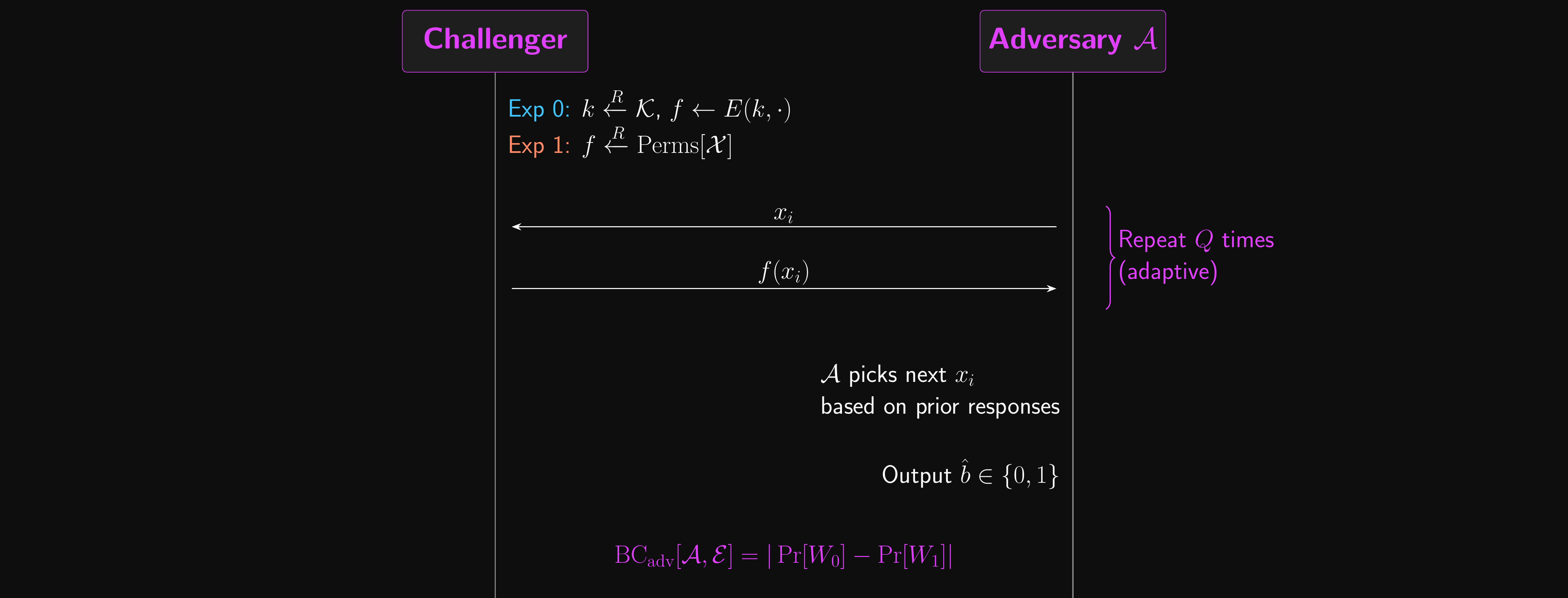
- The adversary \(\mathcal{A}\) in this game is powerful: adaptive, with unlimited queries
- They decide what to ask based on previous answers
- Ultimately, they guess which experiment they’re playing
- Experiment 0:
- The challenger selects \(k \xleftarrow{R} \mathcal{K}\), \(f \leftarrow E(k, \cdot)\)
- …the block cipher encryption function with a randomly-selected fixed key
- Experiment 1:
- The challenger selects \(f \xleftarrow{R} \text{Perms}[\mathcal{X}]\)
- …a randomly-selected permutation from the symmetric group on \(\mathcal{X}\)
- \(\mathcal{A}\) sends a sequence of queries \(x_1, x_2, \ldots, x_Q\) one by one, based on the responses
- The challenger responds with \(f(x_1), f(x_2), \ldots, f(x_Q)\)
- After sending \(Q\) queries, \(\mathcal{A}\) guesses if it’s in experiment 0 or 1
Attack Games: Advantage and PRPs
- Similarly to semantic security and PRG security, we can define the advantage
- \(\text{BC}_\text{adv}[\mathcal{A}, \mathcal{E}] = |\Pr[W_0] - \Pr[W_1]|\)
- \(\mathcal{A}\) is a \(Q\)-query BC adversary if it issues at most \(Q\) queries
- The more queries, the stronger the adversary!
- Some block ciphers take large values of \(Q\) to break
- \(\mathcal{A}\) is adaptive: it can wait for each response before choosing the next query
- Remember, the enemy knows the system
- A block cipher \(\mathcal{E}\) is secure if for all efficient adversaries \(\mathcal{A}\), \(\text{BC}_\text{adv}[\mathcal{A}, \mathcal{E}]\) is negligible
- A block cipher achieving this is called a Pseudo-Random Permutation (PRP)
- This implies that \(\text{SS}_\text{adv}[\mathcal{A}, \mathcal{E}]\) is also negligible
- This is a stronger notion of security! We’ll see why shortly.
Block Cipher Security: Attack Game
Implications
- We don’t want our block cipher to be brute-forced by an efficient adversary
- So the size of the data block space should be super-poly
- A secure block cipher should be unpredictable
- Knowing a subset of block-to-block mappings shouldn’t let you predict others…
- …with anything better than random chance
- Even if you know all but two mappings, it should be a 50-50 guess!
- This implies security against key recovery too!
- If an adversary could guess the key with non-negligible probability…
- …then the block cipher would be predictable and wouldn’t be secure
- And that implies that the key space must be large enough!
- \(1/|\mathcal{K}|\) probability of guessing the key correctly
- \(1/|\mathcal{K}|\) must be negligible, so \(|\mathcal{K}|\) must be super-poly!
Exhaustive Search Attacks
- To illustrate why that’s so important, let’s see how it could be exploited.
- If \(|\mathcal{K}|\) is poly-bounded, we lose to an exhaustive search attack
- The adversary starts by running \(Q\) queries as usual
- This gives them a partial permutation of blocks that map to other blocks
- Next, the adversary loops over all possible keys in \(\mathcal{K}\)
- Once they find a key that produces the partial permutation, they can stop
- Even for small values of \(Q\), it turns out that key is almost always correct!
- Time to find the correct key is \(\Theta(|\mathcal{K}|)\), i.e. linear in \(|\mathcal{K}|\)
- To prevent this kind of attack, we need to make it prohibitively expensive
- We do this by making \(|\mathcal{K}|\) super-poly
- This gives a negligible probability of finding the correct key in polynomial time
- Two preconditions for block cipher security should be pretty clear by now!
- It needs both a large key space and a large data block space
Secure?
- We can also define strongly secure block ciphers with an adjustment to the game!
- We allow forward queries already
- \(\mathcal{A}\) sends a block to the challenger, who responds with its encryption
- We can also allow inverse queries
- \(\mathcal{A}\) sends a block to the challenger, who responds with its decryption
- A strongly secure block cipher should only allow a negligible advantage here
- So, is a secure block cipher also semantically secure?
- Yes! BC security is strictly stronger than SS for single-block messages
- The practical limitation is that block ciphers encrypt exactly one block
- AES uses 128-bit blocks: works for a key, not for a file
- What if we need to send longer messages?
- How can we do it?
- Can we maintain this level of security?
Pseudo-Random Functions (PRFs)
- Last week we built PRGs: stretch a short seed into a long pseudorandom output
- A PRG has no input besides the seed, it just produces one long keystream
- A pseudo-random function (PRF) goes further: it takes a key \(k\) AND an input \(x\)
- \(F : \mathcal{K} \times \mathcal{X} \to \mathcal{Y}\), a deterministic function defined over finite sets
- Think of it as a keyed lookup table that looks random to anyone without the key
- Intuitively, a PRF “looks like” a truly random function to any efficient adversary
Secure PRFs
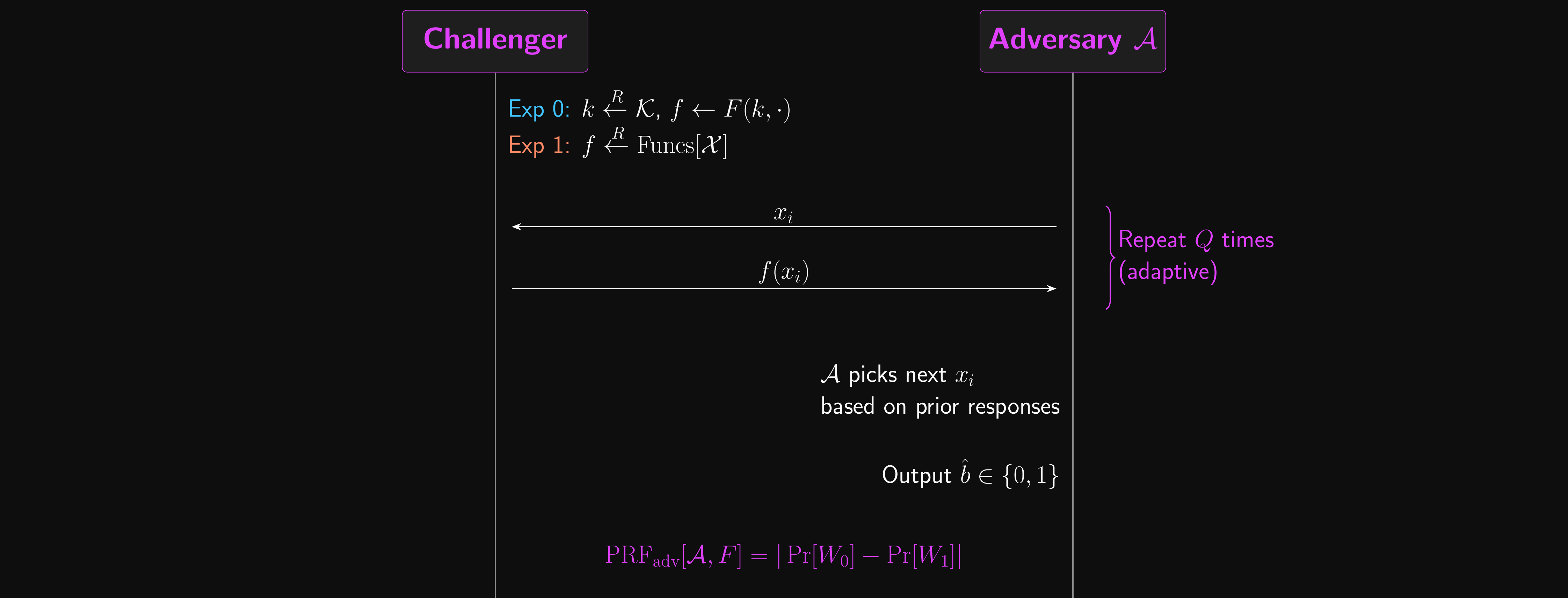
- What makes a secure PRF? An adversary queries either:
- A real PRF \(F(k, \cdot)\) (Experiment 0)
- A truly random function from \(\mathcal{X} \to \mathcal{Y}\) (Experiment 1)
- We write \(\text{Funcs}[\mathcal{X}]\) for the set of all such functions; unlike \(\text{Perms}[\mathcal{X}]\), functions can repeat output values
- If \(\text{PRF}_\text{adv}[\mathcal{A}, F]\) is negligible for all efficient adversaries, the PRF is secure
- Adversaries are adaptive and can make as many queries as they want to
- Weakly-secure PRFs are similar…
- …but the adversary can only query random inputs
- Easier to construct, but weaker guarantees!
PRF Security: Attack Game
Building PRFs from Block Ciphers
- Can a secure block cipher be a PRF?
- Yes, if the input space is large enough (\(|\mathcal{X}|\) is super-poly)
- Small domains are vulnerable to birthday attacks
- 64-bit domain → \(2^{64}\) possible inputs
- Due to the birthday paradox, only ~\(2^{32}\) queries are needed to find a collision with high probability.
- In the PRF attack game:
- Real block ciphers are permutations, so they cannot produce collisions
- Random functions can have collisions
- An adversary can exploit this difference to easily distinguish a block cipher from a random function!
- Block ciphers like DES (with 64-bit blocks) are not secure PRFs!
- The formal statement is the PRF/PRP switching lemma (B&S Theorem 4.4); we’ll walk through the argument after the birthday paradox
The Cake is a Lie
- Anyone heard of the birthday paradox?
- There’s a 50% chance of a shared birthday among just 23 people
- It’s a veridical paradox: true, but counterintuitive
- In a domain of size \(N\), the probability of at least one collision among \(Q\) samples is:
- \(\Pr[\text{collision}] \approx Q^2 / 2N\)
- \(N = 365\) possible birthdays, \(Q\) = number of people
- Collisions become 50% likely when \(Q \approx \sqrt{N}\)
- Why does this matter for block ciphers?
- A block cipher is a permutation: every input maps to a unique output, no collisions ever
- A truly random function CAN produce collisions (two inputs, same output)
- So if you query enough times and never see a collision… you know it’s a permutation, not random!
- With a 64-bit block, that only takes \(\approx 2^{32}\) queries. Too easy.
- Birthday bounds will pop up again with hash functions in an upcoming lecture!
Birthday Bound: Concrete Numbers
- DES has 64-bit blocks: \(N = 2^{64}\)
- 50% collision at \(Q \approx 2^{32}\) queries (about 4 billion)
- That’s feasible on modern hardware, so DES is not a secure PRF!
- AES has 128-bit blocks: \(N = 2^{128}\)
- 50% collision at \(Q \approx 2^{64}\) queries (about 18 quintillion)
- At 1 billion queries/second, that would take 500+ years
- The birthday bound is the gap between a random permutation and a random function
- After \(Q\) queries, the advantage is at most \(Q^2 / (2 |\mathcal{X}|)\)
- For AES: \(2^{64}\) queries before the gap becomes detectable
- This is why block size matters for PRF security, not just key size!
Why Does Breaking PRF Security Matter?
- “So I can tell it’s a permutation. So what? The plaintext is still encrypted!”
- The security of CBC and CTR mode is proven under the assumption that the block cipher is a good PRF
- The proof says: “if no one can distinguish \(E(k, \cdot)\) from a random function, then no one can distinguish ciphertexts”
- If the PRF assumption breaks (birthday bound), the proof breaks
- An adversary who can tell \(E(k, \cdot)\) apart from random can use that ability to distinguish ciphertexts
- That’s exactly the definition of breaking semantic security!
- Concrete: with DES in CBC mode, after \(2^{32}\) encrypted blocks (\(\approx\) 32 GB), an adversary can detect repeated block cipher outputs and learn XOR relationships between plaintext blocks
- The chain: small block \(\to\) birthday distinguisher \(\to\) PRF broken \(\to\) mode of operation insecure
PRF/PRP Switching Lemma
- We want to show \(E(k, \cdot)\) is a secure PRF, given that it is a secure PRP
- Three steps:
- By BC security, \(E(k, \cdot)\) is indistinguishable from \(f \xleftarrow{R} \text{Perms}[\mathcal{X}]\)
- A random permutation differs from a truly random function only by never repeating an output
- After \(Q\) queries, the probability a random function ever repeats an output is \(\leq Q^2 / (2|\mathcal{X}|)\)
- This is the birthday bound: the gap between \(\text{Perms}[\mathcal{X}]\) and \(\text{Funcs}[\mathcal{X}]\)
- Triangle inequality: \(\text{PRF}_\text{adv}[\mathcal{A}, E] \leq \text{BC}_\text{adv}[\mathcal{B}, E] + Q^2 / (2|\mathcal{X}|)\)
- An adversary’s best chance of breaking the PRF is bounded by
- Their chance of breaking the block cipher, plus…
- Their chance of spotting a repeated output!
- This bridge is why CTR and CBC mode security can reduce directly to block cipher security
ECB Mode
What if we just encrypt all the blocks?
Electronic Codebook (ECB) Mode
- Our goal: encrypt multi-block messages with IND-CPA security, reusing the same key
- A bare block cipher encrypts one block; a mode of operation handles longer messages
- We wrap the block cipher in a mode of operation to do this
- To encrypt arbitrary-length messages, we use block ciphers as the core of a larger construct called a block cipher mode of operation
- The most straightforward option is electronic codebook mode
- Usually abbreviated to ECB mode
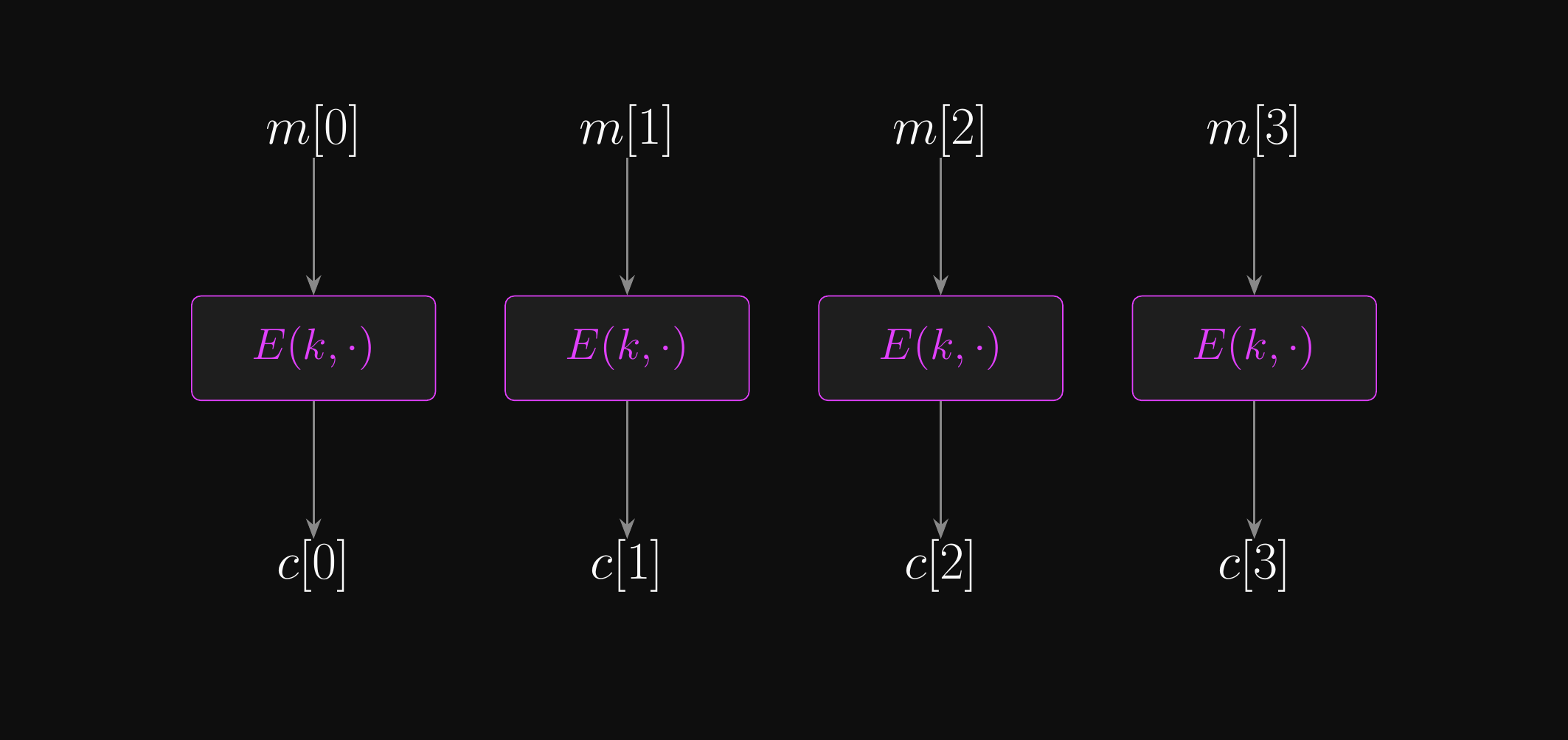
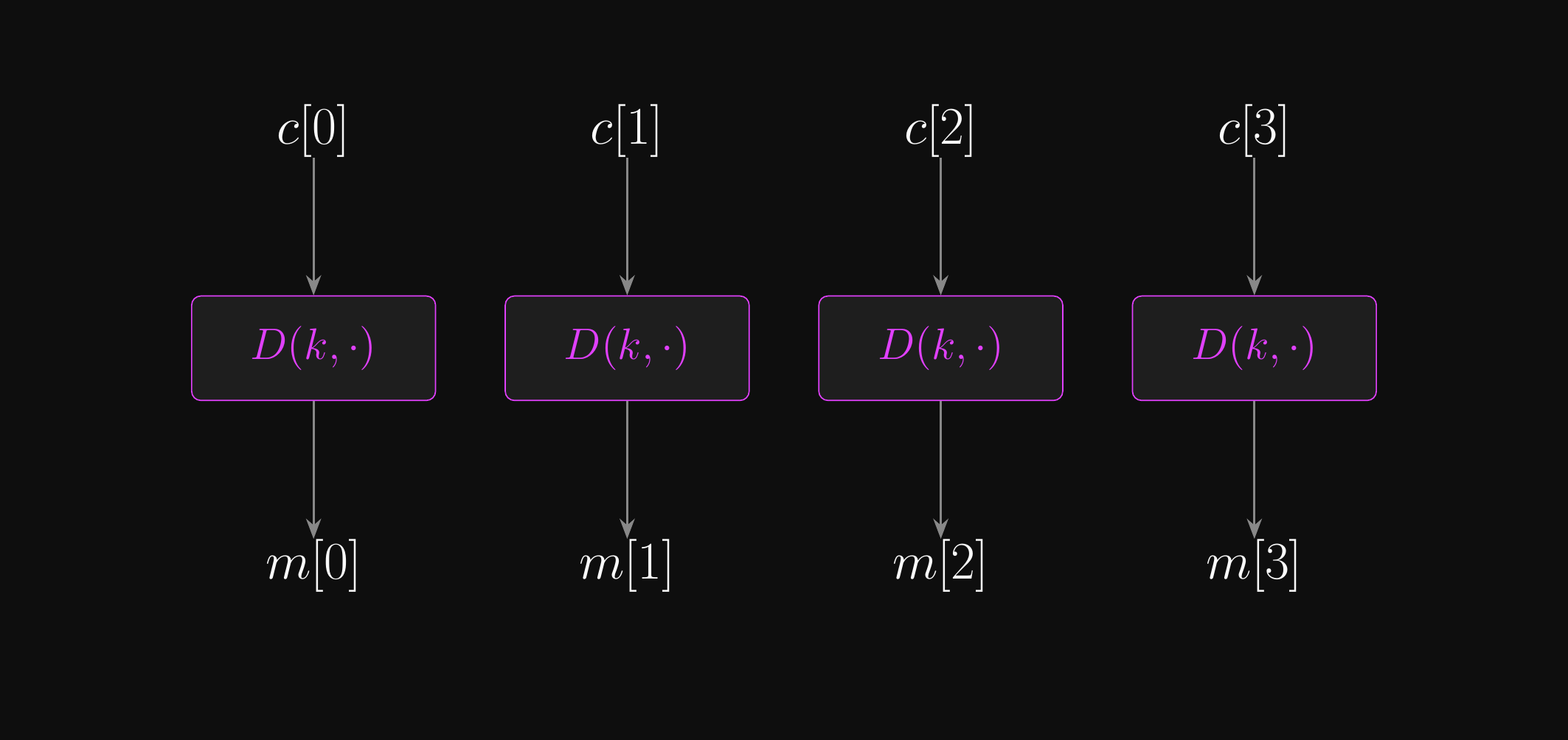
- Start by slicing the message into a sequence of data blocks
- What if the message length isn’t an integer multiple of the block size?
- Padding is an important (and surprisingly thorny) issue for block ciphers
- For now, let’s just pad with null bytes (
0x00) until the message length is a multiple of the block size
- For now, let’s just pad with null bytes (
- Encrypt each block and concatenate the results to make the ciphertext
- Decrypting: slice into blocks, decrypt each one, concatenate
Electronic Codebook (ECB) Mode: Encryption
Electronic Codebook (ECB) Mode: Decryption
ECB Mode: Properties
- This is a surprisingly flexible construct!
- Encryption is trivial to parallelise
- Decryption is trivial to parallelise
- Random access is feasible
- No need to do any extra work to read a specific block
- Not malleable in the way the one-time pad is
- But integrity is still an unsolved problem for us
- Apart from that, why even bother talking about other modes of operation?
- ECB mode has a tiny problem…
- Remember how we said a block cipher is kind of like a substitution cipher?
The Penguin of Doom

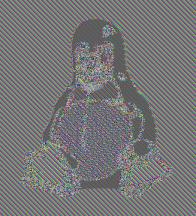
Original comparison on Wikipedia
- Each block encrypts independently; identical input blocks produce identical output blocks
- The block boundaries follow the pixel grid, preserving all large-scale structure
- The ciphertext reveals the structure of the plaintext
What Could Possibly Go Wrong?
- What went wrong there? Is it a problem with the block cipher?
- Is it a problem with the mode of operation?
- Looking at the ciphertext, can you recover the plaintext of the blocks?
- But it’s clearly leaking information about the plaintext…
- ECB mode leaks information about the structure of the plaintext
- Same input block will always produce the same output block!
- Not so devastating if we’re using ASCII or UTF-8 text, as repetition isn’t so common
- But it absolutely breaks semantic security!
- ECB mode isn’t semantically secure, let alone IND-CPA secure
- It should never be used in practice
- ECB mode fails to provide diffusion: patterns in plaintext survive to ciphertext
- We’ll formalise exactly why this breaks security in the next section (IND-CPA)
Diffusion and Confusion
- Diffusion refers to a cipher’s ability to obscure the relationship between the ciphertext and plaintext
- Without diffusion, patterns in plaintext survive to ciphertext (the penguin!)
- An adversary can infer plaintext structure without breaking the cipher at all
- Diffusion is necessary but not sufficient on its own
- Confusion obscures the relationship between the ciphertext and the key
- Without confusion, an adversary can find correlations between ciphertext bits and key bits
- This enables key-recovery attacks (like linear cryptanalysis on DES)
- A single-bit change in the key should change most of the bits in the ciphertext
- Both of these ideas date back to Claude Shannon
- AES achieves diffusion via MixColumns/ShiftRows and confusion via SubBytes
IND-CPA Security
From semantic security to chosen-plaintext attacks.
From Semantic Security to IND-CPA
- Recall: semantic security guarantees that a single ciphertext leaks nothing
- This is good enough if we only encrypt one message per key
- But we reuse keys in practice! What if an adversary sees multiple ciphertexts?
- IND-CPA (indistinguishability under chosen-plaintext attack):
- The adversary has access to an encryption oracle \(\text{Enc}(k, \cdot)\)
- Query it with any single message \(m\); receive \(c \leftarrow E(k, m)\)
- Can query before and after receiving the challenge ciphertext
- The adversary submits a challenge pair \((m_0, m_1)\) with \(|m_0| = |m_1|\)
- Receives \(c^* \leftarrow E(k, m_b)\) for a uniformly random secret bit \(b\)
- The adversary outputs \(\hat{b}\); \(\text{CPA}_\text{adv}[\mathcal{A}, \mathcal{E}]\) must be negligible for all efficient \(\mathcal{A}\)
- The adversary has access to an encryption oracle \(\text{Enc}(k, \cdot)\)
- This is the standard we need for any practical encryption scheme
- Keys are expensive to establish, so we reuse them!
No Deterministic Cipher is IND-CPA Secure
- Claim: if \(E(k, m)\) is deterministic, it can’t be IND-CPA secure
- The core problem: a deterministic cipher always gives the same answer for the same input
- So an adversary can just ask “encrypt \(m_0\) for me” and compare the result to the challenge ciphertext
- Proof: construct an adversary \(\mathcal{A}\) that always wins
- Pick any two distinct messages \(m_0, m_1\)
- Submit the challenge pair \((m_0, m_1)\); receive \(c^* \leftarrow E(k, m_b)\)
- After the challenge: query the encryption oracle with the single message \(m_0\)
- The oracle returns \(c' \leftarrow E(k, m_0)\)
- Since encryption is deterministic: \(E(k, m_0)\) always gives the same result
- If \(c^* = c'\), output \(\hat{b} = 0\). Otherwise, output \(\hat{b} = 1\).
- \(\mathcal{A}\) is correct with probability 1, so \(\text{CPA}_\text{adv}[\mathcal{A}, \mathcal{E}] = 1\)
- Not negligible! The cipher is broken under IND-CPA. \(\square\)
What This Tells Us
- A bare block cipher \(E(k, \cdot)\) is semantically secure (for a single encryption)
- But it is not IND-CPA secure, because it’s deterministic!
- The proof above applies to any deterministic cipher
- Bare AES or DES? Deterministic. Not IND-CPA secure.
- ECB mode? Deterministic. Not IND-CPA secure.
- Stream cipher without a nonce? Deterministic. Not IND-CPA secure.
- To achieve IND-CPA, encryption must be non-deterministic
- Either randomised (e.g. random IV) or nonce-based (e.g. counter)
- This is exactly why we need modes of operation
So are SS and IND-CPA equivalent?
- For a deterministic cipher: no! We just saw the bare block cipher is SS but not IND-CPA
- For a probabilistic cipher (one that uses randomness or a nonce): yes!
- SS \(\Rightarrow\) IND-CPA and IND-CPA \(\Rightarrow\) SS
- The second direction (IND-CPA \(\Rightarrow\) SS) is easy:
- If you can’t distinguish ciphertexts even with an encryption oracle, you certainly can’t without one!
- The first direction (SS \(\Rightarrow\) IND-CPA) is the interesting one
- How do we go from “one ciphertext is safe” to “\(Q\) ciphertexts are safe”?
- We need a proof technique: the hybrid argument
The Hybrid Argument: Intuition
- Imagine two photos of a room that differ in 10 small ways
- Spotting all the differences at once is hard
- But comparing two photos that differ in one way? Much easier
- A hybrid argument works the same way:
- You want to show that World A and World B are indistinguishable
- Instead of comparing them directly, build a chain of intermediate “hybrid” worlds
- Each neighbouring pair differs in exactly one small change
- If nobody can spot any single change, nobody can spot all the changes together
Hybrid Proof: SS \(\Rightarrow\) IND-CPA
- Suppose the adversary makes \(Q\) encryption-oracle queries in the IND-CPA game
- Each oracle response is either \(E(k, m_0)\) or \(E(k, m_1)\); this varies across hybrid worlds
- Build a chain of hybrid worlds \(H_0, H_1, \ldots, H_Q\):
- \(H_0\): all \(Q\) ciphertexts encrypt \(m_0\) (this is Experiment 0)
- \(H_1\): the first ciphertext encrypts \(m_1\), the rest encrypt \(m_0\)
- \(H_2\): the first two encrypt \(m_1\), the rest encrypt \(m_0\)
- \(\ldots\)
- \(H_Q\): all \(Q\) ciphertexts encrypt \(m_1\) (this is Experiment 1)
- Each step \(H_i \to H_{i+1}\) changes exactly one ciphertext from \(E(k, m_0)\) to \(E(k, m_1)\)
- But the cipher is probabilistic, so the ciphertext looks fresh each time!
Hybrid Proof: The Punchline
- If the adversary could distinguish \(H_0\) from \(H_Q\)…
- …they must be able to distinguish at least one neighbouring pair \(H_i\) from \(H_{i+1}\)
- But \(H_i\) and \(H_{i+1}\) differ in only one ciphertext
- Distinguishing one ciphertext of \(m_0\) from one of \(m_1\)?
- That’s just the SS game!
- So the IND-CPA advantage is bounded by the sum of \(Q\) SS advantages:
- \(\text{CPA}_\text{adv}[\mathcal{A}, \mathcal{E}] \leq Q \cdot \text{SS}_\text{adv}[\mathcal{B}, \mathcal{E}]\)
- If \(\text{SS}_\text{adv}\) is negligible and \(Q\) is polynomial, the product is still negligible
- For a probabilistic cipher, SS and IND-CPA are equivalent!
- For a deterministic cipher, this breaks down: fresh encryptions of \(m_0\) are identical, so the adversary can spot the change
Hybrid Proofs: The Bigger Picture
- The hybrid technique shows up throughout cryptography
- PRF switching, CCA reductions, key exchange proofs…
- You’ll see it again!
- Note: this shows SS \(\Rightarrow\) IND-CPA for any probabilistic cipher where each fresh ciphertext is independently random
- For CTR and CBC specifically, B&S uses a tighter proof via PRF security directly
- The principle is the same: replace real randomness with ideal randomness, one step at a time
CBC Mode
What if we just XOR all the things?
Cipher Block Chaining (CBC) Mode
- ECB mode is critically flawed, so we need another approach
- We need a strategy to obscure the output of the block cipher function
- Identical plaintext blocks should produce different output blocks
- What if we just throw XOR at the problem? This has worked so far!
- Anything XOR a random number produces a random output
- Or at least, an output indistinguishable from a truly random output…
- What kind of pseudo-random values do we have available?
- Block cipher output should be indistinguishable from random blocks
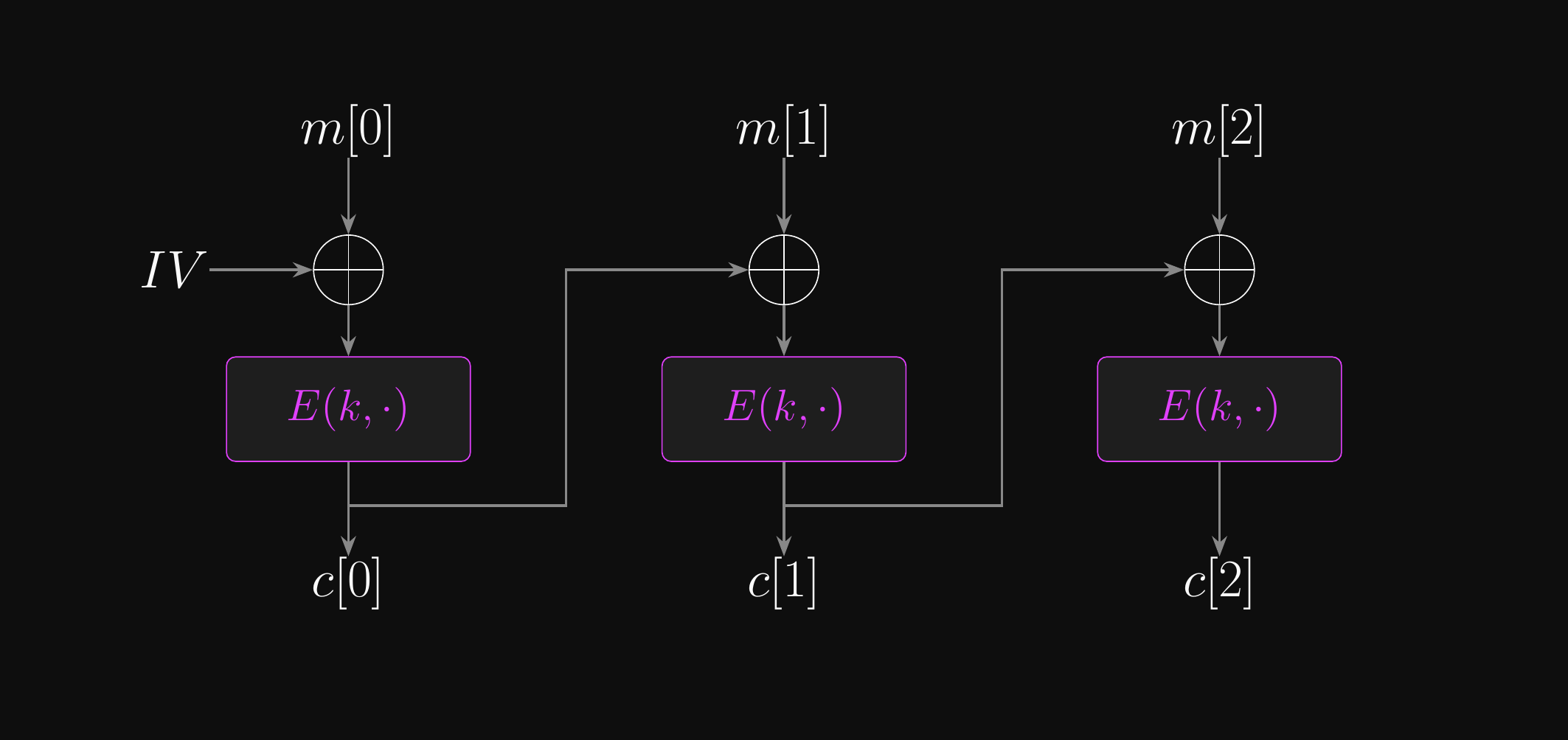
- What if we XOR the plaintext block with the previous ciphertext block?
- Then we’re encrypting essentially random input!
- What about the first plaintext block?
- We’ll need to use some kind of initialisation vector (IV) as a starting point
- It turns out that doing this incorrectly can have consequences…
Cipher Block Chaining (CBC) Mode: Encryption
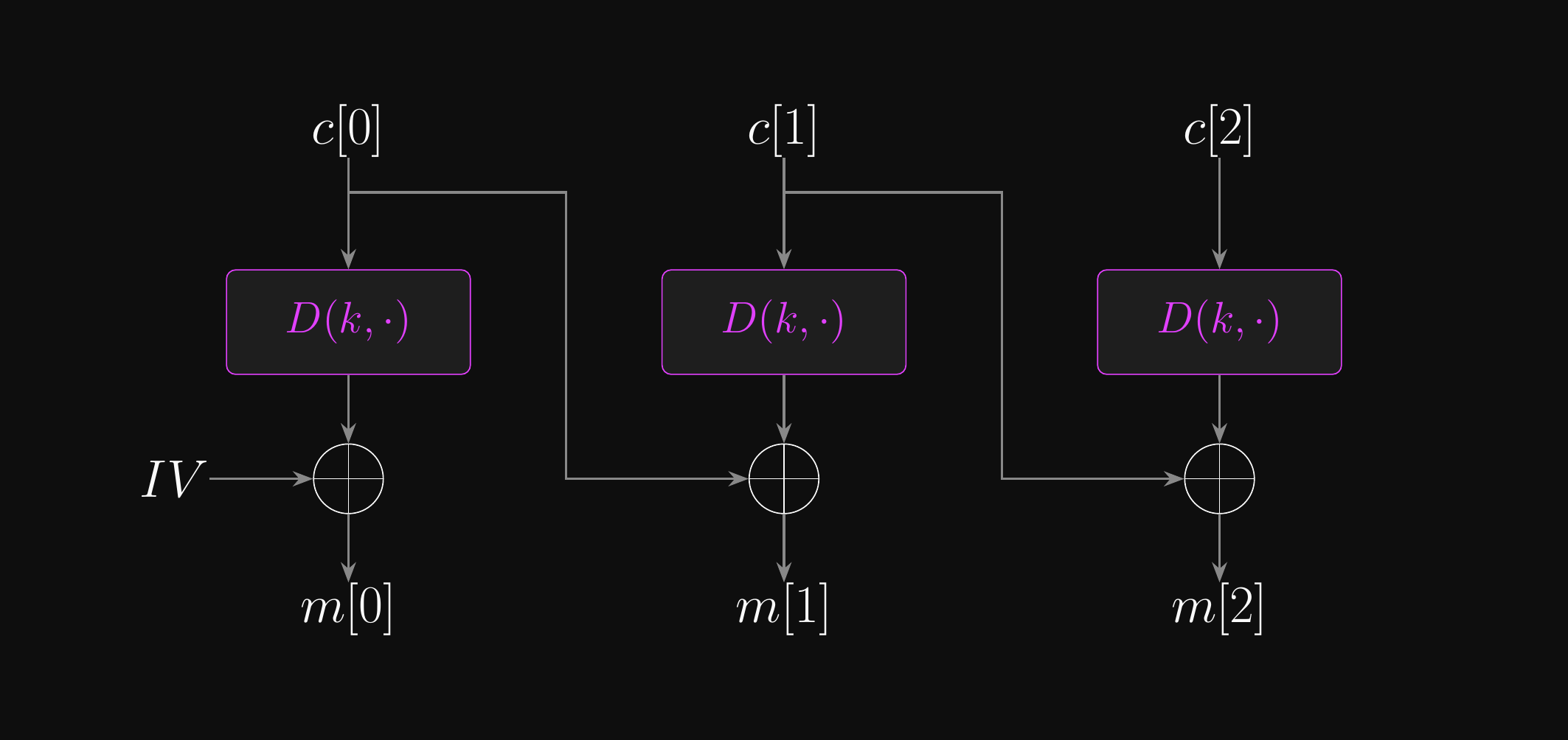
Cipher Block Chaining (CBC) Mode: Decryption
CBC Mode: Properties and Decryption
- Can CBC mode encryption be parallelised?
- No! Each block encryption has a dependency on the previous ciphertext block
- Can CBC mode decryption be parallelised?
- Yes! All ciphertext blocks are already known before decryption begins
- Decrypting block \(i\) only requires \(c[i]\) and \(c[i-1]\) (no forward dependencies)
- Does CBC mode allow random access?
- Yes, for the same reason!
CBC Mode: IV and Security
- Note that the IV must be unpredictable
- The IV is what makes CBC non-deterministic: same plaintext + different IV = different ciphertext
- If the IV is predictable, the adversary can undo its effect, turning CBC back into a deterministic cipher
- But the IV doesn’t have to be secret! It’s sent in the clear most of the time
- Sometimes prepended to the ciphertext as \(c[0]\), sometimes sent separately
- We’ll see concrete attacks on predictable IVs later…
- CBC with a random, unpredictable IV is IND-CPA secure (B&S Theorem 5.2)
- Security reduces to PRF security of the block cipher via the switching lemma
- The unpredictable IV ensures each message is encrypted with a fresh “effective key”
- Even encrypting the same plaintext twice produces different ciphertexts
CTR Mode
What if we just build a stream cipher instead?
Counter (CTR) Mode
- CBC mode is great (or not so great, as we’ll discuss), but not being able to parallelise encryption is a serious disadvantage compared to ECB mode
- Can we have the best of both worlds?
- Counter mode is an interesting (and powerful) construct
- Instead of encrypting the plaintext blocks using the block cipher…
- …we use the block cipher as a CSPRNG to create a keystream…
- …then we XOR the plaintext with the keystream…
- …to yield the ciphertext!
- Basically, CTR mode turns a block cipher into a stream cipher!
- But wait! Won’t this make key reuse a huge problem, just like the many-time pad?
- Not if we use a nonce!
- CTR mode incorporates a nonce, so instead of counting 0, 1, 2, 3, …
- CTR mode counts \((n, \langle0\rangle_b)\), \((n, \langle1\rangle_b)\), \((n, \langle2\rangle_b)\), …
- Where \(\langle x \rangle_b\) is the \(b\)-bit binary representation of \(x\)
Counter (CTR) Mode: Encryption
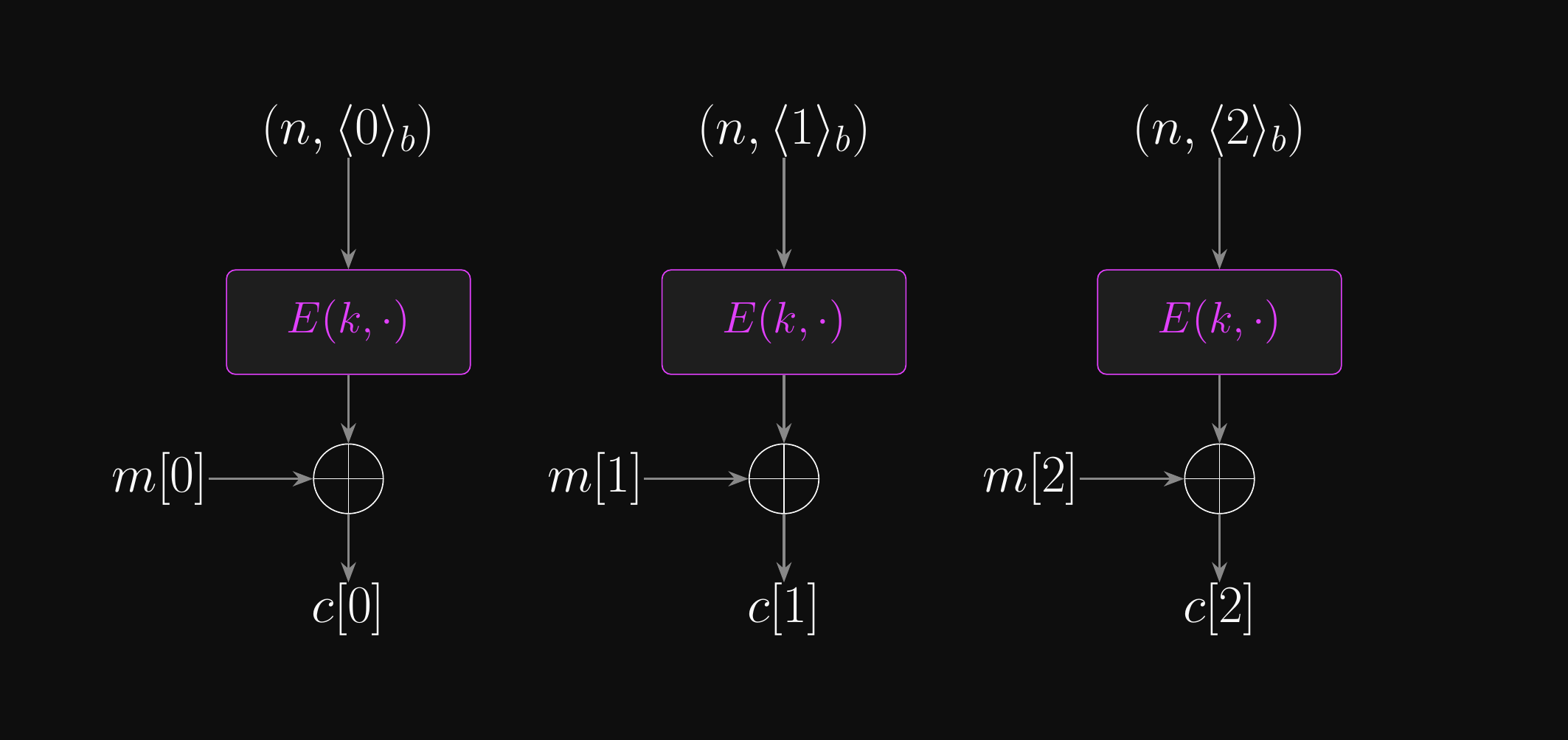
Counter (CTR) Mode: Decryption
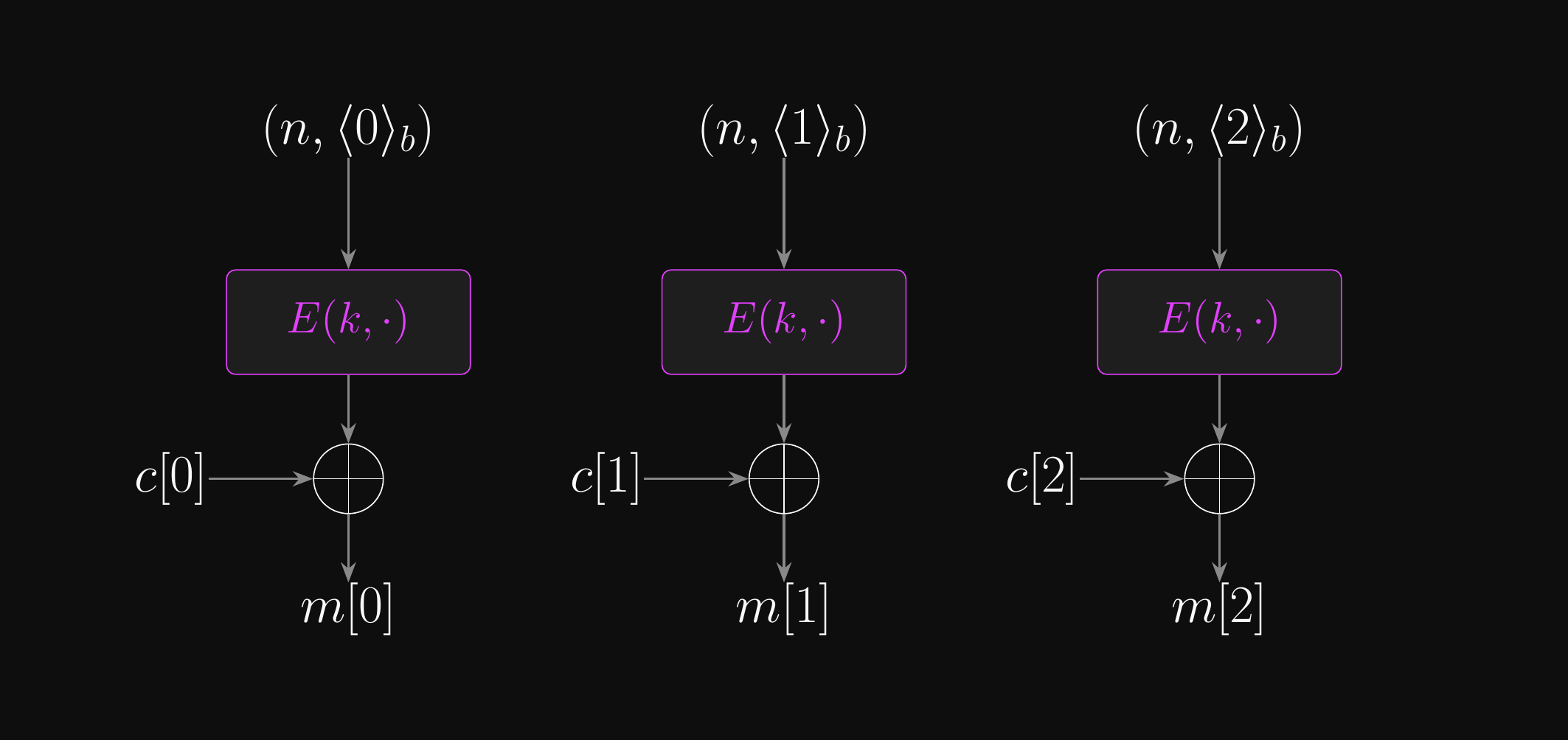
CTR Mode: Decryption
- Can encryption be parallelised?
- Yes! Each keystream block \(E(k, (n, \langle i \rangle_b))\) is independent of all others
- Can decryption be parallelised?
- Yes, for the same reason: decryption is identical to encryption in CTR mode
- Is random access feasible?
- Yes! Generate any keystream block directly from its counter value, with no chain dependency
- As an interesting historical note, CTR mode was quite controversial when it was originally proposed!
- The idea of systematic, predictable block cipher input was viewed negatively
- But now it’s popular and well-regarded
- And is used as the basis for Galois/counter mode (GCM), which we’ll meet later on during our discussion of authenticated encryption and AEAD
- Originally proposed by Whitfield Diffie and Martin Hellman in 1979
CTR Mode: Nonce Discipline
- Notice that encryption and decryption are the same operation!
- CTR mode is, to all intents and purposes, a stream cipher
- This is a good example of how block ciphers can build CSPRNGs too
- The combination of key, nonce and counter must be unique!
- No two blocks should be encrypted with identical values
- This applies both within the same message and across many messages
- Much like with ChaCha20, the split between nonce and counter isn’t significant
- You could just start the count from a random number to make it unpredictable
- But this allows for potential overlaps across many messages!
- Using a nonce in the construction avoids that risk by design
CTR Mode: Security
- Note that concatenating the nonce and counter is the safest option!
- You could XOR the nonce and counter, but this requires a truly random nonce
- With a non-random nonce, XOR can produce collisions:
- \((n_1 \oplus \langle 0 \rangle_b) = (n_2 \oplus \langle 1 \rangle_b)\) if \(n_1 \oplus n_2 = 1\), defeating uniqueness!
- CTR with a unique nonce is IND-CPA secure (B&S Theorem 5.1)
- Security reduces to PRF security of the block cipher via the switching lemma
- An adversary breaking CTR-mode IND-CPA can be used to break the underlying PRF, which is a contradiction
Block Cipher Modes: Comparison
| ECB | CBC | CTR | |
|---|---|---|---|
| Encryption | \(c[i] = E(k, m[i])\) | \(c[i] = E(k, m[i] \oplus c[i{-}1])\) | \(c[i] = m[i] \oplus E(k, (n, \langle i \rangle_b))\) |
| Decryption | \(m[i] = D(k, c[i])\) | \(m[i] = D(k, c[i]) \oplus c[i{-}1]\) | \(m[i] = c[i] \oplus E(k, (n, \langle i \rangle_b))\) |
| \(\texttt{Enc}\) parallelisable | Yes | No | Yes |
| \(\texttt{Dec}\) parallelisable | Yes | Yes | Yes |
| Random read | Yes | Decryption only | Yes |
| Partial last block | Padding required | Padding required | Yes |
| IV / Nonce | None | Unpredictable IV | Unique nonce |
| IND-CPA secure | No | Yes | Yes |
| Notes | Leaks block equality | IV sent unencrypted | \(\texttt{Enc}\) = \(\texttt{Dec}\) (stream cipher) |
PKCS#5 and PKCS#7
- Zero-padding (appending null bytes) is the simplest approach but fails at decryption time
- A message that legitimately ends with the padding byte is indistinguishable from a padded message!
- Both PKCS#5 and PKCS#7 solve this elegantly; they are basically the same thing!
- PKCS#5 is technically only for 64-bit (8-byte) blocks.
- PKCS#7 generalises to any block size up to 255 bytes.
- First, figure out how many bytes of padding you need.
- If the message is already a multiple of the block size, you need to add an entire block of padding!
- Why?
- Let’s say we need \(n\) bytes of padding
- If the message is already a multiple of the block size, you need to add an entire block of padding!
- Add that \(n\) bytes of padding, using \(n\) as the byte value.
- E.g. if \(n = 3\), then add
03 03 03(base 16) - E.g. if \(n = 6\), then add
06 06 06 06 06 06(base 16)
- E.g. if \(n = 3\), then add
- Finally, go ahead and encrypt the padded message as usual!
Removing PKCS Padding
- After decryption, read the last byte of the message.
- This gives you \(n\), the number of padding bytes
- Trim \(n\) bytes from the end of the message
- Now we’re left with the original plaintext
- Unlike zero-padding, this is unambiguous
- There are lots of other padding schemes out there too…
Feistel Networks
From round functions to full block ciphers.
Feistel Networks
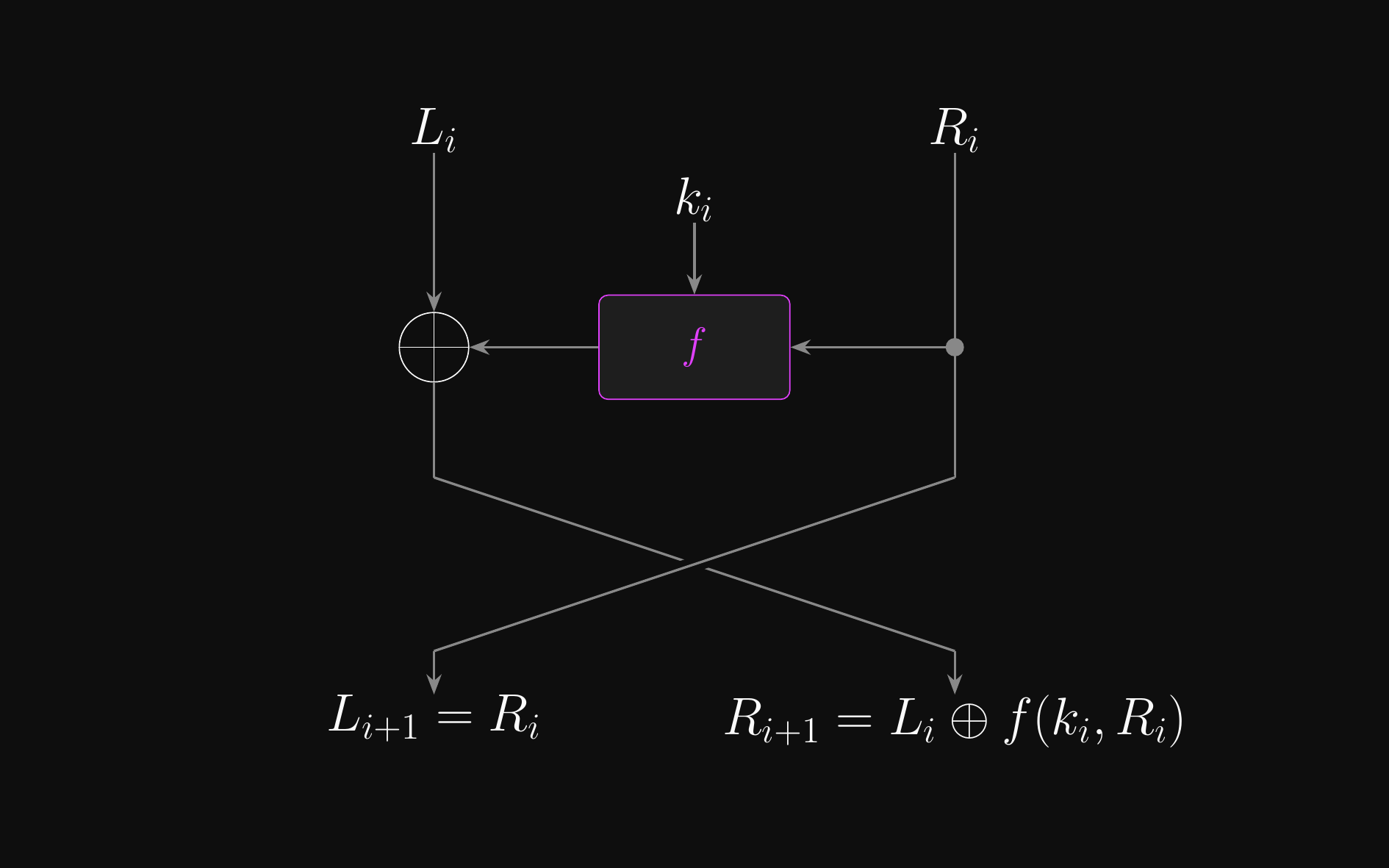
- A Feistel network builds a block cipher from a simple round function \(f\)
- Split the input block into two halves: \(L_0\) and \(R_0\)
- Each round \(i\) applies:
- \(L_{i+1} \leftarrow R_i\)
- \(R_{i+1} \leftarrow L_i \oplus f(k_i, R_i)\)
- After all rounds, concatenate the halves to produce the output
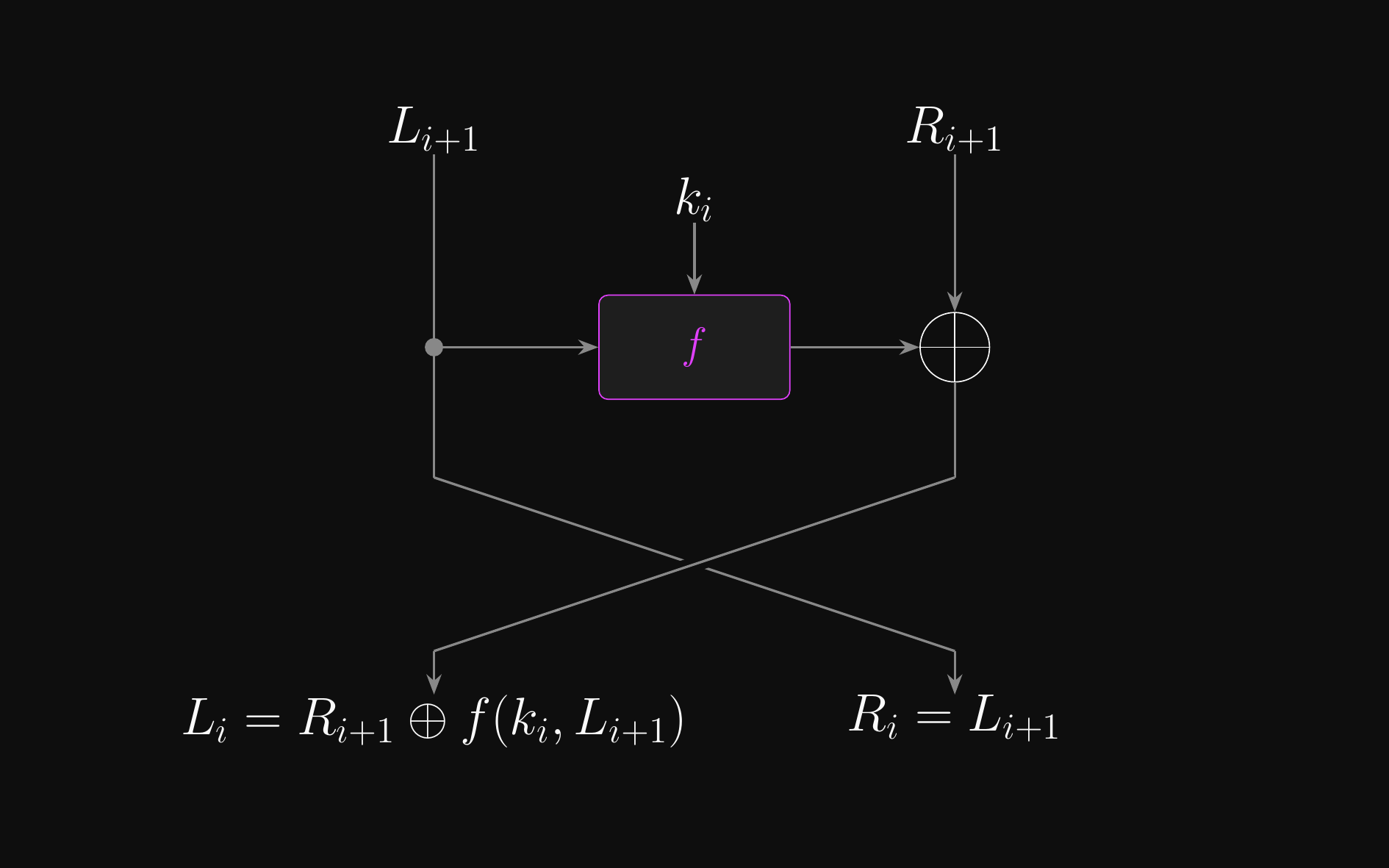
- Key property: always invertible, even if \(f\) itself is not
- To invert, just recompute \(f(k_i, R_i)\) and XOR again
- That’s the trick: \(f\) only needs to be a good PRF, not a permutation
- Designing a good PRF is much easier than designing a full permutation, and the Feistel structure gives you invertibility for free
- Used by DES, Blowfish, Camellia, and many other block ciphers
Feistel Round: \(\pi(L_i, R_i)\)
Feistel Round Inverse: \(\pi^{-1}(L_{i+1}, R_{i+1})\)
Constructing Iterated Block Ciphers
- Most practical block ciphers use the iterated cipher paradigm
- Building an iterated block cipher requires two design choices
- Pick a simple round function to use as the per-round cipher
- Pick a simple PRG to expand the key into a number of subkeys or round keys
- This is called the key expansion function, and doesn’t have to be secure
- The subkeys it produces are collectively called the key schedule
- Neither the round function nor the key expansion needs to be individually secure
- Security emerges from sufficient iteration of the two together
The Luby-Rackoff Theorem
- How many Feistel rounds do we need for security?
- The Luby-Rackoff theorem (1988) answers this for the idealised case (B&S Theorem 4.11):
- A 3-round Feistel network with truly random round functions is a secure PRP
- A 4-round Feistel network with truly random round functions is a strongly secure PRP (secure even when the adversary can query the inverse)
- This is a clean, proven result – but it comes with a big caveat
- The round functions must be truly random: independently chosen, with no structure an adversary can exploit
- Real ciphers use keyed round functions that are efficient and structured – not truly random
- The theorem tells us the Feistel structure is sound; it says nothing about any specific round function
In Practice: No Shortcuts
- Luby-Rackoff tells us 3–4 rounds suffice in the ideal world, but we don’t live in one…
- Can any function work as a round cipher?
- No – linear or affine functions shouldn’t be used, e.g. \(f(k, x) = k \oplus x\)
- We need non-linearity, e.g. via S-boxes, to achieve security
- Is there an easy way to tell if a specific function is “good enough”?
- Unfortunately, no – no general test exists
- Real block ciphers use many more rounds than the theoretical minimum
- Extra rounds provide a margin of safety against attacks the designers didn’t foresee
- What conclusion should we draw from this?
- DON’T ROLL YOUR OWN BLOCK CIPHER
- Block cipher design is highly non-trivial and very easy to get wrong
- It takes years of cryptanalysis to gain confidence in a cipher’s security
Feistel Networks vs SPNs
- Two dominant paradigms for building iterated block ciphers
- Feistel network: splits block into halves, applies a round function to one half and XORs with the other
- Round function does not need to be invertible – Feistel structure guarantees invertibility
- Examples: DES, Blowfish, Camellia
- Substitution-permutation network (SPN): applies substitution (S-box, non-linear) and permutation (linear diffusion) layers to the entire block
- Each layer must be individually invertible
- Simpler structure; rounds can be parallelised more easily
- Examples: AES, Serpent, PRESENT
DES
A block cipher from the bad old days.
The Origin of DES
- The Data Encryption Standard (DES) was built by IBM for NIST in the 1970s
- Adopted as a federal standard for unclassified data in 1977
- NBS (the future NIST) constrained the block to 64 bits and key to 56 bits
- Very controversial! Allegations of deliberate sabotage by intel agencies
- Small block size is also a problem
- Fantastic moment for cryptanalysis: a gold standard cipher to attack!
- Lots of theoretical breakthroughs
- Eventually cracked in the late 1990s
- Please don’t use DES for anything these days!
- Exhaustive key search is feasible to the point where there’s SaaS for it
- But it’s not as gone as you might think…
The DES Round Function
- DES uses a 16-round Feistel network
- Split 64-bit input into 32-bit halves \(x\) and \(y\)
- Each round: apply \(f\) to \(x\) and subkey, XOR with \(y\), swap
- The DES round function takes a 48-bit subkey and 32-bit input
- Expansion: \(E\) expands 32 bits to 48 using fixed bit mappings
- Key mixing: XOR with 48-bit subkey
- Substitution: \(S\)-boxes reduce 48 bits to 32 bits using 6-bit to 4-bit LUTs
- The design criteria for the 8 \(S\)-boxes were initially kept secret by the NSA, raising backdoor suspicions
- Later analysis found them to be hardened against differential cryptanalysis (studying how input differences propagate through the cipher)
- This controversy helped establish the nothing-up-my-sleeve principle: derive constants from natural mathematical values (e.g. SHA uses fractional parts of square roots of primes) so no hidden structure can be engineered in
- **Permutation**: the function $P$ reorders bits for diffusion
    - This is a fixed ***mixing permutation***
DES Round Function
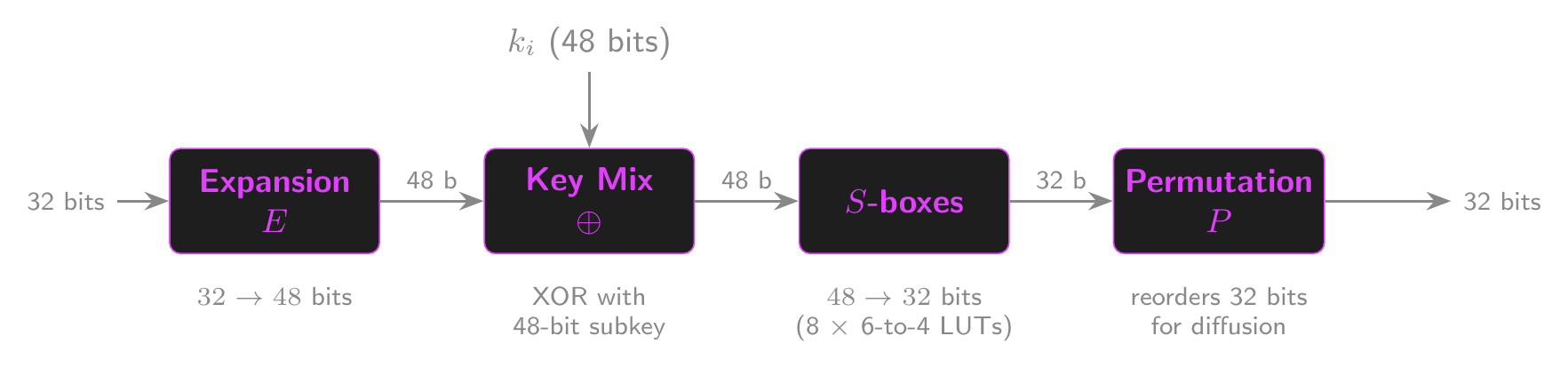
The DES Algorithm
- The key expansion function G takes the 56-bit key \(k\) as input
- Outputs 16 48-bit round keys
- Each round key’s 48 bits are a specific subset of bits from \(k\)
- DES runs a 16-round Feistel network using the key expansion function (KEF) and round function
- An initial permutation \(\text{IP}\) runs at the start
- A final permutation \(\text{FP} = \text{IP}^{-1}\) runs at the end
- We don’t really know why…
- The permutations have no cryptographic significance
- DES isn’t any more or less secure with them present
- One theory is deliberate performance degradation for DES software!
The Flaw in the Plan
- The 56-bit key size should be ringing alarm bells!
- Minimum safe key size today is 128 bits
- Controversial even at the time!
- DES is vulnerable to exhaustive key search (demonstrated in 1998)
- DeepCrack cost $250k and managed it in 56 hours to win a $10k prize
- No one said cryptographers were good at economics…
- Takes about a day on modern hardware
- DeepCrack cost $250k and managed it in 56 hours to win a $10k prize
- One of the S-boxes is too linear, and can be attacked with linear cryptanalysis (finding statistical correlations between plaintext, ciphertext, and key bits)
- The key can be recovered after \(2^{41}\) operations
- The 64-bit block size is also too small!
- Birthday attacks mean that \(2^{32}\) queries would be enough to get a solid advantage against DES in CBC mode
- 128-bit blocks should be considered the standard
Triple-DES
- So, your federal encryption standard is rapidly falling apart. What next?
- Make a new standard, right? But…
- Lots of companies have bought dedicated DES hardware
- They’re not going to be happy if it’s made obsolete…
- As a stopgap measure, we got 3DES in 1998
- What if, instead of doing DES once, we just did it three times?
- That means triple the key size! A 168-bit key is much more secure
- Triple-DES encrypts, decrypts, and then encrypts again:
- \(E_\text{3DES}((k_1, k_2, k_3), x) = E_\text{DES}(k_3, D_\text{DES}(k_2, E_\text{DES}(k_1, x)))\)
- Why? For backwards-compatibility with DES if all keys are the same!
- Double-DES is no more secure than DES due to meet-in-the-middle attacks (encrypt forward under \(k_1\), decrypt backward under \(k_2\), find a match in the middle: cost is \(2|\mathcal{K}|\), not \(|\mathcal{K}|^2\))
- 3DES is much more expensive to run than DES
- It’s obvious that a better standard is needed…
AES
Rijndael to the rescue!
The Foot-Shooting Prevention Agreement
- The AES pledge (paraphrased from Jeff Moser):
- “I promise that once I see how simple AES really is, I will not implement it in production code even though it would be really fun.”
- “This agreement will remain in effect until I learn all about side-channel attacks and countermeasures to the point where I lose all interest in implementing AES myself.”
- The Stick Figure Guide to AES
The AES Process
- The AES process was started by NIST in 1997 to replace DES
- The new cipher would be the Advanced Encryption Standard (AES)
- Requirements: 128-bit blocks, key sizes of 128, 192 and 256 bits
- Global submissions were accepted, discussed and subjected to cryptanalysis
- A final five candidates presented at an open conference in April 2000
- In October 2000, Rijndael was selected as the AES cipher
- Designed by Joan Daemen and Vincent Rijmen (Belgium).
- AES became official in 2001 (FIPS 197).
- Unlike DES, AES is recommended by the NSA for classified information
- Some of Rijndael’s features, like variable block sizes, were removed
- AES has hardware-level support from all major CPU manufacturers
- For example, AES-NI in the x86 ISA
- Sometimes provided by an AES co-processor on a separate chip
- Extremely fast, usually optimised and pipelined
The AES Algorithm
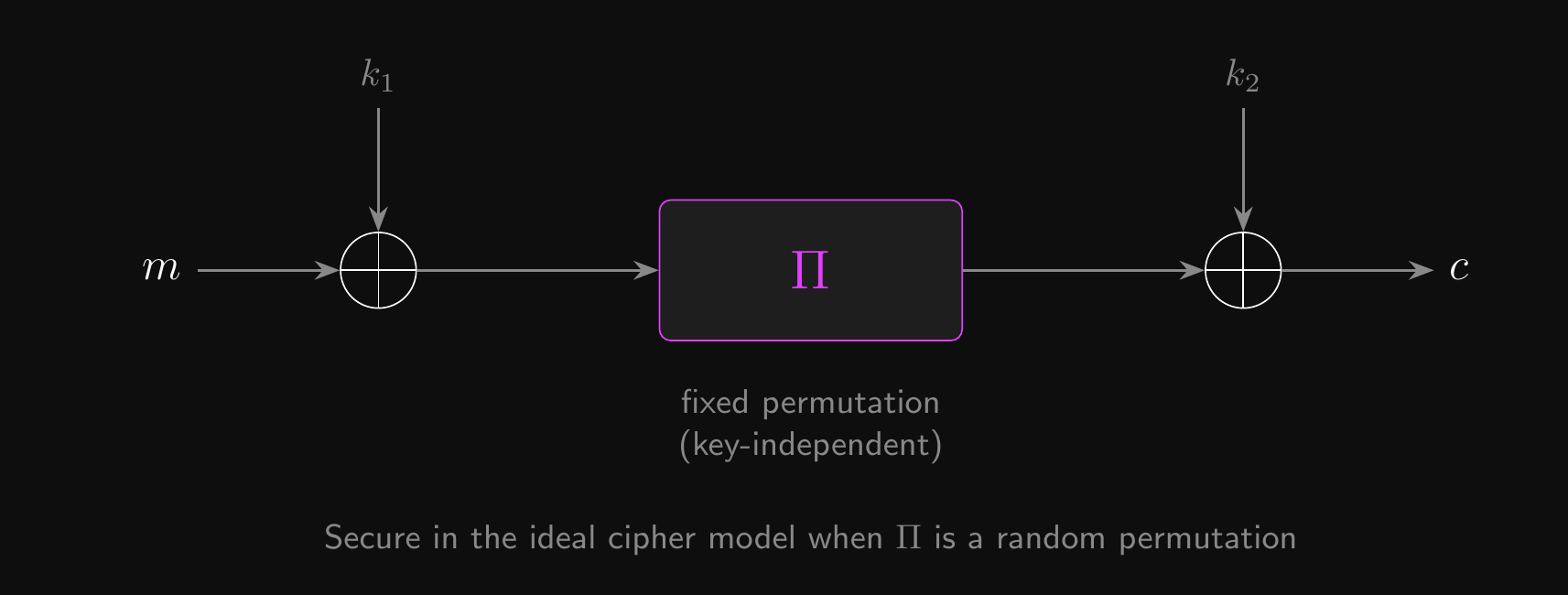
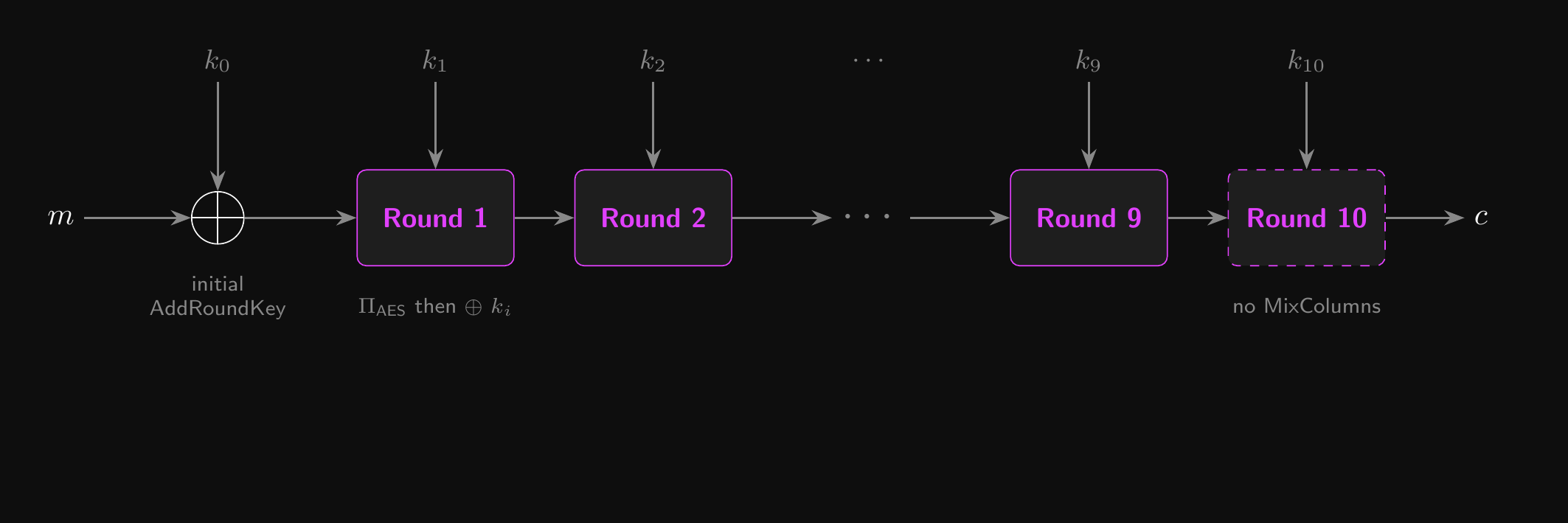
- AES is an alternating key cipher, or an iterated Even-Mansour cipher (a design where round keys are XORed between applications of a fixed permutation)
- The input is XORed with the zeroth round key
- Each round starts with a fixed permutation that doesn’t depend on the key
- At the end of each round, the current round key is XORed with the output
- AES-128 has 10 rounds, AES-192 has 12 rounds, and AES-256 has 14 rounds
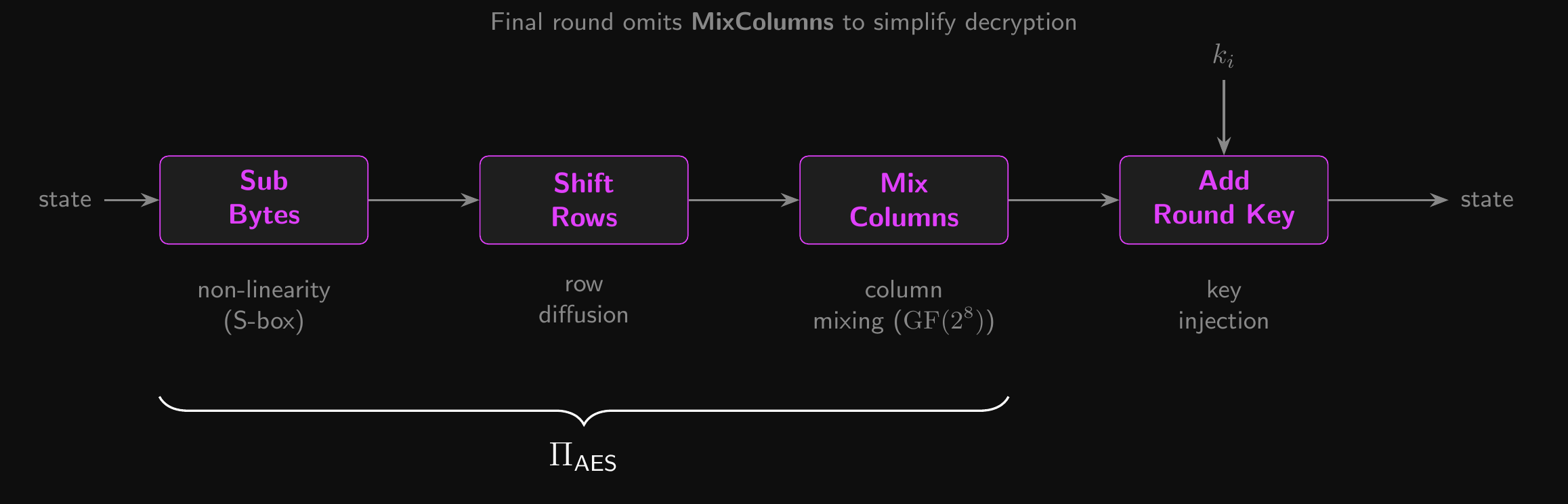
- Each round permutation \(\Pi_\text{AES}\) is an SPN – a substitution layer followed by a permutation layer:
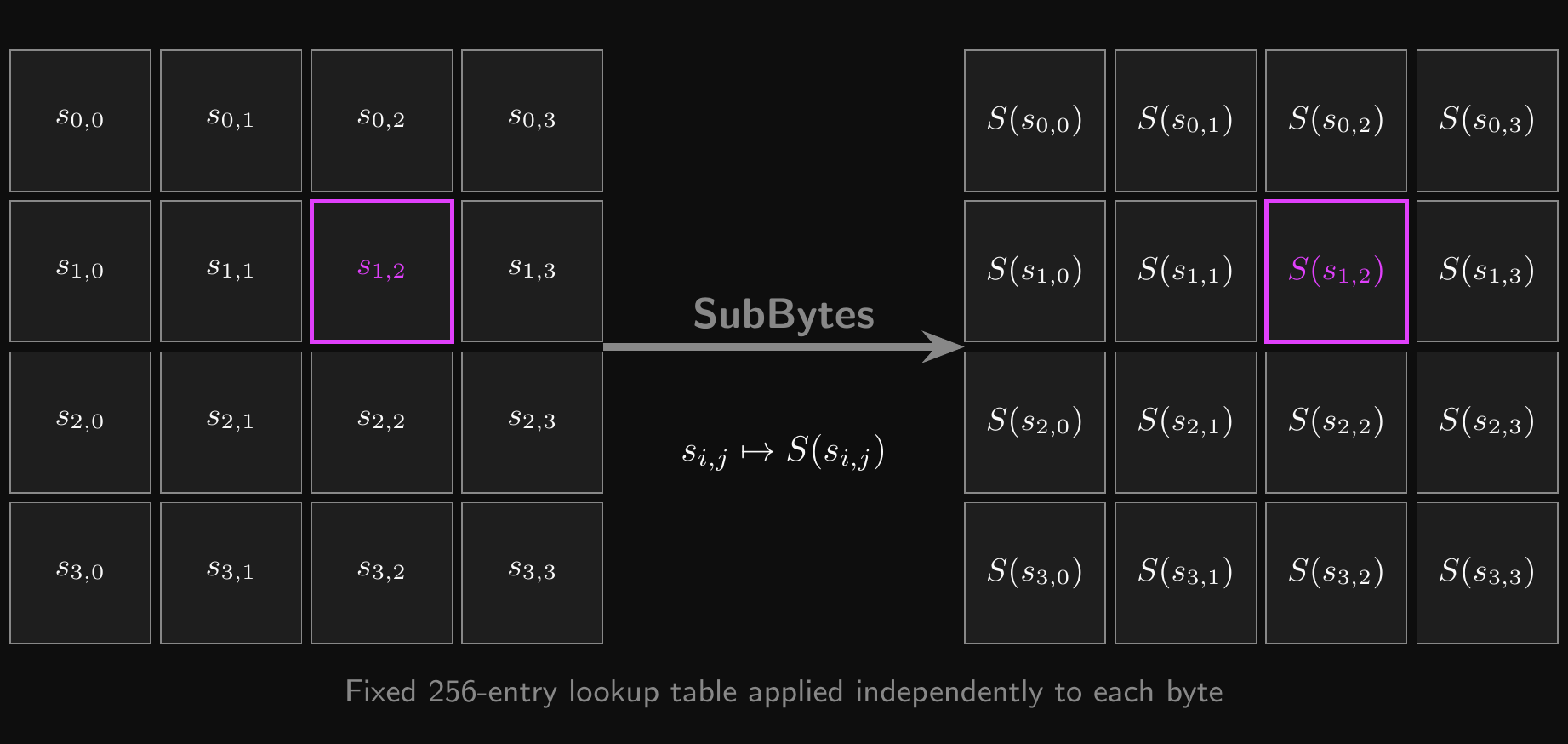
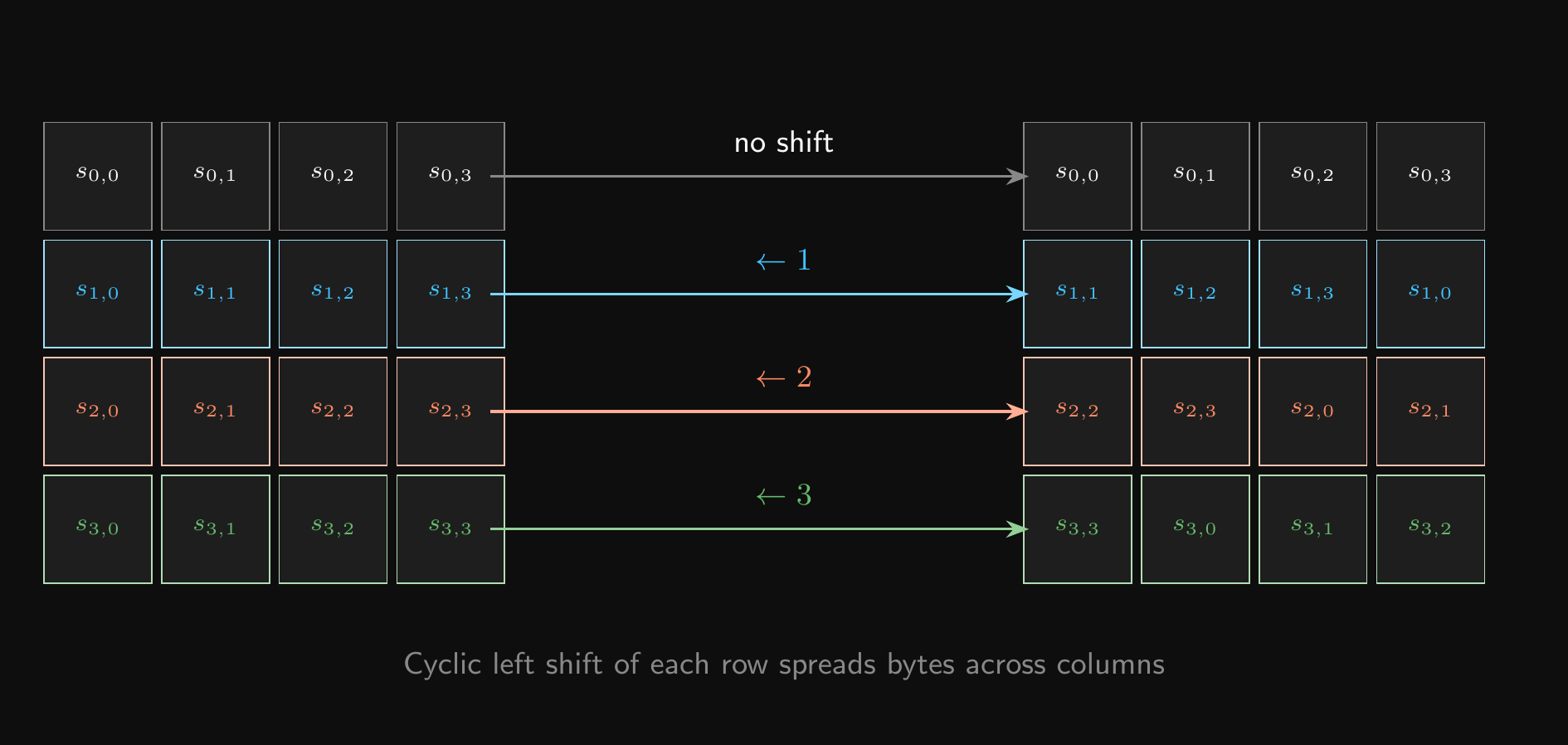
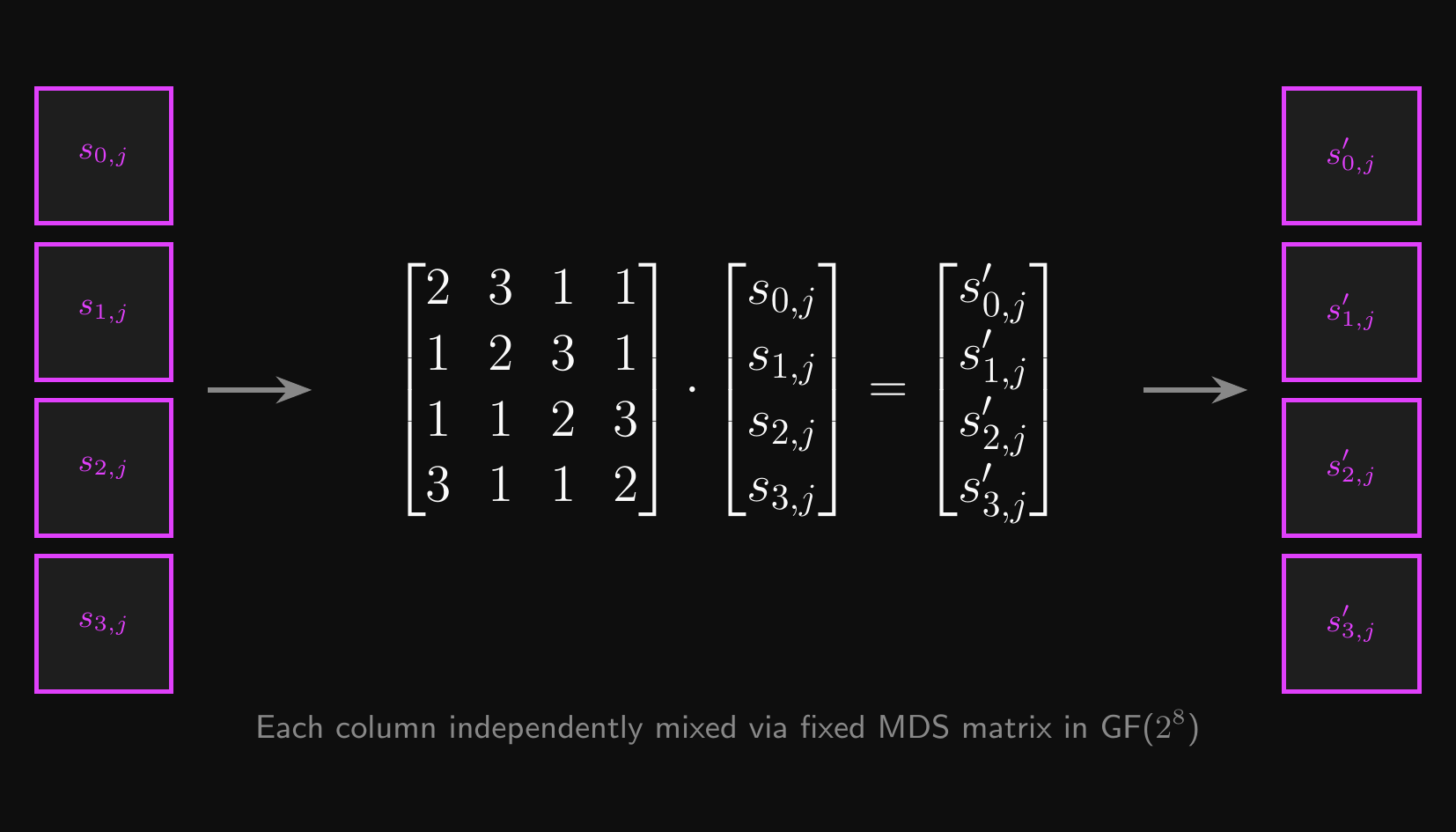
SubBytes: the substitution layer – applies a fixed S-box to each byte for non-linearityShiftRows+MixColumns: the permutation layer – linear diffusion across the blockShiftRowscyclically shifts rows in a \(4 \times 4\) byte matrixMixColumnsmixes columns using matrix multiplication in GF(\(2^8\))- See the Galois Fields reference for how GF(\(2^8\)) arithmetic works
Even-Mansour Construction
AES-128: Cipher Structure
AES: Security and Implementation
- This structure has a formal security proof in the ideal cipher model
- If \(\Pi_\text{AES}\) is modelled as a random permutation, the iterated Even-Mansour construction is a secure block cipher in the ideal cipher model (B&S §4.3.4)
- AES inherits its security argument from this framework
- The final round omits
MixColumnsto simplify decryption logic - Each step is designed to be easily invertible!
- AES can be implemented with pre-computed lookup tables (LUTs) for efficiency
- This is a nice idea that usually ends in disaster…
AES Round Permutation \(\Pi_\text{AES}\)
SubBytes: Byte Substitution
ShiftRows: Row Diffusion
MixColumns: Column Mixing
AES Key Schedule
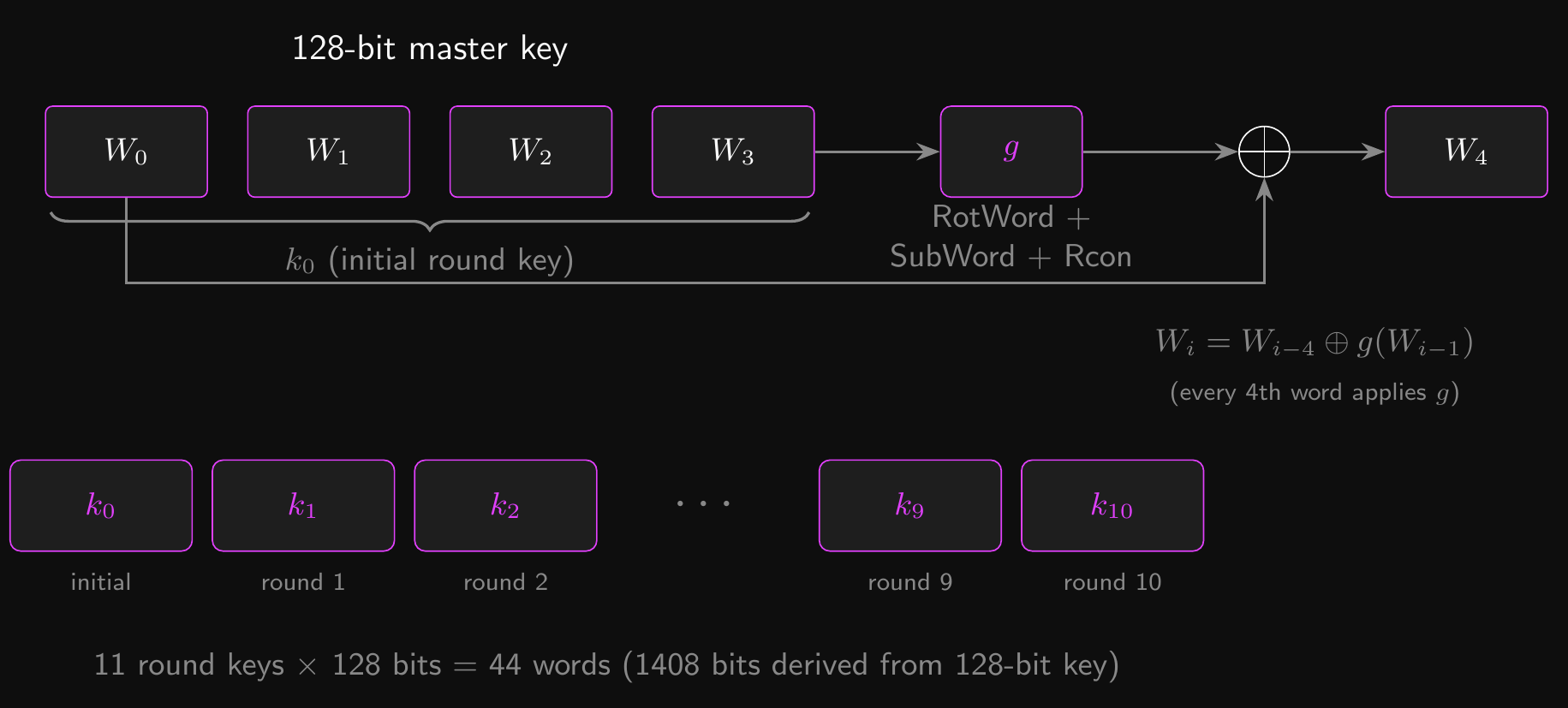
- AES-128 needs 11 round keys (one initial + ten rounds) from a single 128-bit key
- The key schedule expands 128 bits into \(11 \times 128 = 1408\) bits
- The master key is split into four 32-bit words: \(W_0, W_1, W_2, W_3\)
- Subsequent words are derived recursively:
- Most words: \(W_i = W_{i-4} \oplus W_{i-1}\)
- Every 4th word applies a function \(g\): \(W_i = W_{i-4} \oplus g(W_{i-1})\)
- The function \(g\) provides non-linearity:
RotWord: cyclic byte rotationSubWord: apply the SubBytes S-box to each byte- XOR with a round constant \(\text{Rcon}[i]\)
- Each round key \(k_i\) is the next group of four words: \(k_i = (W_{4i}, W_{4i+1}, W_{4i+2}, W_{4i+3})\)
AES-128: Key Schedule
Security of AES
- AES has withstood extensive cryptanalysis since its standardization.
- A much more impressive history than DES!
- Best key recovery attacks use biclique techniques (a refined form of meet-in-the-middle that exploits structure in the key schedule)
- Slightly faster than exhaustive search, but still impractical
- Best-known attack on AES-128 takes \(2^{126.1}\) AES evaluations
- Best-known attack on AES-256 takes \(2^{254.4}\) AES evaluations
- No real-world security impact
- Slightly faster than exhaustive search, but still impractical
- AES-256 shows theoretical vulnerability to related key attacks
- With four carefully chosen related keys satisfying a specific XOR equation…
- …an attacker could recover all of the keys in ~\(2^{99.5}\) AES evaluations
- Not relevant in practice, where keys are random and unrelated
- With four carefully chosen related keys satisfying a specific XOR equation…
- Attacks are mostly of academic interest under unrealistic assumptions (for now)
Side-Channel Attacks
- Side-channel attacks are a bit different from mathematical attacks
- They attack the implementation rather than the design of the cipher
- Timing attacks exploit a relationship between the time it takes to encrypt a block and the value of the secret key
- This might be caused by branching or caching at the CPU level
- With vulnerable implementations, key recovery attacks have been demonstrated in practice within a few minutes!
- Hardware implementations are a better option when available
- Power attacks exploit a relationship between the power consumption of a device and the instructions it executes
- AES is secure against simple power analysis
- But not all implementations are secure against differential power analysis
- Power traces over thousands of encryptions can leak the key
- Mitigations at a hardware level use capacitors for constant power consumption
The Quantum Apocalypse?
- We’ve only discussed classical computers thus far
- What about quantum computers? Is there an apocalypse coming?
- Remember exhaustively searching the key space in our attack game?
- On a classical computer, this takes \(O(|\mathcal{K}|)\)
- For AES-128, \(|\mathcal{K}|\) means \(2^{128} \approx 3.4 \times 10^{38}\)
- Grover’s algorithm is a quantum search that checks all keys in \(\sqrt{N}\) time instead of \(N\)
- Given \(f : \mathcal{K} \to \{0, 1\}\), where \(f(k) = 1\) if \(k = k_0\) and 0 otherwise…
- …a quantum computer can find \(k_0 \in \mathcal{K}\) in \(O(\sqrt{|\mathcal{K}|} \cdot \text{time}(f))\)
- So if we define \(f_\text{AES}(k) = 1\) if \(\text{AES}(k, m) = c\) and 0 otherwise…
- …we can find the key in \(O(\sqrt{|\mathcal{K}|})\)
- For AES-128, \(\sqrt{|\mathcal{K}|}\) means \(2^{64} \approx 1.84 \times 10^{19}\)
- That’s alarmingly feasible, and a massive reduction in security!
Are We Doomed?
- Time to panic? Not yet. No quantum computer exists that can do this.
- Grover’s halves the effective key size: AES-128 \(\to\) 64-bit, AES-256 \(\to\) 128-bit
- So if you’re worried about quantum attacks, just use AES-256
- This is part of the reason why AES supports a 256-bit key size!
- Why act now? Adversaries may follow a harvest now, decrypt later strategy
- Intercept and store encrypted traffic today, even if it is currently undecryptable
- Decrypt it in the future once a sufficiently powerful quantum computer exists
- Medical records, financial data, state secrets: some information stays valuable for decades
- So you can already do post-quantum symmetric cryptography - crisis averted!
- You should really be panicking about asymmetric cryptography instead…
- More on that in an upcoming lecture!
Attack the Block
Cracking block ciphers (for fun and profit).
Encryption Oracle Attack
- ECB mode can be defeated by simple visual inspection, e.g. Tux the penguin
- You might argue that we haven’t actually decrypted anything…
- But we’ve successfully extracted information from the ciphertext!
- You might also point out that text doesn’t seem so vulnerable…
- But with just a few assumptions, ECB mode can blow encryption wide open
- No matter how strong the block cipher we use is!
- Let’s see how this works with AES
Encryption Oracle Attack: The Setup
- All we need is a setup where we can:
- inject some chosen plaintext
- to be prepended to some secret information being encrypted
- E.g. an input to a server.
- What’s AES’s block size?
- How many possible values can we store in 128 bits / 16 bytes?
- How feasible is a brute-force attack?
- Can we be smarter about this using those assumptions?
Encryption Oracle Attack: The Trick
- We can’t feasibly brute-force AES, even in ECB mode
- But we can prepend bytes to the message! Let’s exploit this…
- Let’s take the first block…
- ???????? ???????? ???????? ????????
- Can we narrow down the possibilities?
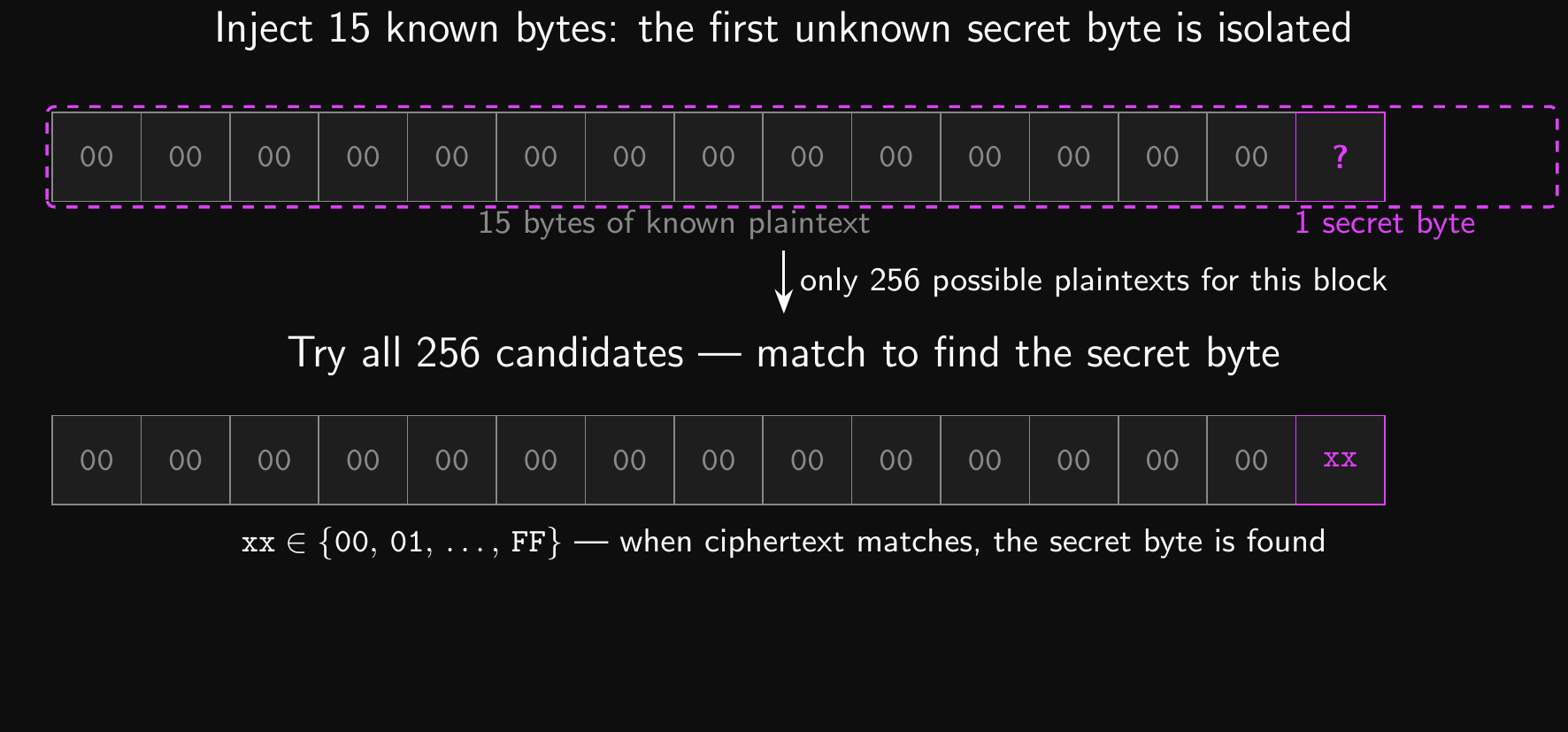
- We can inject 15 bytes of known plaintext at the start!
- The first block now looks like this:
- 00000000 00000000 00000000 000000??
- Only a single byte (the first byte of the secret message) is unknown!
- So the ciphertext for our new block…
- …only has 256 corresponding plaintexts
- That’s a huge improvement for our chances!
Encryption Oracle: Isolating One Byte
Encryption Oracle Attack: Recovering the Block
- Hold on a second! We still don’t have the key.
- How are we supposed to brute force those 256 possibilities?
- Easy! We’ve basically got an encryption oracle we can exploit.
- Keep the ciphertext we got for our block on the last slide in mind
- Let’s inject 16 bytes (a full block) instead of 15 this time…
- Try it 256 times, once for each possible plaintext byte:
- 00000000 00000000 00000000 00000000
- 00000000 00000000 00000000 00000001
- …and so on, all the way to…
- 00000000 00000000 00000000 000000FF
- When the ciphertext matches the one we got on the last slide…
- We’ve cracked the first byte of the secret message!
Encryption Oracle Attack: The Full Attack
- From here, it’s easy!
- How do we get the second character? We now know the first one, remember!
- Inject 14 bytes + 1 cracked byte (15 total), isolating the second byte
- Cycle through 256 possibilities and find a match
- And so on! Shorten the prefix, crack one byte at a time
- After 16 bytes, target the second block. Always isolate a single unknown byte.
- Quick, easy and incredibly dangerous!
- This is a textbook chosen-plaintext attack
- The adversary chooses plaintexts, observes ciphertexts, and exploits ECB’s determinism
- This is exactly what IND-CPA security is designed to prevent
- Only feasible under certain conditions
Predictable IVs
- If we can predict ahead of time what IV is going to be used to encrypt a message, we can exploit it!
- How might this happen?
- Using an all-zero IV
- Using the same IV for a user all the time
- Using the last ciphertext block from the previous message as the IV (BEAST attack on TLS 1.0)
- Using a misconfigured or low-quality RNG.
- If we’ve already intercepted an IV and ciphertext…
- We can potentially crack it!
- Let’s assume that we can send messages to the server…
- …knowing that they’ll be encrypted with the same key…
- …and knowing that we can predict the IV
Predictable IVs: The Attack
- First, let’s guess what the intercepted ciphertext block’s plaintext might be
- Let’s call the guess \(G\)
- We predict the IV that will be used for us, and ask the server to encrypt:
- \(M = IV_\text{ours} \oplus IV_\text{theirs} \oplus G\)
- The server, using CBC, will try to encrypt:
- \(IV_\text{ours} \oplus M\)
- \(= IV_\text{ours} \oplus (IV_\text{ours} \oplus IV_\text{theirs} \oplus G)\)
- \(= (IV_\text{ours} \oplus IV_\text{ours}) \oplus IV_\text{theirs} \oplus G\)
- \(= IV_\text{theirs} \oplus G\)
- If the server’s output matches the intercepted ciphertext, our guess \(G\) was right!
- With structured plaintexts (HTTP, HTML, JSON), guessing is easier than random chance
- Predictable IVs effectively make CBC deterministic, breaking IND-CPA security
Key-as-IV
- Using the key as the IV is really tempting…
- It’s right there and saves us some effort!
- We don’t even have to bother generating, storing or sending the IV.
- Sounds too good to be true…
- Because it is too good to be true!
- A chosen ciphertext attack can recover the key.
- The key is meant to be secret.
- The IV is not meant to be secret, just unpredictable.
- Mixing up secret and non-secret data can have dire consequences!
- Sometimes it’s okay to use secrets where they’re not required…
- …but not as a general rule. Always pay attention to the context!
Chosen Ciphertext Attack on Key-as-IV
- In a chosen-ciphertext attack (CCA), we get to choose ciphertexts and view their corresponding plaintexts.
- Alice and Bob have, in their infinite wisdom, chosen to use the key as the IV in CBC.
- Alice encrypts her message \((P_1, P_2, P_3)\) with the key and sends the ciphertext to Bob.
- Alice and Bob don’t have to transmit the IV
- It’s the key, they know it already!
- Alice sends the encrypted blocks \((C_1, C_2, C_3)\)
- Mallory is feeling chaotic, so they intercept the ciphertext and modify it!
- Mallory also happens to have access to Bob’s decryption software
- Mallory can view plaintexts for chosen ciphertexts
- Mallory asks for the decryption of \((C_1, Z, C_1)\)
- \(Z\) is a block of null bytes (all zero in binary)
Key-as-IV: Recovering the Key
- We’ll use \(P\) for Alice’s original plaintext and \(P'\) for Mallory’s fake plaintext
- \(P'_1 = D(k, C_1) \oplus IV = D(k, C_1) \oplus k = P_1\)
- \(P'_2 = D(k, Z) \oplus C_1 = R\) for some \(R \in \mathcal{X}\)
- \(P'_3 = D(k, C_1) \oplus Z = P_1 \oplus IV = P_1 \oplus k\)
- Mallory receives the decryption \((P'_1, P'_2, P'_3)\) and computes \(P'_1 \oplus P'_3\):
- \(P'_1 \oplus P'_3 = P_1 \oplus P_1 \oplus k = k\)
- The key falls directly out of a simple XOR!
- CBC with the key as the IV is not semantically secure under CCA
- Even worse, it’s susceptible to full key recovery!
- This goes beyond IND-CPA; we’ll formalise CCA security later in the module
Conclusion
What did we learn?
So, what did we learn?
- A block cipher \(E : \mathcal{K} \times \mathcal{X} \to \mathcal{X}\) is a keyed permutation
- Security: \(E(k, \cdot)\) is computationally indistinguishable from a random permutation
- No deterministic cipher can be IND-CPA secure; modes of operation are required
- ECB is broken: identical plaintext blocks always produce identical ciphertext blocks
- CBC (unpredictable random IV) and CTR (unique nonce) are IND-CPA secure
- Block ciphers are built from iterated round ciphers and key schedules (Feistel networks, SPNs)
- DES is broken: 56-bit key, 64-bit block; use AES-128 or AES-256
- 64-bit block ciphers cannot be secure PRFs due to the birthday bound
- AES-256 provides quantum-safe symmetric encryption
- Harvest-now, decrypt-later is a real and present threat
- Misusing modes (predictable IVs, key-as-IV) breaks IND-CPA security or enables key recovery
Where do we go from here?
- We’ve covered a massive amount of content so far!
- Started with classical cryptography
- Covered stream ciphers
- Covered block ciphers
- Ready to do real-world (post-quantum) symmetric encryption
- What problems do we still need to solve?
- How can we achieve message integrity?
- Can we sign a piece of data to show that it’s authentic?
- How can we share a symmetric key over an insecure channel?
- Can we derive keys from passwords?
- Can we encrypt and decrypt with different keys?
For next time…
- If you can explain the material, then you understand it
- Bloom’s taxonomy is a good guide for learning and exam prep
- Remember, Understand, Apply, Analyze, Evaluate, and Create
- Recommended reading to consolidate symmetric cryptography:
- Chapter 6 of Crypto 101
- Chapter 4 of A Graduate Course in Applied Cryptography, sections 4.1 and 4.2
- Proofs are for understanding, not for rote learning
Questions?
Ask now, catch me after class, or email eoin@eoin.ai