ISE Cryptography — Lecture 02
Stream Ciphers
The story so far…
- Classical cryptography!
- Don’t use it in the modern world, though.
- Cryptanalysis!
- Cracking classical ciphers (and appreciating awful alliteration).
- Perfect security!
- Awesome, but about as useful as a chocolate teapot.
- Semantic security!
- Less-than-perfect, but practical.
- Today’s themes: using short keys, proving security, and variable-length messages
- All of this (and more) as we look at stream ciphers…
Fix the One-Time Pad?
Starting the day with some déjà vu
The One-Time Pad
Everyone remember the one-time pad from last time?
What does it use as…
- The encryption function?
- The decryption function?
- The key?
What constraints apply when using it?
Is it…
- Perfectly secure?
- Semantically secure?
- IND-CPA secure? (a term we’ll define later)
- Secure against message recovery attacks?
Why can’t we just use it for everything and skip the rest of cryptography?
One-Time Pad: Encryption
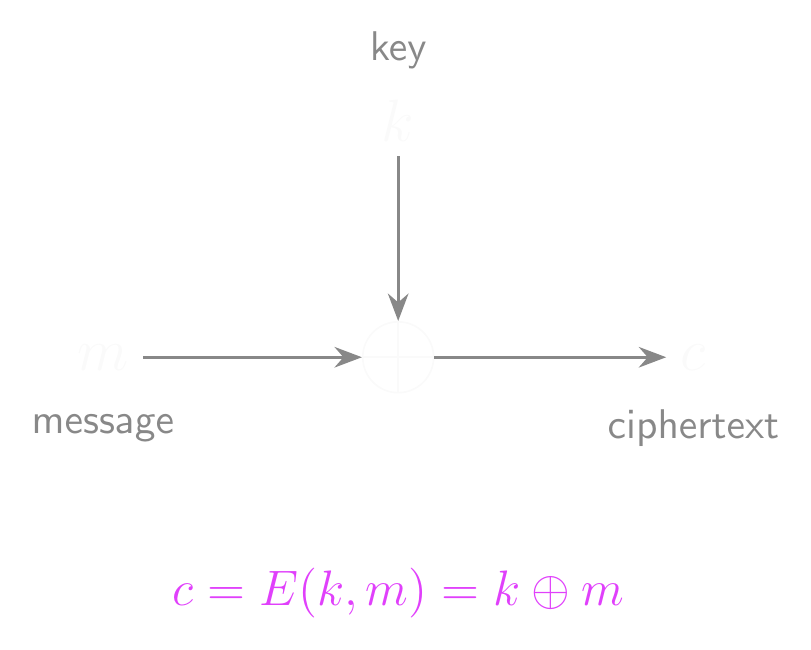
The Key Problem
- Needing a key as long as the message makes the one-time pad almost useless.
- How can we share it securely?
- And it’s only good for a single message!
- The USSR (Venona) and Microsoft (PPTP) both fell victim to that particular issue!
- We need a way to use a short, fixed-length key to encrypt/decrypt
- But we can’t do this with the one-time pad!
- Why can’t we just repeat the short key end-to-end for long messages?
- If an attacker can predict parts of the key…
- They can break semantic security!
- How did you generate keys for last week’s lab/tutorial?
- Probably with Python’s
secretsmodule, right? - So we can generate them, but we’d still have to share them…
- Probably with Python’s
The Integrity Problem
- A passive attacker can’t read messages encrypted with a one-time pad…
- But an active attacker can cause a lot of trouble.
- The one-time pad is malleable
- You have no way of verifying whether the message you’ve decrypted is the one that was sent! It could have been…
- Modified in transit
- Stored and replayed later
- Cut into chunks and selectively reassembled
- Also vulnerable to bit-flipping attacks
- Flipping a bit in the ciphertext flips that same bit in the plaintext
- An attacker can make predictable changes to the plaintext…
- Even if they can’t read it!
- Extremely dangerous if the format of the message is known
Solutions
- We’re going to leave the integrity/malleability problem alone for now.
- We’ll circle back and address it fully later on!
- Let’s focus on the key problem.
- Ideally, we want to work with short, manageable keys.
- But we also want to be able to encrypt very long messages.
- We’ve got two broad paths we could go down:
- Chop long messages into smaller chunks
- Stretch short keys into longer keys
- Both of these are viable options!
- Block ciphers encrypt fixed-length blocks of data
- Stream ciphers produce a keystream from a short key
- These definitions look pretty clear right now…
- …but they’ll blur later: we can also use block ciphers to produce a keystream!
Stream Ciphers
“Anyone who considers arithmetical methods of producing random digits is, of course, in a state of sin.” – John von Neumann
And now for something completely different…
- You might have heard of a little-known indie game about mining and crafting.
- Minecraft worlds are absolutely gigantic
- 60,000,000 by 60,000,000 blocks
- Procedurally generated terrain and other features
- How much data is needed to generate an entire world?
- Just the seed
- Either a 64-bit integer or text converted to a 32-bit integer
- Even a small change in the seed can create radically different terrain!
- Random, but also not random
- It looks and feels random, but it’s completely deterministic
- An identical seed will always generate the same world
- It’s pseudorandom
Pseudo-Random Generators
- A pseudo-random generator (PRG) is an efficient, deterministic algorithm \(G\)
- Also abbreviated as PRNG - pseudo-random number generator
- Input: a seed \(s\) from a finite seed space \(\mathcal{S}\)
- Output: a value \(r\) from a finite output space \(\mathcal{R}\)
- \(G : \mathcal{S} \to \mathcal{R}\)
- Typically, \(\mathcal{S}\) and \(\mathcal{R}\) are sets of fixed-length bitstrings
- Seed lengths are typically much shorter than output lengths
- Note that a PRG has to be efficient!
- Where has that term come up before?
- And a PRG has to be deterministic.
- Each input maps to a fixed output - it’s not random!
- Intuitively, even though the function is deterministic…
- …the output should seem to be random!
True RNGs
- A random number generator that’s actually random?
- This is actually harder than you’d think!
- Classical computers aren’t good at randomness
- Instead, we pull from a physical source of randomness
- Any suggestions for random physical processes?
- Onboard hardware, e.g. device drivers, disk activity, network traffic
- Often the seed source used for
/dev/random
- Often the seed source used for
- Quantum mechanics, e.g. radioactive decay, shot noise or qubits
- Thermal processes, e.g. Nyquist noise
- Oscillator drift, timing events, lava lamps…
The Obligatory Lavarand Photo

Cloudflare’s wall of lava lamps at 101 Townsend Street, San Francisco. Photo: HaeB, CC BY-SA 4.0
- Cloudflare uses a wall of 100 lava lamps as an entropy source
- A camera captures images of the lamps continuously
- The chaotic, unpredictable flow of wax generates random data
- Fed into their secure PRG to seed cryptographic keys
- Why lava lamps? They’re a physical process that’s genuinely unpredictable
- Tiny variations in heat, air currents, and wax composition
- No two frames are ever the same
- Other companies use different approaches
- Random.org uses atmospheric noise
- Some use radioactive decay or quantum processes
Building a Stream Cipher
- How does this help us turn the one-time pad into a more practical cipher?
- Let’s encrypt messages up to some maximum length \(L\)
- How long does the key need to be if we use the original one-time pad?
- Let’s pick a short seed value \(s\) with length \(\ell < L\)
- Assume that we have a PRG \(G\) that maps from \(\mathcal{S}\) to \(\mathcal{R}\)
- \(\mathcal{S} = \{0,1\}^\ell\) and \(\mathcal{R} = \{0,1\}^L\)
- What if we replace the key with a pseudo-random number from \(G\)?
- Key idea: if \(G(s)\) is indistinguishable from a truly random key, the cipher should be indistinguishable from the one-time pad!
- Our stream cipher is defined as:
- \(E(s, m) = G(s) \oplus m\)
- \(D(s, c) = G(s) \oplus c\)
Is This Cipher Secure?
- Does the correctness property hold? Why (or why not)?
- Is it possible for this cipher to be perfectly secure?
- No: \(|\mathcal{S}| < |\mathcal{R}|\), so Shannon’s theorem rules it out
- Is it possible for this cipher to be semantically secure?
Stream Cipher: Encryption
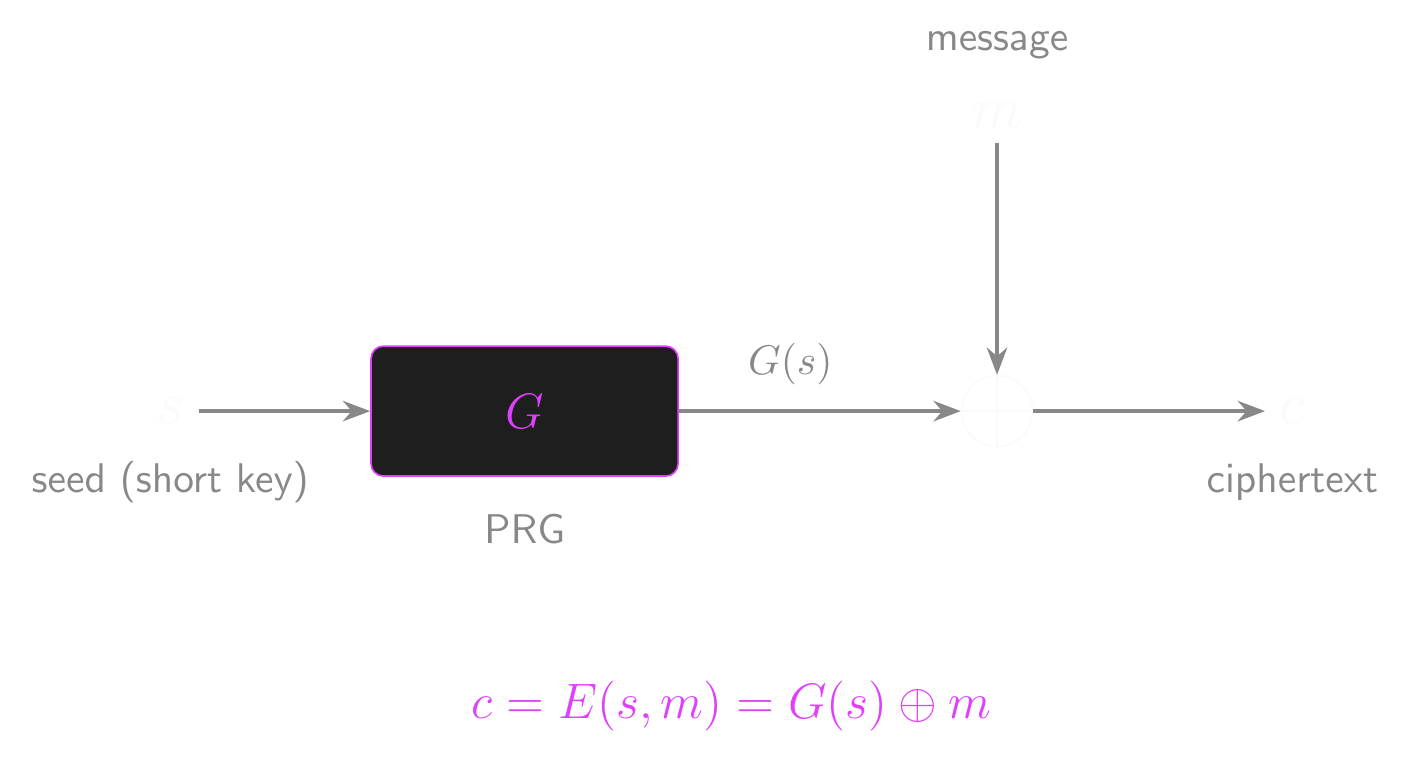
A Toy Example
Let’s make this concrete with a tiny (insecure!) PRG
Suppose \(G : \{0,1\}^4 \to \{0,1\}^8\) and our seed is \(s = 1011\)
The PRG stretches the seed: \(G(s) = G(1011) = 10110011\)
We want to encrypt the message \(m = 01001110\)
Encrypt: \(c = G(s) \oplus m = 10110011 \oplus 01001110 = 11111101\)
Decrypt: \(m = G(s) \oplus c = 10110011 \oplus 11111101 = 01001110\) ✓
The seed is 4 bits but we encrypted an 8-bit message!
- That’s the whole point: short key, long ciphertext
Of course, 4-bit seeds are trivially brute-forced
- We’ll need to talk about how big is big enough
Secure PRGs
- Think about this from the attacker’s point of view…
- The security of the cipher hinges on the properties of the PRG
- Can we distinguish between the PRG’s output and true random values?
- Maybe! It dependsTM on the PRG we’re using.
- If we can’t tell the difference between \(G(s)\) and a truly random \(k\)…
- With better accuracy than random guessing…
- Then the one-time pad and our stream cipher can’t be distinguished…
- So our stream cipher must be secure!
- What’s the catch?
- This is semantic security, not perfect security!
- And it only holds if the PRG is actually secure
- How do we formalise what “secure PRG” means?
PRG Security Intuition
- Let’s get some clear ideas about what makes a secure PRG for cryptography
- Imagine two scenarios:
- Scenario 0: you receive \(G(s)\), where \(s\) is a randomly chosen seed
- Scenario 1: you receive \(r\), a string chosen uniformly at random from \(\mathcal{R}\)
- A secure PRG is one where no efficient adversary can reliably tell which scenario they’re in
- The two distributions look computationally identical
- If that holds, the PRG is secure!
- This might sound pretty familiar…
- Indistinguishable?
- Efficient adversary?
- Let’s build a quick guessing game…
PRG Security: Attack Game
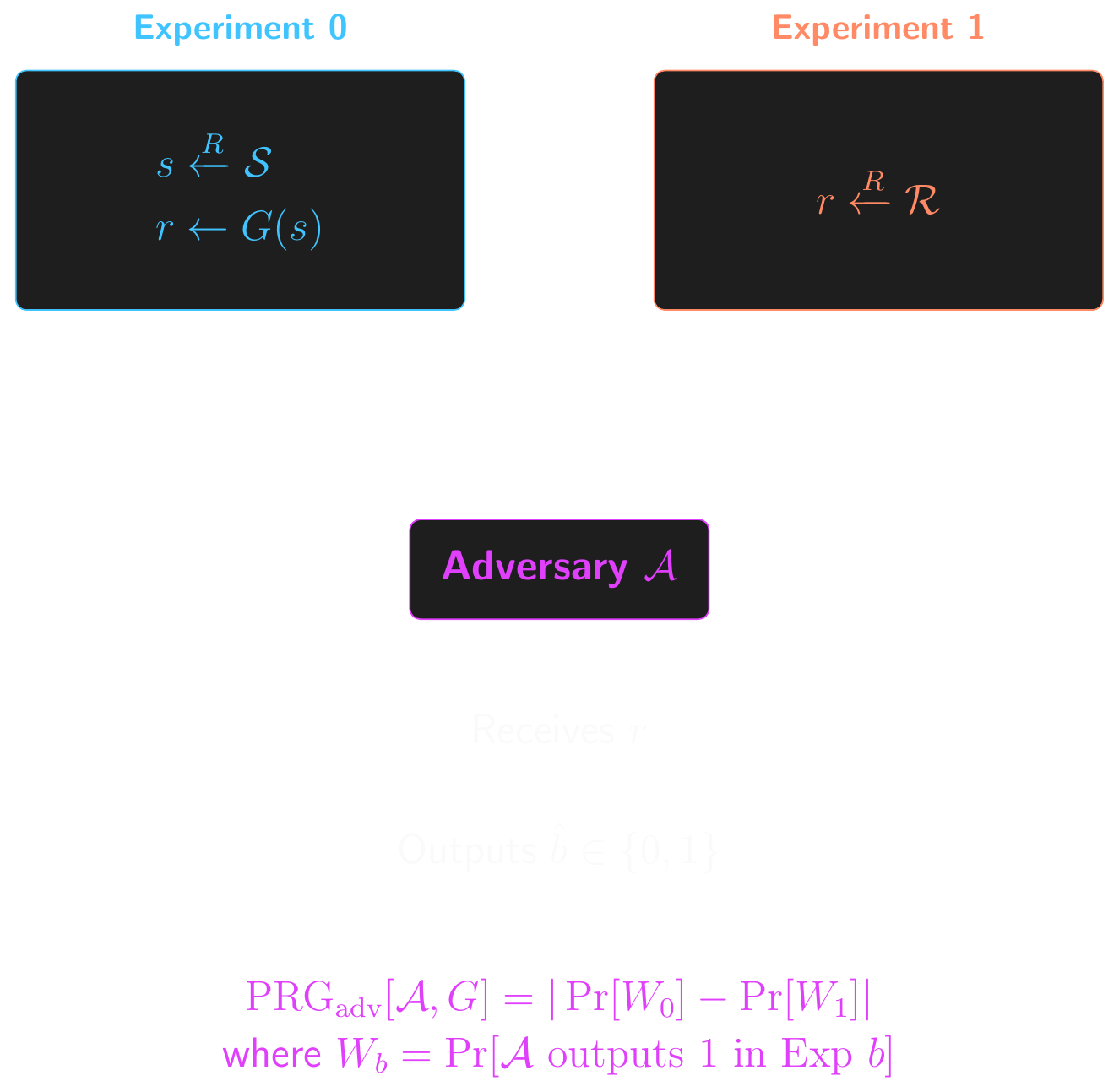
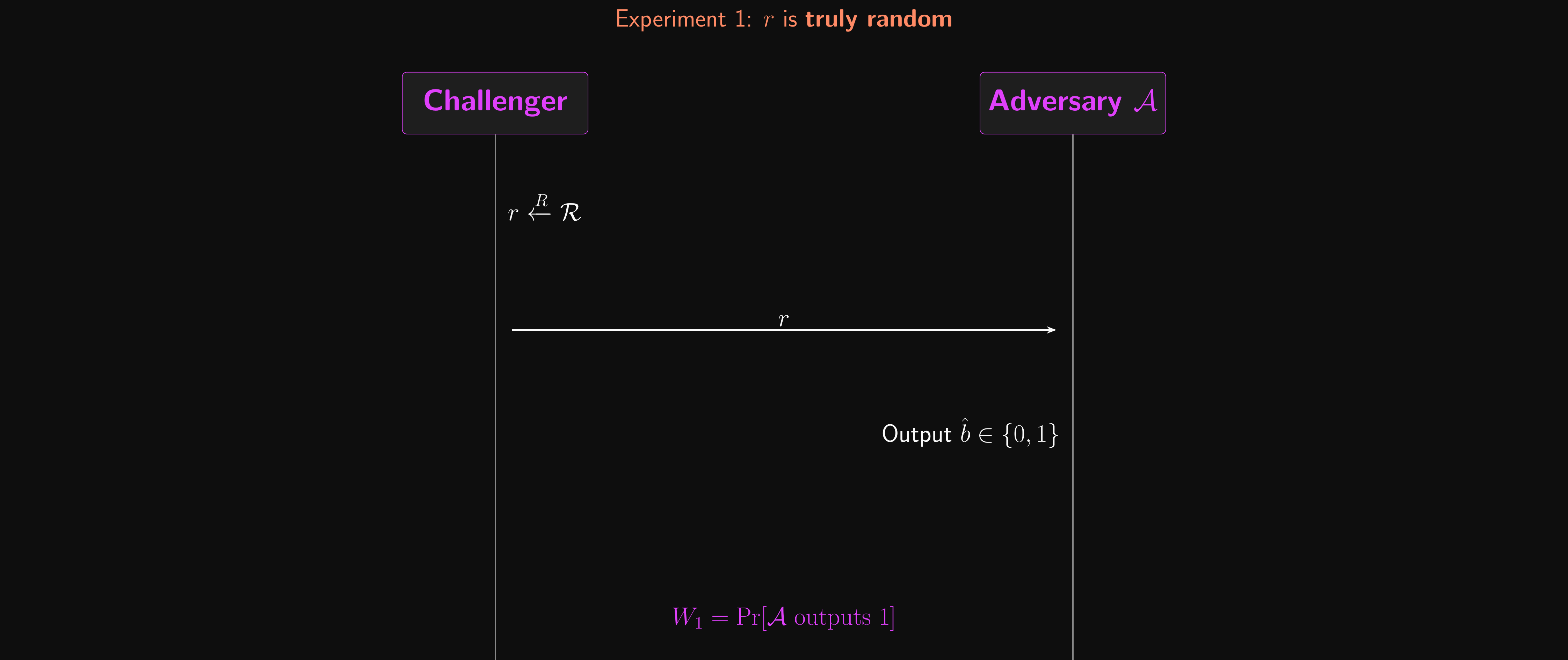
- This time around, our attack game will have two sub-games or experiments
- The adversary \(\mathcal{A}\) doesn’t know which one they’re playing, and has to guess!
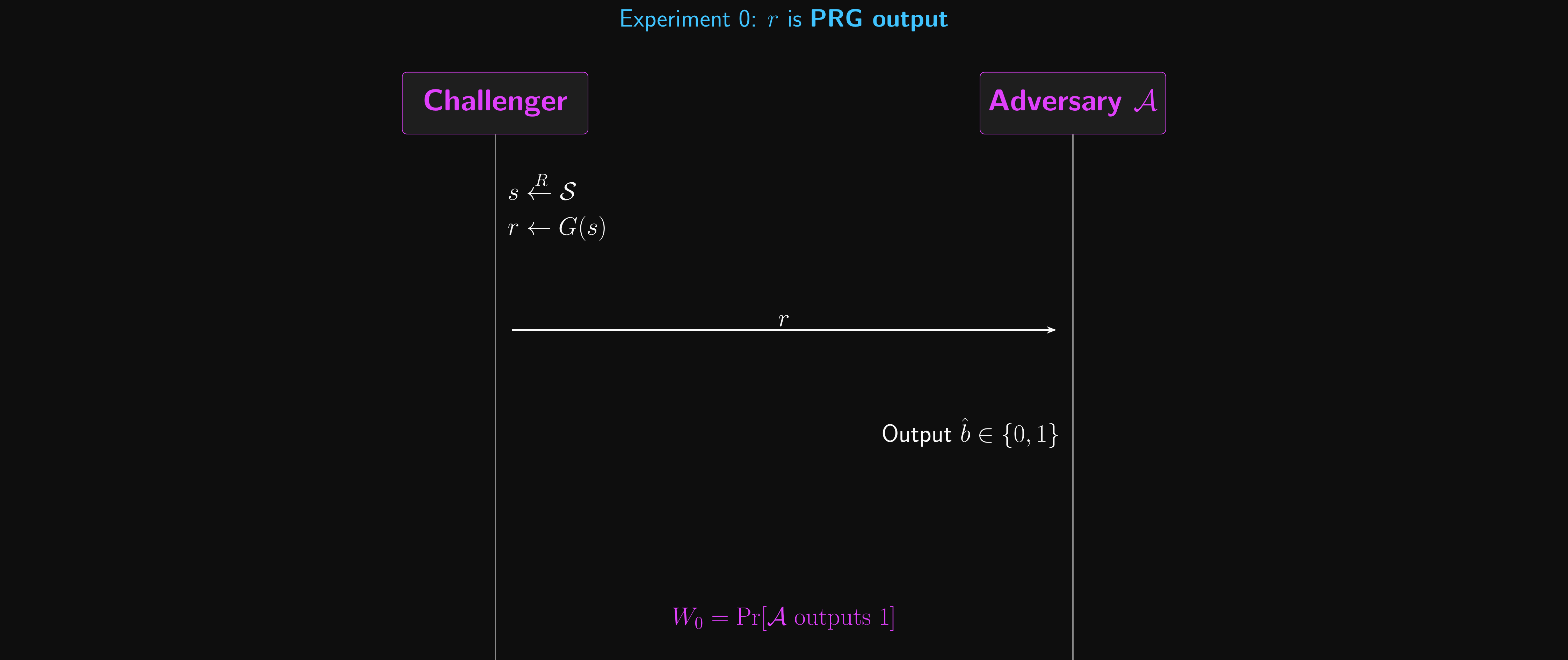
- Experiment 0: the challenger computes…
- \(s \xleftarrow{R} \mathcal{S}\)
- \(r \leftarrow G(s)\)
- Experiment 1: the challenger computes…
- \(r \xleftarrow{R} \mathcal{R}\)
- \(r\) is sent to \(\mathcal{A}\), and \(\mathcal{A}\) outputs its guess: 0 for “this was PRG output”, 1 for “this was truly random”
- Let \(W_b\) be the event that \(\mathcal{A}\) outputs 1 on Experiment \(b\)
- \(\text{PRG}_\text{adv}[\mathcal{A}, G] = |\Pr[W_0] - \Pr[W_1]|\)
- The advantage measures how much better than random guessing (50/50) the adversary can do
- A random guesser has \(\Pr[W_0] = \Pr[W_1]\), so the advantage is 0
- If \(\text{PRG}_\text{adv}[\mathcal{A}, G]\) is negligible for all \(\mathcal{A}\), then \(G\) is a secure PRG
PRG Security: Attack Game
PRG Security: Experiment 0
PRG Security: Experiment 1
How Big is Big Enough?
- There’s one more element needed to make our PRG secure
- Why was it so easy to break the Caesar cipher?
- An adversary can always try to brute-force the seed space
- Try every possible seed \(s \in \mathcal{S}\), compute \(G(s)\), check if it matches
- How long does this take? \(|\mathcal{S}|\) operations (one per seed)
- If \(\ell = 4\): \(|\mathcal{S}| = 2^4 = 16\) seeds. Trivial to brute-force.
- If \(\ell = 40\): \(|\mathcal{S}| = 2^{40} \approx 10^{12}\). A fast computer checks this in minutes.
- If \(\ell = 128\): \(|\mathcal{S}| = 2^{128} \approx 10^{38}\). At a billion guesses per second, this takes \(10^{29}\) seconds. The universe is only \(\approx 4 \times 10^{17}\) seconds old.
- The seed length \(\ell\) controls how hard it is to break the PRG
- This is a really important idea, so we need to formalise it!
The Security Parameter
- The security parameter \(\lambda\) is the single number that controls how secure a system is
- In symmetric crypto, \(\lambda\) is the key or seed length in bits
- In our stream cipher, the seed length \(\ell\) plays the role of \(\lambda\)
- Everything is parameterised by \(\lambda\): key spaces, seed spaces, advantage bounds
- We write \(\{0,1\}^\lambda\) for the seed/key space, giving \(|\mathcal{S}| = 2^\lambda\) possible seeds
- Increasing \(\lambda\) makes life harder for efficient adversaries
- The work to brute-force grows as \(2^\lambda\) (exponential)
- But legitimate operations (encryption, decryption) stay polynomial in \(\lambda\)
- This gap is what makes computational security possible!
- But a computationally unbounded adversary can always brute-force, no matter how large \(\lambda\) is
- \(\lambda = 128\) is the minimum for symmetric crypto today (\(\lambda = 256\) for quantum margin)
- When we say an advantage is “negligible”, we mean negligible as a function of \(\lambda\)
Negligible and Super-Poly
- A function \(f(\lambda)\) is negligible if it shrinks faster than any inverse polynomial in \(\lambda\)
- For every positive integer \(d\), there exists \(\lambda_0\) such that for all \(\lambda > \lambda_0\): \(f(\lambda) < 1/\lambda^d\)
- Intuition: not just small, but vanishingly small. Smaller than \(1/\lambda\), \(1/\lambda^2\), \(1/\lambda^{100}\), …
- Example: \(1/2^\lambda\) is negligible. It beats any \(1/\lambda^d\) once \(\lambda\) is large enough.
- The mirror image: \(Q(\lambda)\) is super-poly if it grows faster than any polynomial in \(\lambda\)
- \(Q\) is super-poly iff \(1/Q\) is negligible
- Otherwise, \(Q\) is poly-bounded
- Example: \(2^\lambda\) is super-poly. No polynomial \(\lambda^d\) can keep up.
- Now we can state security precisely:
- “For all efficient adversaries \(\mathcal{A}\), \(\text{PRG}_\text{adv}[\mathcal{A}, G]\) is negligible in \(\lambda\)”
Concrete Security
- Asymptotic “negligible” guarantees security scales correctly with \(\lambda\)
- But we deploy at a fixed \(\lambda\), so we also need concrete bounds
- \(b\)-bit security: the best known attack needs \(\approx 2^b\) operations
- For key search, \(T\) trials give advantage \(\approx T / 2^b\)
- Calibrating the scale (advantage shown for a 128-bit key at each attack budget \(T\)):
- \(T = 2^{56}\): cracked on dedicated hardware in hours (DES, 1998); advantage \(2^{-72}\)
- \(T = 2^{64}\): feasible on modern hardware; advantage \(2^{-64}\)
- \(T = 2^{80}\): within reach for well-funded adversaries; advantage \(2^{-48}\)
- \(T = 2^{128}\): advantage \(= 1\) (full break), but this is beyond any foreseeable classical computer
- 128 bits is the minimum acceptable security level for new systems
- This is the concrete reality behind “negligible” at \(\lambda = 128\)
- Some constructions lose security bits to structural bounds (e.g. birthday attacks)
Seed Space
- The seed space is \(\mathcal{S} = \{0,1\}^\lambda\), so \(|\mathcal{S}| = 2^\lambda\)
- \(2^\lambda\) is super-poly in \(\lambda\), so the brute-force probability \(1/2^\lambda\) is negligible
- A PRG can only be secure if the seed space is super-poly
- Otherwise, an efficient adversary can just enumerate it!
- Given a large enough security parameter \(\lambda\), our PRG is secure!
- All the security definitions we’ve seen work the same way:
- \(\text{SS}_\text{adv}\), \(\text{PRG}_\text{adv}\), and later \(\text{BC}_\text{adv}\), … all must be negligible in \(\lambda\)
Proving Security
Prove it or it didn’t happen.
Why This Stream Cipher Is Secure
- Our stream cipher \(\mathcal{E}\) is defined as:
- \(E(s, m) = G(s) \oplus m\)
- \(D(s, c) = G(s) \oplus c\)
- What’s the only difference between the two?
- Stream cipher uses a PRG to generate the key
- One-time pad uses a truly random key
- Secure PRG output is indistinguishable from a random bitstring
- An adversary can only do negligibly better than random guessing
- No useful information about the seed is leaked from the keystream
- To have any non-negligible chance at distinguishing ciphertexts…
- …an adversary has to exploit some pattern in the PRG output!
Security Depends on the PRG
- The security of a stream cipher is based on \(\text{PRG}_\text{adv}[\mathcal{A}, G]\)
- If \(\text{PRG}_\text{adv}[\mathcal{A}, G]\) is negligible, then \(\text{SS}_\text{adv}[\mathcal{B}, \mathcal{E}]\) is negligible
- But why is this true? Let’s prove it!
Theorems and Lemmas
- Before we dive in, let’s define some terms you’ll see in the textbook
- A theorem is a statement that has been proven to be true
- “If the PRG is secure, the stream cipher is semantically secure” is a theorem!
- It has a specific structure: “if [assumptions], then conclusion”
- A lemma is a smaller result that helps prove a bigger theorem
- Think of it as a stepping stone: useful on its own, but mainly there to make the main proof easier
- We’ll prove lemmas and then use them as building blocks
- A proof shows why a theorem is true, not just that it is
- In cryptography, most proofs are constructive: we build something (an adversary, a simulator) to demonstrate the claim
- You won’t need to memorise proofs for the exam
- But understanding the technique behind each proof is important: these patterns recur throughout cryptography
Stream Cipher Security Theorem
Theorem: Let \(G\) be a secure PRG. Then the stream cipher \(\mathcal{E}\) built from \(G\) is semantically secure.
More precisely: for every efficient SS adversary \(\mathcal{A}\) attacking \(\mathcal{E}\), there exists an efficient PRG adversary \(\mathcal{B}\) attacking \(G\) such that:
- \(\text{SS}_\text{adv}[\mathcal{A}, \mathcal{E}] \leq \text{PRG}_\text{adv}[\mathcal{B}, G]\)
In words: anyone who can break the stream cipher can also break the PRG
- PRG is secure (by assumption), so the stream cipher must be too
How do we prove this? We need a new technique…
Proof by Reduction
- Our first proof technique: the reduction
- The claim: if the PRG \(G\) is secure, then the stream cipher \(\mathcal{E}\) built from \(G\) is semantically secure
- How do we prove this? By showing:
- “If you could break the stream cipher, you could use that ability to break the PRG”
- But we assumed the PRG is secure (nobody can break it!)
- So nobody can break the stream cipher either
- This is proof by contradiction, with a twist:
- We don’t just say “assume it’s broken”
- We build a specific adversary \(\mathcal{B}\) that uses the stream cipher attacker \(\mathcal{A}\) as a subroutine
- \(\mathcal{B}\) translates \(\mathcal{A}\)’s ability to break \(\mathcal{E}\) into an ability to break \(G\)
The Reduction
- Adversary \(\mathcal{B}\) plays the PRG game: receives a challenge string \(r\)
- \(r\) is either \(G(s)\) for a random seed \(s\), or a truly random string
- \(\mathcal{B}\) doesn’t know which!
- \(\mathcal{B}\) uses \(r\) to run an SS game against \(\mathcal{A}\):
- \(\mathcal{A}\) submits two messages \(m_0, m_1\)
- \(\mathcal{B}\) flips a coin \(b \xleftarrow{R} \{0, 1\}\) and computes \(c \leftarrow r \oplus m_b\)
- \(\mathcal{B}\) sends \(c\) to \(\mathcal{A}\), who outputs a guess \(\hat{b}\)
- \(\mathcal{B}\) outputs 1 (“it was a PRG”) if \(\hat{b} = b\), else 0 (“it was random”)
The Reduction: Two Worlds
- If \(r = G(s)\): \(\mathcal{A}\) sees a real stream cipher ciphertext and wins with its usual advantage
- If \(r\) is truly random: \(\mathcal{A}\) sees a one-time pad ciphertext, and its advantage is 0!
- (Recall from L01: the OTP is perfectly secure, so no information about the message is leaked)
- \(\mathcal{B}\) outputs 1 when \(\mathcal{A}\) guesses correctly (\(\hat{b} = b\))
- In Exp 0 (PRG): \(\mathcal{A}\) is playing a real SS game, so \(\Pr[\mathcal{B} \text{ outputs } 1] = \frac{1}{2} + \text{SS}_\text{adv}[\mathcal{A}, \mathcal{E}]\)
- In Exp 1 (random): \(\mathcal{A}\) is playing against a one-time pad, so \(\Pr[\mathcal{B} \text{ outputs } 1] = \frac{1}{2}\)
- The gap between these two probabilities is exactly \(\text{SS}_\text{adv}[\mathcal{A}, \mathcal{E}]\)
- Therefore: \(\text{PRG}_\text{adv}[\mathcal{B}, G] \geq \text{SS}_\text{adv}[\mathcal{A}, \mathcal{E}]\)
- If the left side is negligible (PRG is secure), the right side must be too
The Reduction: Diagram
What Just Happened?
- We proved stream cipher security without knowing anything about how \(G\) works
- We only used the fact that \(G\) is a secure PRG
- This is the power of reductions: they let us build on existing guarantees
- The key trick: replacing \(G(s)\) with a truly random string turns the stream cipher into a one-time pad
- Real world (PRG output): adversary has some advantage \(\epsilon\)
- Ideal world (truly random): adversary has advantage 0 (perfect security!)
- The gap between the two worlds is exactly the PRG advantage
- This “real world vs ideal world” pattern shows up in nearly every security proof in this course
- The real-vs-ideal trick isn’t just for encryption
- We’ll use it for a completely different problem at the end of this lecture
Ghosts of Problems Past
- While we’re here, let’s fix the length problem too!
- We can encrypt arbitrary-length messages shorter than the keystream.
- \(E(s, m) = G(s)[0 \ldots |m| - 1] \oplus m\)
- \(D(s, c) = G(s)[0 \ldots |c| - 1] \oplus c\)
- Have we solved the key length problem?
- Yes!
- Have we solved the malleability/integrity problem?
- No!
- But we’ll get back to that one… eventually.
- Key reuse was a big problem for the one-time pad
- Does our stream cipher allow for key reuse?
- Try it out and see! Hint: what happens when you XOR two ciphertexts encrypted with the same key?
- We’ll see some possible solutions to this later
The Many-Time Pad (Again)
- Remember the many-time pad from L01? The same problem applies here
- Reusing key \(s\) means \(G(s)\) cancels: \(E(s, m_0) \oplus E(s, m_1) = m_0 \oplus m_1\)
- An attacker recovers the XOR of the plaintexts, enough for crib-dragging attacks
- Our stream cipher inherits this vulnerability directly from the OTP
- Real-world examples of this exact mistake:
- Project Venona: the USSR reused one-time pad pages; US/UK intelligence exploited this for decades
- Microsoft PPTP: reused RC4 keystreams, allowing practical plaintext recovery
- Key reuse (or nonce reuse) is catastrophic, we’ll need a way to safely encrypt multiple messages with the same key
PRGs all the way down…
Making generators from generators.
Building PRGs from PRGs
- Our PRG \(G\) maps \(\{0,1\}^\lambda \to \{0,1\}^L\), producing \(L\) bits of keystream
- But what if our message is longer than \(L\) bits?
- Do we need to design a completely new PRG with a bigger output?
- We can build larger PRGs from existing ones!
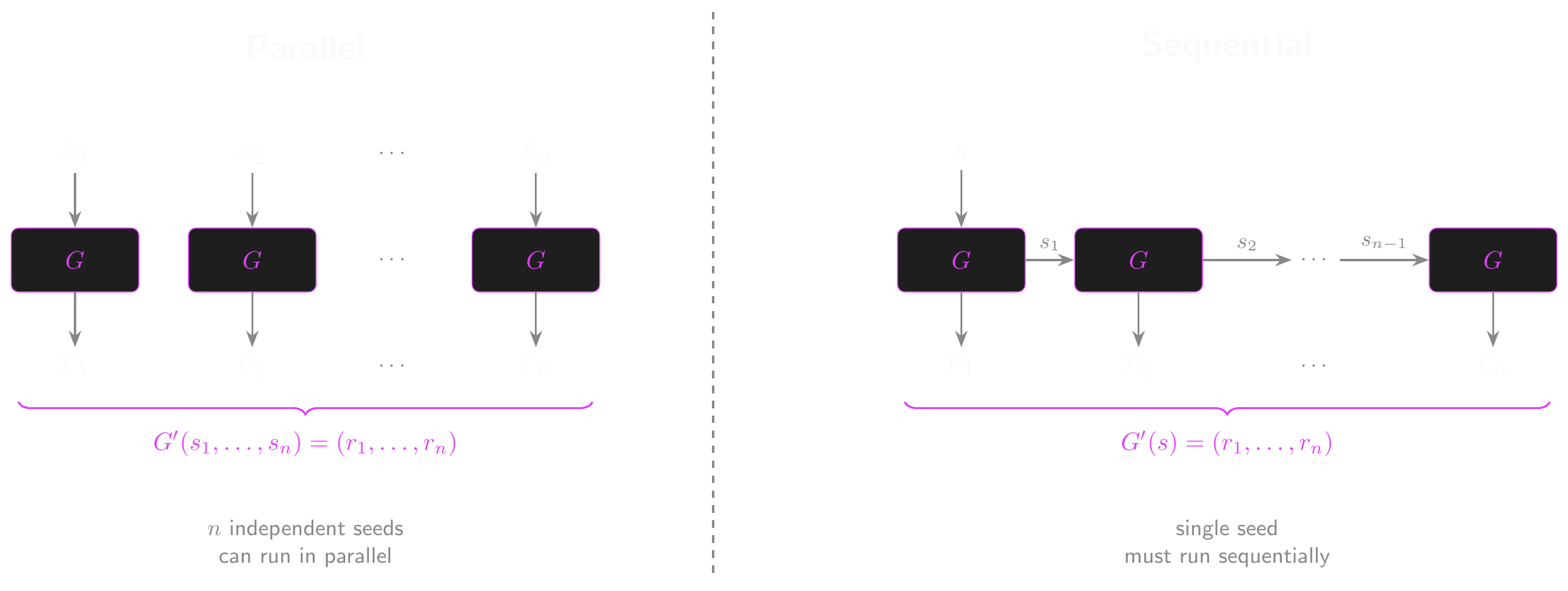
- Two approaches: parallel and sequential composition
- Both produce \(n \times L\) bits of output from a PRG that only outputs \(L\) bits
- But they have very different tradeoffs
- And we have to be careful not to compromise the security of the PRG!
Parallel Construction
- One technique is \(n\)-wise parallel composition
- We take \(n\) independent seeds…
- Generate the output from each seed…
- And concatenate the results into one long output
- The new PRG, \(G'\), is defined over \((\mathcal{S}^n, \mathcal{R}^n)\)
- \(G'(s_1, \ldots, s_n) = (G(s_1), \ldots, G(s_n))\) for \((s_1, \ldots, s_n) \in \mathcal{S}^n\)
- The repetition parameter, \(n\), must be poly-bounded
- Is it secure? Can an adversary distinguish it from truly random output?
- Intuitively, an adversary has better odds the more we use the PRG
- \(\text{PRG}_\text{adv}[\mathcal{A}, G'] \leq n \cdot \text{PRG}_\text{adv}[\mathcal{B}, G]\)
- Security degrades linearly as the repetition parameter increases
Parallel Construction: Seed Size
- Note the seed is now \(n\) times as long: \((s_1, \ldots, s_n) \in \mathcal{S}^n\)
- We need \(n \times \lambda\) bits of seed to get \(n \times L\) bits of output
- The expansion rate barely improves! Can we do better? (Yes, but first…)
- Easy to parallelise: each \(G(s_i)\) is independent, so all \(n\) can be computed simultaneously
- But why does the security bound hold? Let’s prove it!
Proving the Parallel Bound
- We claimed \(\text{PRG}_\text{adv}[\mathcal{A}, G'] \leq n \cdot \text{PRG}_\text{adv}[\mathcal{B}, G]\). But why?
- We can’t directly use a reduction to a single PRG instance (there are \(n\) of them!)
- Instead, we use a hybrid argument: build a chain of intermediate distributions
- Each adjacent pair in the chain differs in exactly one slot
- If an adversary can tell the endpoints apart, they must be able to tell some adjacent pair apart
- And telling an adjacent pair apart is the same as breaking a single PRG instance!
The Hybrid Chain
- Define \(n + 1\) hybrid distributions:
- \(H_0\): \((G(s_1), G(s_2), \ldots, G(s_n))\) – all real PRG outputs
- \(H_1\): \((r_1, G(s_2), \ldots, G(s_n))\) – first slot replaced with random
- \(H_2\): \((r_1, r_2, G(s_3), \ldots, G(s_n))\) – first two slots random
- \(\quad\vdots\)
- \(H_n\): \((r_1, r_2, \ldots, r_n)\) – all truly random
- The adversary needs to distinguish \(H_0\) (all PRG) from \(H_n\) (all random)
- But \(H_0\) and \(H_n\) are connected by a chain of \(n\) small steps
- Each step changes exactly one slot from PRG output to truly random
Hybrid Chain: A Concrete Example
Let’s try this with \(n = 2\) and tiny 4-bit outputs
\(H_0 = (G(s_1),\; G(s_2)) = (1011,\; 0110)\) – both from the PRG
\(H_1 = (r_1,\; G(s_2))\;\, = (1100,\; 0110)\) – first slot replaced with random
\(H_2 = (r_1,\; r_2)\;\;\;\;\;\, = (1100,\; 0011)\) – both truly random
Can you tell \(H_0\) from \(H_2\)?
If not, you shouldn’t be able to spot any single step either
- Each adjacent pair differs in only one slot
- And we’ve already shown that’s a PRG game!
Each Step is a PRG Game
- Suppose an adversary can distinguish \(H_i\) from \(H_{i+1}\)
- These differ in only one slot: slot \(i + 1\) is \(G(s_{i+1})\) in \(H_i\) and random \(r_{i+1}\) in \(H_{i+1}\)
- We can use this to break \(G\) itself:
- Receive challenge \(r\) from the PRG game (either \(G(s)\) or truly random)
- Fill in slots \(1, \ldots, i\) with fresh random values
- Put the challenge \(r\) in slot \(i + 1\)
- Fill in slots \(i+2, \ldots, n\) with fresh PRG outputs
- If \(r = G(s)\): this looks like \(H_i\). If \(r\) is random: this looks like \(H_{i+1}\).
Completing the Proof
- But we assumed \(G\) is a secure PRG!
- No efficient adversary can distinguish \(G(s)\) from random
- So no efficient adversary can distinguish \(H_i\) from \(H_{i+1}\) for any \(i\)
- And if they can’t spot any single step, they can’t spot the overall change from \(H_0\) to \(H_n\)
- The total advantage is at most the sum of the \(n\) individual advantages
- Each individual step has advantage \(\leq \text{PRG}_\text{adv}[\mathcal{B}, G]\)
- So the total is \(\leq n \cdot \text{PRG}_\text{adv}[\mathcal{B}, G]\)
- This is why \(n\) must be poly-bounded! If \(n\) were super-poly, \(n \cdot \epsilon\) could stop being negligible
The Hybrid Argument
- The hybrid argument is one of the most common proof techniques in cryptography
- Recipe for showing two distributions are indistinguishable:
- Build a chain of hybrids from one distribution to the other
- Make each adjacent pair differ in exactly one “atomic” step
- Show that each atomic step reduces to a known hard problem
- The total advantage is at most the sum of all the individual step advantages
- Think of it like a game of “spot the difference”:
- Comparing two photos that differ in 10 places at once is hard
- But if you had 11 photos, each differing from the next in only one place, you could check each pair
- If nobody can spot any single change, nobody can spot the overall difference
- We’ll use this technique again when we look at block cipher modes and IND-CPA security
Sequential Construction
- The Blum-Micali method (1984, a foundational result in provable pseudorandomness) allows us to chain PRGs sequentially.
- This time, take \(G\) to be a secure PRG defined over \((\mathcal{S}, \mathcal{R} \times \mathcal{S})\)
- Outputs a seed in addition to the usual output!
- The new PRG, \(G'\), is defined over \((\mathcal{S}, \mathcal{R}^n)\)
- \(G'(s)\):
- \(s_0 \leftarrow s\)
- \(\textbf{for } i = 1 \textbf{ to } n \textbf{ do: } (r_i, s_i) \leftarrow G(s_{i-1})\)
- \(\textbf{return } (r_1, \ldots, r_n)\)
Sequential Construction: Properties
- \(G'\) is the \(n\)-wise sequential composition of \(G\)
- The big win: only ONE seed of \(\lambda\) bits, but \(n \times L\) bits of output!
- Much better expansion rate than parallel composition
- This is essentially how real stream ciphers work
- Downside: inherently sequential (each step needs the previous seed)
- But ChaCha20 cleverly avoids this by using a counter instead of chaining seeds
- The counter gives both sequential structure (for security) and random access (for parallelism)
- The security bound is similar to the parallel case (also provable by hybrid argument)
- \(\text{PRG}_\text{adv}[\mathcal{A}, G'] \leq n \cdot \text{PRG}_\text{adv}[\mathcal{B}, G]\)
PRG Composition: Parallel vs Sequential
Expansion Rate
- We can evaluate PRGs by their expansion rate
- How much does it “stretch” the seed into the output?
- A PRG with a \(\lambda\)-bit seed and \(L\)-bit output has an expansion rate of \(L / \lambda\)
- Or we can use the seed space and output space to express it as
- \(\log |\mathcal{R}| / \log |\mathcal{S}|\)
- Parallel composition: \(n \times L\) bits of output from \(n \times \lambda\) bits of seed
- Expansion rate: \((n \times L) / (n \times \lambda) = L / \lambda\), no improvement!
- Sequential composition: \(n \times L\) bits of output from just \(\lambda\) bits of seed
- Expansion rate: \((n \times L) / \lambda\), scales linearly with \(n\)!
Real-World Stream Ciphers
From state-of-the-art to cautionary tale.
Let’s Build!
- Usually, this would be the part where we implement some kind of toy stream cipher
- Great for a hands-on example, but riddled with flaws
- But I’ve been impressed so far… so let’s build a state-of-the-art stream cipher!
- And when I say stream cipher…
- I mean a pseudo-random generator
- With an XOR operation tacked on at the end
- Obligatory reminder: DON’T ROLL YOUR OWN CRYPTO
- We’re implementing a cipher to learn by doing!
- The cipher is secure
- Your implementation isn’t necessarily secure!
Cryptographic Nonce
- Remember: the basic stream cipher \(E(s, m) = G(s) \oplus m\) is deterministic
- Encrypting the same message twice produces the same ciphertext!
- It’s only safe for a single message per key
- A nonce (“number used only once”) breaks that determinism
- Generally doesn’t have to be secret (unlike a key)
- Generally doesn’t have to be unpredictable (unlike an IV)
- But it does have to be unique!
- We’ll encounter IVs (initialization vectors) next week!
- Some sources will also call IVs nonces, so caveat lector.
Nonces and Multi-Message Security
- Adding a nonce extends a PRG into a primitive that produces a unique keystream for each (key, nonce) pair
- We’ll formally define this as a pseudorandom function (PRF) next week
- For now: think of it as a PRG that takes both a key and a counter as input
- This allows multiple messages to be safely encrypted with the same key!
- Only if each key-nonce pair is used only once
- Nonce reuse breaks security! (Same key + same nonce = same keystream)
- Each key-nonce pair produces a unique keystream
- This is the difference between single-message and multi-message security
- We’ll formalise this as IND-CPA security next week with block cipher modes
Salsa and ChaCha
- We’re going to take a different approach to the parallel and sequential compositions we looked at earlier.
- Instead, we’re going to build a pseudorandom function in counter mode.
- Salsa and ChaCha are related families of fast stream ciphers.
- Used as part of protocols like TLS and SSH
- Specifically, we’re going to implement ChaCha20
- ChaCha20 takes a 256-bit key as input
- Represented as 8 32-bit words (a word is a fixed-size data unit, typically 32 bits)
- It also takes a second input: a 64-bit nonce
- Represented as 2 32-bit words
State Initialization
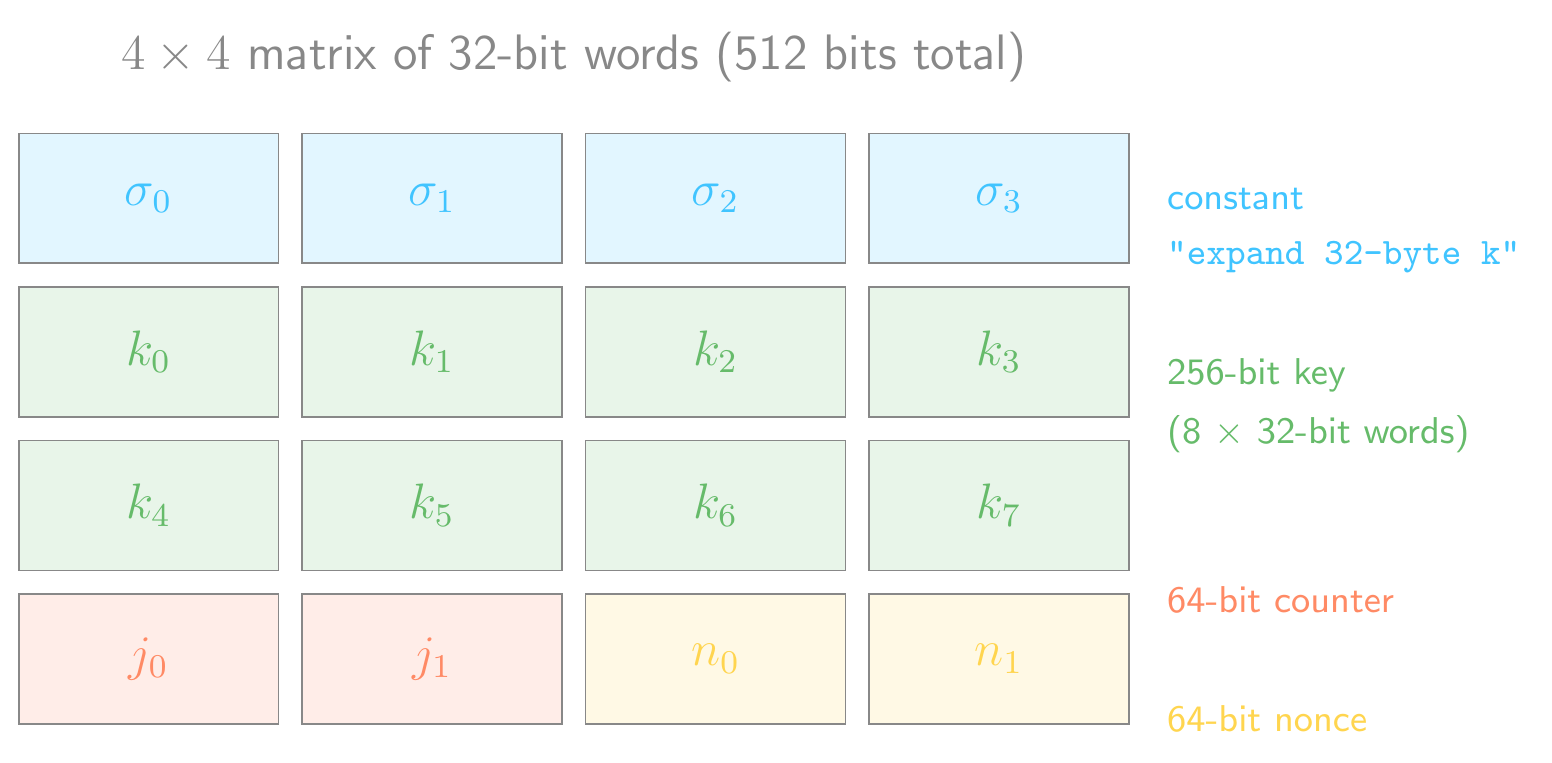
- The initial state for ChaCha20 is a \(4 \times 4\) matrix of 32-bit words constructed from:
- \(\sigma\) =
"expand 32-byte k"(128-bit constant, four 32-bit words) - \(k\) (256-bit key, eight 32-bit words)
- \(j\) (64-bit counter, two 32-bit words)
- \(n\) (64-bit nonce, two 32-bit words)
- \(\sigma\) =
- Remember, this doesn’t have to be implemented as a 2-dimensional array!
ChaCha20: State Matrix
Permutation
- The permutation \(\pi : \{0, 1\}^{512} \to \{0, 1\}^{512}\) is made up of a fixed number of rounds
- ChaCha20 runs 20 rounds in total (hence the name)
- A quarter-round function is applied four times per round, covering all 16 state words
- Odd rounds execute column-wise over the working state matrix
- Even rounds execute diagonal-wise over the working state matrix
- The full spec can be found in RFC 7539
- RFC 7539 — ChaCha20 and Poly1305
- Note that the RFC uses a 32-bit counter and 96-bit nonce
- Finally, the initial state matrix is added to the working state matrix (word-wise, \(\bmod 2^{32}\))
- Without this step, the permutation could be inverted to recover the key!
- The result is a 512-bit pseudo-random output block
- Counter value \(j\) produces keystream block \(j\), enabling direct random access to any block
- Random access and parallel computation are possible!
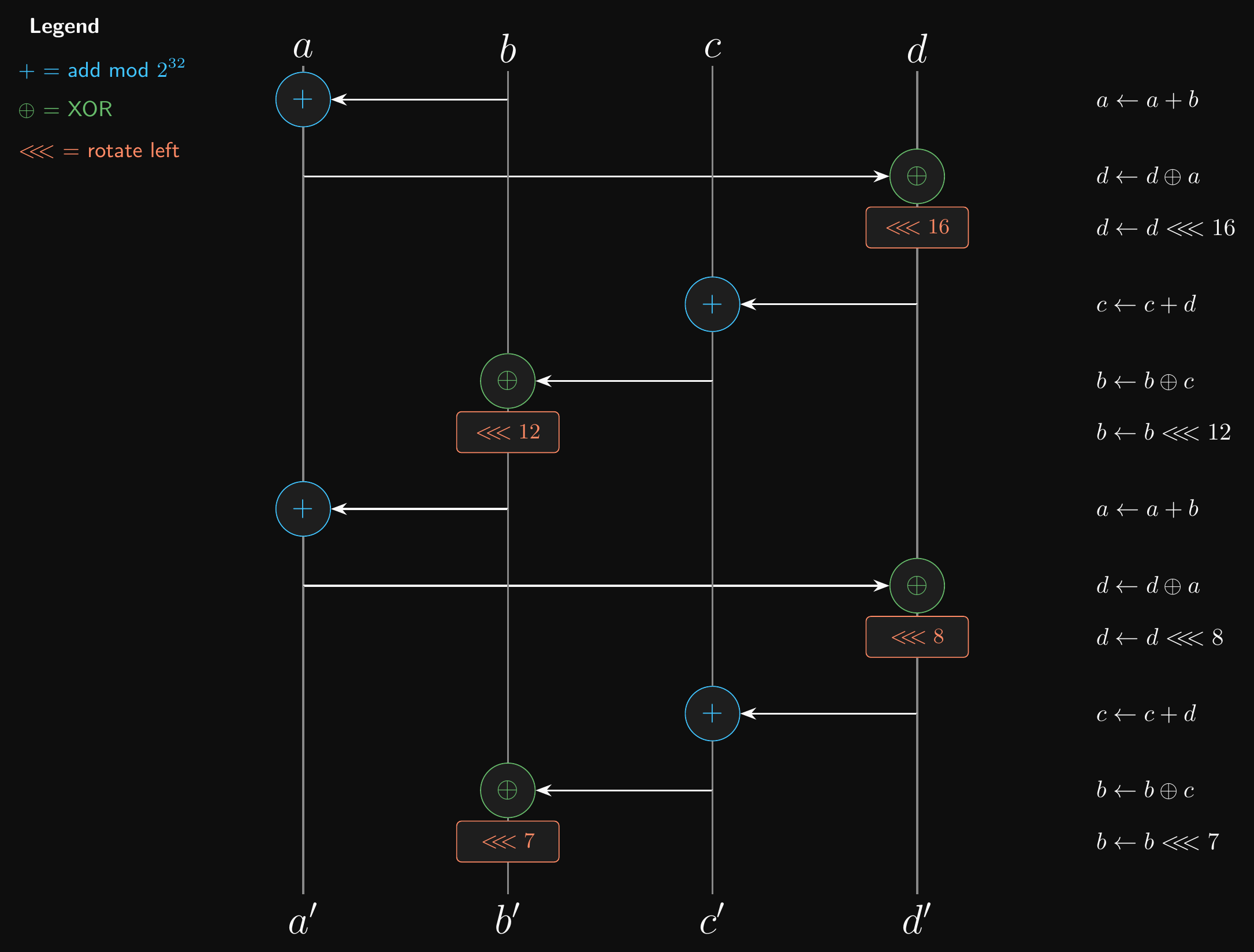
Quarter Round Function
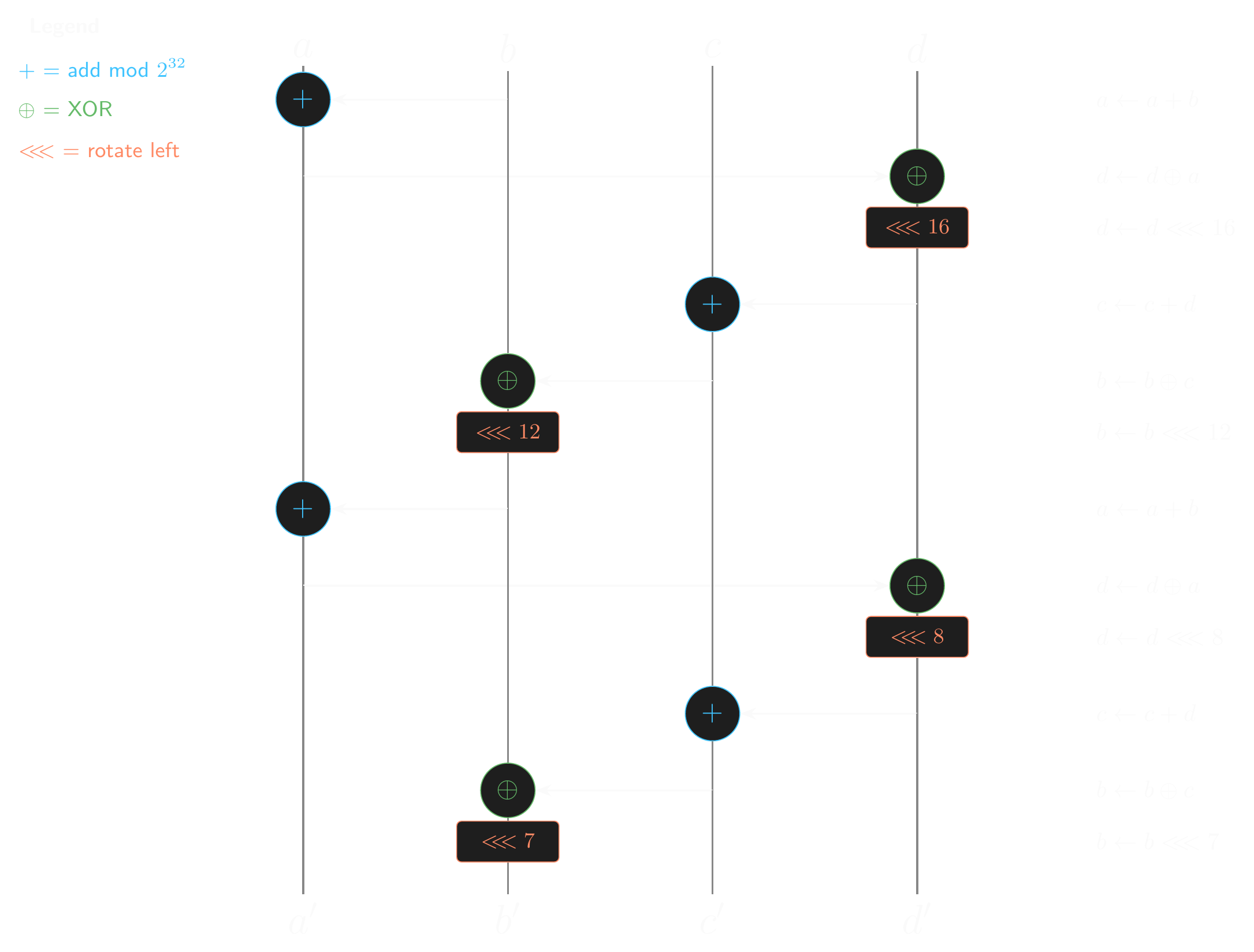
- The quarter round function is made up of addition, XOR and rotation operations
- Easy to implement in software or hardware
- It’s an ARX algorithm (Add-Rotate-XOR)
- Each ARX step has the form: \(a \mathrel{+}= b\); then \(d \mathrel{\oplus}= a\); then \(d \text{ <<<}= n\)
- The quarter-round chains four such steps together, mixing all four input words
- \(+\) is modular addition \(\bmod 2^{32}\), \(\text{<<<}\) is rotate left
- Constant-time operations, no branching
- Resistant to timing attacks
ChaCha20: Quarter-Round Function
RC4
- Sometimes called ARCFOUR or ARC4 - “alleged” RC4
- Leaked from, but never acknowledged by, RSA Security
- The author (Ron Rivest) eventually confirmed it in a 2014 paper
- Yes, that RSA Security! They’ll pop up a few more times in other lectures.
- Popular at the time!
- Simple to implement, easy to apply
- No need to worry about modes of operation, block sizes or padding
- Very fast: comparable to AES, much faster than 3DES
- Some built-in OS secure PRGs (CSPRNGs) used RC4
- Let’s look at how it actually works
RC4: Key Scheduling Algorithm (KSA)
- RC4’s internal state is a permutation of the integers \(0, 1, \ldots, 255\)
- 256 bytes of state, often called the “S-box”
- The KSA initialises this permutation using the key \(k\):
- \(\textbf{for } i = 0 \textbf{ to } 255 \textbf{ do: } S[i] \leftarrow i\)
- \(j \leftarrow 0\)
- \(\textbf{for } i = 0 \textbf{ to } 255 \textbf{ do:}\)
- \(j \leftarrow (j + S[i] + k[i \bmod |k|]) \bmod 256\)
- \(\text{swap}(S[i], S[j])\)
- Only 256 swaps, regardless of key length
- Short keys (e.g. 40-bit WEP keys) repeat cyclically
- Many elements barely move from their initial position
RC4: Keystream Generation (PRGA)
- Once the state is initialised, keystream bytes are generated one at a time:
- \(i \leftarrow 0, \; j \leftarrow 0\)
- \(\textbf{for each output byte:}\)
- \(i \leftarrow (i + 1) \bmod 256\)
- \(j \leftarrow (j + S[i]) \bmod 256\)
- \(\text{swap}(S[i], S[j])\)
- \(\textbf{return } S[(S[i] + S[j]) \bmod 256]\)
- Each output byte depends on the current state of the permutation
- The state evolves incrementally: each byte depends on all previous state
- No random access, no parallelism (contrast with ChaCha20!)
- Beautifully simple: fits in a few lines of code
Why RC4 is Broken
- Biased early outputs: The KSA doesn’t mix the state enough
- The second output byte equals 0 with probability \(\approx 1/128\) instead of \(1/256\)
- This bias in the first bytes leaks information about the key
- Even dropping the first 256 bytes doesn’t fully fix the problem
- No nonce input: Same key always produces the same initial state and keystream
- WEP concatenated the key with a 24-bit IV: only \(2^{24} \approx 16\) million possible keystreams per key
- This is exactly the many-time pad problem!
- Statistical biases throughout: Long-range correlations in the keystream
- Practical plaintext recovery demonstrated against TLS (2013, 2015)
- Prohibited from use with TLS since 2015
- Ironically, it was previously recommended as a workaround for the BEAST attack (a 2011 CBC-mode attack on TLS… we’ll cover CBC next week)
- Don’t use RC4!
Randomness
A user’s guide.
Classes of RNGs
- The secure PRGs we’ve discussed so far are also called CSPRNGs
- Cryptographically Secure Pseudo-Random Number Generators
- Be careful not to get these mixed up! Not all PRGs are secure
- Picking the wrong kind of RNG for a task can have dire consequences
- True RNGs (TRNGs) are actually random, but expensive!
- Usually used to seed a cheaper CSPRNG
Attacking RNGs
- A CSPRNG needs to do everything a normal PRNG can do
- That means passing rigorous statistical tests!
- E.g. the next-bit test: an attacker shouldn’t be able to guess the next generated bit
- …even if they know every bit that came before it!
- In polynomial time, the best they can do is negligibly better than a 50-50 guess
- Sound familiar?
- If you know the state of a PRNG, then you can figure out the next output
- You might also be able to figure out past outputs (and the seed)
- A good CSPRNG must not reveal past outputs…
- …even if its state is fully or partially compromised!
- Some routers seeded their RNG from the time since boot, giving an attacker a tiny, predictable seed space, brute-forceable in seconds
What CSPRNG should we use?
- Most/all of you will probably use one in your projects!
- Probably some built-in secure random number generator (I hope…)
- Python and Web Crypto both provide these
- Under the hood, most of these hook into the OS’s RNG
- E.g.
/dev/randomand/dev/urandomon Linux - These use real sources of entropy with a CSPRNG based on ChaCha20
- E.g.
- Please don’t roll your own CSPRNG!
- Rolling your own PRNG for a game or other non-security context should be fine
- But maybe not for research purposes or Monte Carlo simulations…
- If you want to try your hand at creating a PRNG, test it!
- Use a well-known battery of statistical tests like TestU01
- But remember, passing statistical tests doesn’t imply security!
- It’s sine qua non (necessary but not sufficient): passing statistical tests is required, but it doesn’t imply security
When RNG goes bad
Can you really trust your standard library?
Bad PRNGs
java.util.Randomhas always used a linear congruential generator (LCG), and still does- Java 17 introduced
RandomGeneratorwith better algorithms, but you have to opt in
- Java 17 introduced
- LCGs were already known to be poor, but the default stayed anyway
- LCGs are fast and don’t need much memory
- Completely unsuitable for cryptography (of course)
- Problems get really obvious with multi-dimensional data
Linear Congruential Generators
- Let’s build a PRNG!
- LCGs are old and well-known. They’re also easy to implement!
- All you need to do is implement this recurrence relation:
- \(X_{n+1} = (a \cdot X_n + c) \mod m\), where \(X_0\) is the seed value
- The seed, multiplier and increment must be less than the modulus!
- There are a bunch of different subtypes
- Let’s implement RANDU
- Set \(a = 65539\), \(c = 0\), \(m = 2^{31}\)
- LCGs are sensitive to parameter choice
- The LCG will repeat after a parameter-dependent period
- The quality of the RNG will vary wildly depending on the parameters!
- RANDU used to be widely used, but it’s laughably poor
- May have wrecked lots of scientific papers
And this is why it’s bad!
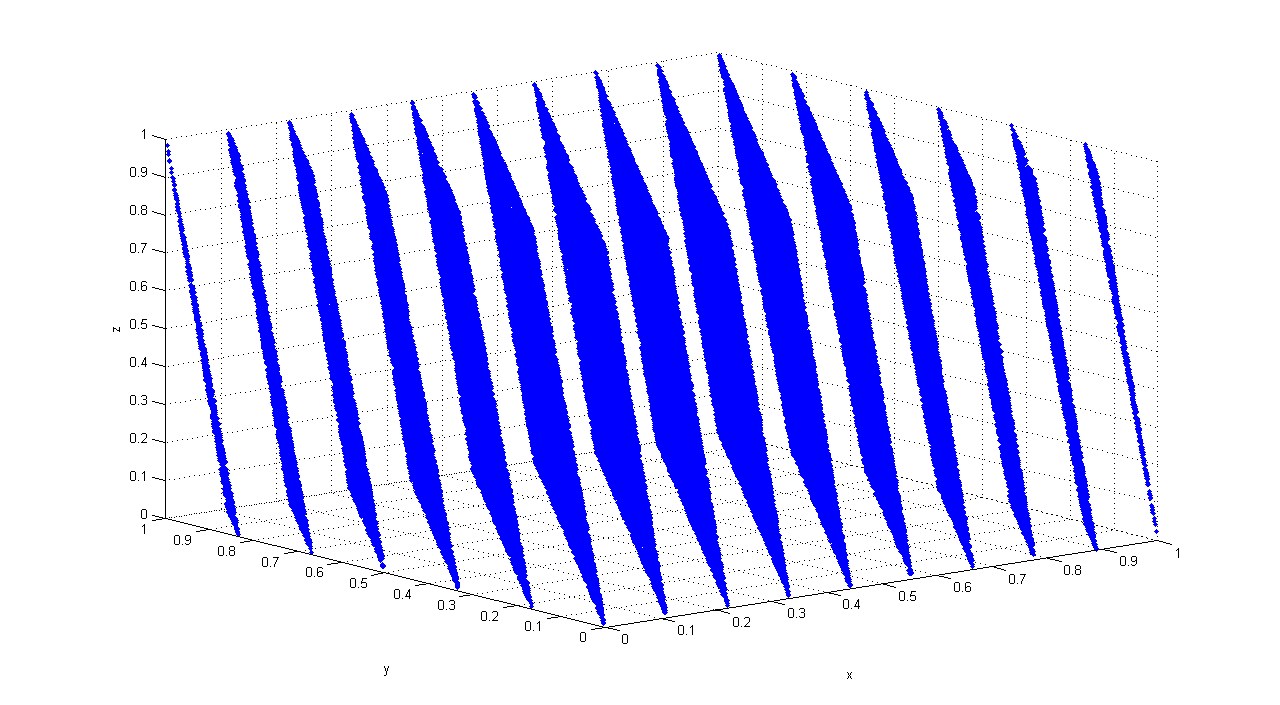
100,000 consecutive triples from RANDU plotted in 3D. The points fall on just 15 parallel planes. Image: Luis Sanchez, CC BY-SA 3.0
RANDU: 15 Parallel Planes
- RANDU satisfies: \(X_{n+2} = 6 X_{n+1} - 9 X_n \pmod{2^{31}}\)
- Every output is a linear combination of the previous two
- That’s why the points fall on 15 parallel planes!
- A truly random source would fill the cube uniformly
- RANDU’s output has massive, visible structure
- This is exactly the kind of pattern a statistical test (or an attacker) can detect
- And why choosing good parameters for even a simple PRNG matters!
Mersenne Twister
- Mersenne Twister is a decent general-purpose PRNG
- Huge period of \(2^{19937} - 1\) (a Mersenne prime, hence the name)
- A Mersenne prime is a prime of the form \(2^p - 1\) (which requires \(p\) itself to be prime, but that alone isn’t enough: \(2^{11} - 1 = 2047 = 23 \times 89\))
- Relatively high memory requirements
- Passes most (but not all) standard test suites for statistical randomness
- Used as the default in many programming languages and libraries
- Even in some versions of Microsoft Excel
- Not cryptographically secure!
- After observing just 624 consecutive outputs, an attacker can fully reconstruct the internal state
- All future (and past) outputs become predictable
Xorshift
- Xorshift is a family of PRNGs
- Fast, very simple to implement, low memory requirements
- With some modifications, can pass most statistical tests
- But only once a non-linear step is added!
- Fits in a single screen’s worth of C code
Quis custodiet ipsos custodes?
- We can’t talk about RNG in cryptography without mentioning that there have been several standards published and later withdrawn
- Some that didn’t work as intended
- And some that did work as intended, just not as expected…
- Most notoriously, Dual_EC_DRBG, published by NIST
- DRBG? Deterministic Random Bit Generator, i.e. a PRNG
- EC? Because it’s built using elliptic curves.
- Usually associated with asymmetric cryptography.
- Unusual for a PRNG…
- No security proof was published
- Just a suggestion that it would be hard to crack
- You can probably guess what’s coming next!
The Dual_EC_DRBG Backdoor
- Turns out that the standard was mostly written by the NSA
- And the NSA secretly paid RSA Security $10m to include it as a default in their cryptographic library
- Why? Because Dual_EC_DRBG has a possible backdoor…
- The generator uses two elliptic curve points \(P\) and \(Q\) whose relationship was chosen by the NSA
- If you know the discrete log \(e\) such that \(Q = eP\), you can recover the internal state from a short output
- Only the NSA knew \(e\), so only the NSA could decrypt traffic using the backdoored generator
- Major embarrassment for NIST (and everyone else involved)
- The standard has been withdrawn since
- OpenSSL’s implementation, amusingly, never actually worked
Commit to the Bit
PRGs aren’t just for encryption.
Heads or Tails?
- Ever flipped a coin with someone?
- Easy for both parties to have mutual trust!
- One person calls heads or tails
- The other person flips the coin
- Both of them can hear the call and verify the result of the toss
- No way for anyone to cheat it
- Even with an unfair coin, you don’t know if the call will be heads or tails
- This isn’t so easy if you’re not in the same place…
- If Alice tosses the coin knowing what Bob’s guess is…
- She can cheat!
- But if Bob only reveals his guess after he knows the result of the toss…
- He can cheat!
- And neither of them can trust the result…
Bit Commitment
- Let’s try to fix the coin toss protocol with some very practical™ cryptography!
- Bob needs to be able to commit to a guess - heads or tails, 0 or 1
- Bob needs to be able to send a commitment string to Alice
- It shouldn’t give Alice any information about Bob’s guess
- This is the hiding property
- Even if Alice rigs the coin toss, she doesn’t have a better chance of winning
- Getting heads 100% of the time isn’t useful
- Bob has a 50% chance of guessing heads, so the odds are the same!
- Bob needs to be able to prove what his guess was after the toss
- Bob sends Alice an opening string
- Alice uses it to extract the guess from the commitment string
- Bob shouldn’t be able to change his guess!
- This is the binding property
PRGs to the Rescue
- That’s all well and good, but how can we actually implement it?
- Bob commits to a bit \(b_0 \in \{0, 1\}\)
- Alice picks a random \(r \in \mathcal{R}\) and sends \(r\) to Bob first
- Why first? If Bob chose \(r\), he could cheat (we’ll see why in the binding proof)
- Bob picks a random \(s \in \mathcal{S}\) and computes \(c \leftarrow \text{com}(s, r, b_0)\)
- \(\text{com}(s, r, b_0) = G(s)\) if \(b_0 = 0\)
- \(\text{com}(s, r, b_0) = G(s) \oplus r\) if \(b_0 = 1\)
- Bob sends the commitment string \(c\) to Alice
Opening the Commitment
- After the toss, Bob sends his guess \(b_0\) and the opening string \(s\) to Alice
- Alice verifies that \(c = \text{com}(s, r, b_0)\)
- If they match, she accepts that Bob’s guess was \(b_0\)
- Otherwise, she rejects it
Hiding Property
- The hiding property follows directly from PRG security!
- \(G(s)\) is computationally indistinguishable from a random \(r \in \mathcal{R}\)
- And therefore \(G(s) \oplus r\) is too
- So Alice can’t know what Bob’s guess is
- That was easy!
Binding Property: Setup
- The binding property is a bit harder to show, and needs some constraints!
- We require that \(1 / |\mathcal{S}|\) be negligible, i.e. that \(|\mathcal{S}|\) be super-poly
- And we require that \(|\mathcal{R}| \geq |\mathcal{S}|^3\) (we’ll see why in a moment)
- If Bob wants to cheat, he needs an opening string that can open to be 0 or 1
- He needs to find \(s_0, s_1 \in \mathcal{S}\) s.t. \(c = G(s_0) = G(s_1) \oplus r\)
- \(\Rightarrow G(s_0) \oplus G(s_1) = r\)
- A “bad \(r\)” is one where some \(s_0, s_1 \in \mathcal{S}\) exist to satisfy that equation.
- How many possible pairs of seeds can produce a bad \(r\)?
Binding Property: Counting Argument
- There are \(|\mathcal{S}| \cdot |\mathcal{S}| = |\mathcal{S}|^2\) possible pairs of seeds
- Each pair \((s_0, s_1)\) determines exactly one potential bad \(r\): the value \(G(s_0) \oplus G(s_1)\)
- So there are, at worst, \(|\mathcal{S}|^2\) distinct bad \(r\) values
- How likely is it that Alice picks a bad \(r\) at random?
- \(\frac{|\mathcal{S}|^2}{|\mathcal{R}|} < \frac{|\mathcal{S}|^2}{|\mathcal{S}|^3} = \frac{1}{|\mathcal{S}|}\)
- \(1 / |\mathcal{S}|\) is negligible (by our constraint), so the binding property holds!
- The probability that Bob can cheat vanishes as the seed space grows
Bit Commitment
- This scheme isn’t perfect…
- You can attack it at the protocol level
- But it’s a pretty simple scheme and a neat use of PRGs
- There are better bit commitment schemes out there if you ever need one!
- Lots of cryptographic primitives can be used in unexpected ways
- In more complex schemes to achieve different goals
- Or to build other cryptographic primitives
- We’ll see more of these in future lectures!
Conclusion
What did we learn?
So, what did we learn?
- Stream ciphers use a PRG to stretch a short key into a long keystream
- \(E(s, m) = G(s) \oplus m\)
- The security parameter \(\lambda\) controls the level of security
- Advantages must be negligible in \(\lambda\); seed/key spaces must be super-poly
- A PRG is secure if its output is computationally indistinguishable from random
- Formalised via the PRG security game (Experiment 0 vs Experiment 1)
- Proof by reduction: if the PRG is secure, the stream cipher is semantically secure
- PRGs can be composed in parallel or sequentially to produce longer outputs
- The hybrid argument proves that security degrades linearly with \(n\)
So, what did we learn? (cont.)
- ChaCha20 is a modern, widely-used stream cipher (TLS, SSH)
- Uses a nonce to safely encrypt multiple messages with the same key
- Not all PRNGs are created equal!
- CSPRNGs for cryptography, regular PRNGs for everything else
- Bad parameter choices and backdoors have caused real-world failures
- Stream ciphers protect against passive eavesdroppers, but not against active attackers who can modify ciphertexts. We’ll close that gap later with authenticated encryption.
- PRGs can also be used for non-encryption tasks like bit commitment
For next time…
- Complete the challenges in this week’s tutorial!
- No grade this time, just bragging rights.
- And stuff from the tutorials might be helpful later on…
- We’ll take a look at block ciphers next week.
- Complete some assigned reading for next week:
- Chapter 7 of Crypto 101
- Sections 3.1 to 3.3 of Applied Cryptography
- And 3.9 if you’re interested in RC4
- The rest of the chapter is interesting, but only if you’ve got time
- I don’t expect you to learn off proofs from the textbook!
Questions?
Ask now, catch me after class, or email eoin@eoin.ai