ISE Cryptography — Lecture 01
Intro to Cryptography
Introduction
Why study cryptography?
What’s This Module About?
- Cryptography, in a nutshell, is about information.
- We spend most of our lives transferring information in one form or another
- We’ve been recording information in writing for millennia
- Writing is great, because the recipient can understand it!
- But it’s also not so great, because everyone else can too…
- How can we transfer information that an eavesdropper can’t understand, but we can?
- Cryptography = κρυπτός (hidden, secret) + -γραφία (writing)
- Older than computer science
- Older than (most) languages we speak
- Used almost everywhere in the modern world
What Isn’t This Module About?
- We’re looking at applied cryptography - the parts you need as software engineers
- This includes some mathematics, but we’re not doing 10-page proofs!
- …maybe some 5-page proofs?
- Just kidding.
- You’ll have a foundation to delve into theory at the end if you like.
- This is about encryption, not encoding!
- Encoding is publicly reversible if you know the algorithm; no secrets involved.
- E.g. Morse Code, ASCII, UTF-16, PNG, MP3…
- This is about cryptography, not steganography!
- Hiding messages isn’t the same thing as encrypting them.
- It’s a fascinating field in its own right…
- …just not the one we’re covering right now.
Why is Cryptography So Important?
- Cryptography underpins most of our modern information systems.
- HTTPS, authentication, digital signatures, fintech, cryptocurrencies…
- Being able to communicate confidentially and securely is vitally important!
- “If you’ve got nothing to hide, you’ve got nothing to fear.”
- …but does anyone really have nothing to hide?
- Anyone want to share their credit card details, passwords and PINs with the class?
- Encryption periodically comes under attack by governments worldwide.
- Crypto software was subject to US export restrictions during and after the Cold War.
- Plenty of groups have an interest in reading your information…
- …even if it doesn’t seem dangerous to you right now, it might be later.
Kerckhoffs’s Principle
- In cryptography, always assume that the enemy knows the system.
- The cipher itself should not be secret!
- Only the secret key should require secrecy, not the algorithm.
- “Every secret creates a potential failure point”
- Algorithms need to be shared with a lot of people during implementation
- How can you keep source code secret?
- How can you prevent that source code from being decompiled?
- Ciphers should only be considered secure after publication and rigorous analysis!
- Difficult to do that if the cipher itself is secret
- Security through obscurity may hide flaws in the long run
Schneier’s Law
- “Anyone, from the most clueless amateur to the best cryptographer, can create an algorithm that he himself can’t break.”
- Bruce Schneier, 1998
- “Schneier’s Law: any person can invent a security system so clever that she or he can’t think of how to break it”
- Cory Doctorow, 2004
- Read Schneier’s Law
- The phrasing is recent, but the idea is much older.
- A little knowledge is a dangerous thing.
- DON’T ROLL YOUR OWN CRYPTO
Terminology
Speaking the same language
Cast of Characters
- Cryptographers, like most academics, tend to have a few conventions!
- Usually, we send messages from A to B…
- …from Alice to Bob!
- And the eavesdropping adversary is called…
- …Eve.
- An eavesdropper is a passive attacker
- They listen, but don’t act.
- A malicious attacker (Mallory) is an active attacker
- They can interfere with messages, alter them, replay them and substitute them with their own.
- Terrible puns aside, it’s helpful to have a set of names to use in examples.
- Messages aren’t necessarily sent between two parties.
- Any examples where Alice and Bob could be the same person?
- Encrypted files on your hard drive!
Sending a Message
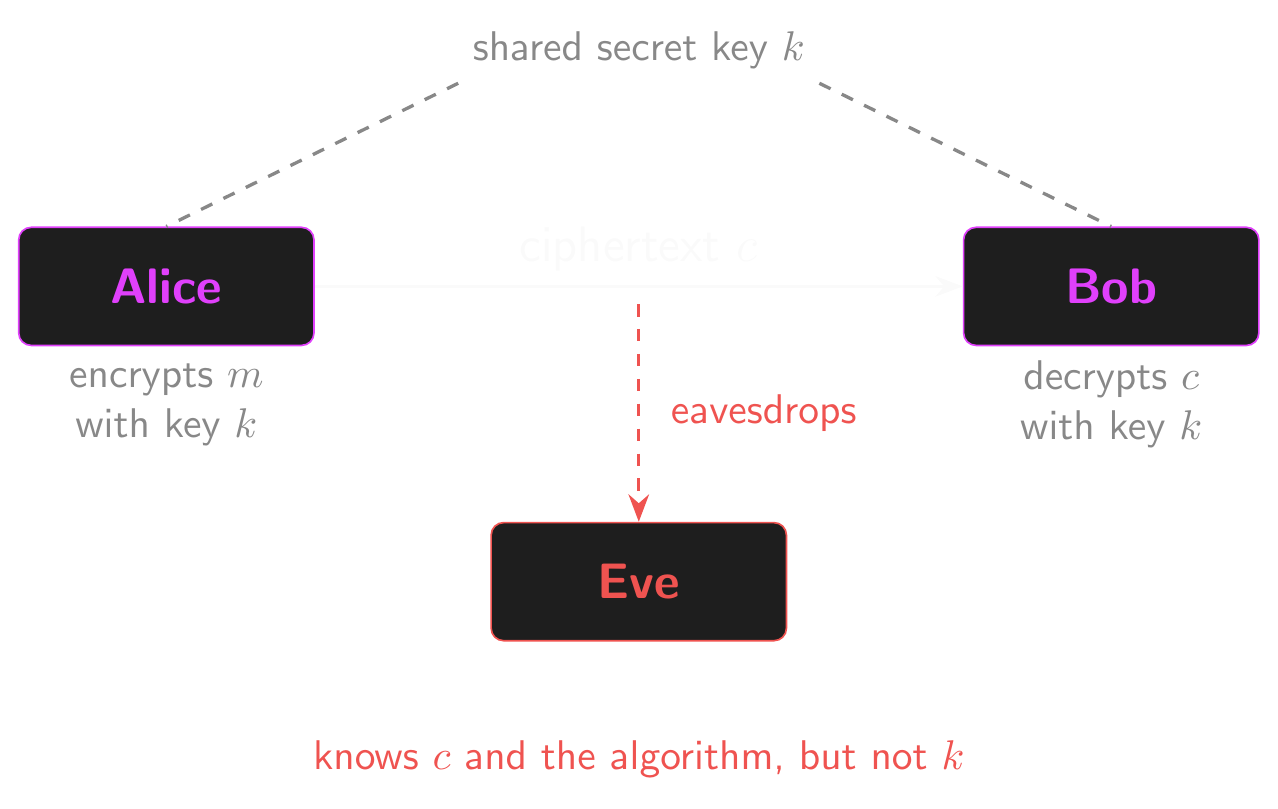
- Alice wants to send a message to Bob about her favourite font!
- But she doesn’t want Eve to find out that it’s Comic Sans.
- “My favorite font is Comic Sans” is the plaintext or message.
- Alice encrypts the message to produce the ciphertext.
- Alice sends the ciphertext to Bob.
- Bob decrypts the ciphertext to recover the plaintext.
- Most ciphers include a secret known only to Alice and Bob called the key.
- In symmetric ciphers, the same key is used for both encryption and decryption… but more on that later!
- Eve knows the ciphertext and the algorithm used to encrypt it.
- Eve doesn’t know the key, so she can’t decrypt the message.
- Eve has to attack the ciphertext to find out what Alice sent.
Sending a Message
Shannon Ciphers
A Shannon cipher is a pair of functions: \(\mathcal{E} = (E, D)\)
- That’s “script-E” or
\mathcal{E}in \(\LaTeX{}\)
- That’s “script-E” or
The encryption function \(E\) takes as input a key \(k\) and a message \(m\), and produces as output a ciphertext \(c\).
- \(c = E(k, m)\)
The decryption function \(D\) takes as input a key \(k\) and a ciphertext \(c\), and produces a message \(m\).
- \(m = D(k, c)\)
The correctness property states that decryption reverses encryption for all \(k\) and \(m\).
- \(D(k, E(k, m)) = m\)
- Use this to formally prove correctness and to derive test cases
Shannon Ciphers: Key, Message and Ciphertext Spaces
- Sometimes, we talk about ciphers being defined over \((\mathcal{K}, \mathcal{M}, \mathcal{C})\) — the key space \(\mathcal{K}\), the message space \(\mathcal{M}\) and the ciphertext space \(\mathcal{C}\)
- Encryption and decryption are mappings between these spaces.
- \(E : \mathcal{K} \times \mathcal{M} \to \mathcal{C}\)
- \(D : \mathcal{K} \times \mathcal{C} \to \mathcal{M}\)
- Anyone remember Cartesian products?
- Note that cipher, encryption scheme, algorithm and other terms can be used interchangeably!
- “Cypher” is a variant, less common spelling
Historical Ciphers
Codes through the ages
A 2,000-Year-Old Cipher
- The Caesar cipher is known by many names.
- It’s a simple substitution cipher
- Substitutes (swaps) between two alphabets of symbols.
- Rotates or shifts the alphabet (A-Z) by a set amount of letters to produce a ciphertext alphabet.
- One is the plaintext alphabet, the other is the ciphertext alphabet.
- Some examples:
- ROT1: \(\texttt{a → b, b → c, c → d, … z → a}\)
- ROT13: \(\texttt{a → n, b → o, c → p, … m → z, n → a, … z → m}\)
- Decryption applies the same mapping in reverse.
- ROT13 is a special case where encryption is identical to decryption!
- Characters outside the alphabet are usually discarded.
- Spaces can be preserved or discarded (like an old-style telegram).
Over to You!
- Enough talk, let’s write some code!
- Write an encryption and decryption function for the Caesar cipher.
encrypt(plaintext: str, shift: int) -> ciphertextdecrypt(ciphertext: str, shift: int) -> plaintext
- Before you dive in, think about:
- Handling upper and lower case letters
- Handling characters outside the range A-Z
- How much work you have to do…
- Do we really need to write two separate functions, or can we cheat a bit?
- Checking correctness:
- Start by writing a few quick tests/assertions!
- Is there a way to “cheat” with an easy test case?
Attacking the Caesar Cipher
- So now we’re encrypting things! How strong do you think the Caesar cipher is?
- What information is meant to be secret?
- Any suggestions for how we might attack a ciphertext?
- \(\texttt{AOPZ PZ UVA AOL TVZA ZLJBYL JPWOLY PU AOL DVYSK}\)
- Let’s attack this ciphertext and try to crack it!
- The encrypt and decrypt functions might come in handy here…
- There are a few ways to do this! Some are more efficient than others.
- What’s the plaintext of the message?
- What does this tell us about how secure this cipher is against an adversary with the most basic compute capabilities?
Et tu, Brūte?
- Why is a brute force attack against the Caesar cipher so trivial?
- How can we make the cipher stronger?
- How strong does it need to be?
- How can we remember a random permutation of 26 letters?
- Lots of ways to do this, not all of them good!
- How hard is it to brute force the cipher with this improvement?
- Try running it in Python (or maybe don’t…)
- How many possible mappings are there for the 26 letters of the alphabet?
- \(26! = 403,291,461,126,605,635,584,000,000 \approx 2^{88}\)
Attacking Ciphers
- What do we know about how our cipher works?
- We might not be able to read the ciphertext…
- But what information does it leak about the plaintext?
- Length! Pretty much every cipher leaks this to some extent.
- Why?
- Where does the plaintext come from?
- English text? Images? Audio? Video?
- Is every symbol equally likely? What are the most common symbols in English?
- What about groups of 2, 3, 4 symbols (n-grams)?
- Frequency analysis and cribs are powerful tools for cracking codes!
- What assumptions are we making about our plaintext?
Random vs Uniformly Random
- “Random” just means unpredictable, but not all randomness is equal!
- A loaded die is random but not uniform: some faces are more likely than others
- English text is unpredictable, but highly structured
- You can often guess the next letter given the ones before it
- That’s exactly why frequency analysis works!
- In cryptography, we almost always need uniformly random values
- Every possible outcome is equally likely
- No outcome is more probable than any other
- A uniformly random byte has 256 possible values, each with probability exactly \(1/256\)
- A non-uniform byte might land on
0x00half the time and spread the rest thinly
- A non-uniform byte might land on
How Random is Random?
- We measure unpredictability in bits of entropy
- Entropy tells you how hard a value is to guess
- More entropy = more surprise = harder to predict
- Some intuitive examples:
- A fair coin flip: 1 bit of entropy (two equally likely outcomes)
- A fair six-sided die: ~2.6 bits of entropy (six equally likely outcomes)
- English text: ~1.1 bits of entropy per character (very predictable!)
- A uniformly random byte: 8 bits of entropy (256 equally likely outcomes)
- Cryptographic keys need lots of entropy
- A 128-bit key should have 128 bits of entropy
- That means it must be sampled uniformly from \(\{0,1\}^{128}\)
- Another way to think about it: entropy and compressibility
- Low entropy = predictable = compressible. That’s why
.zipshrinks text files so well! - High entropy = unpredictable = incompressible. Try zipping a file of random bytes!
- Low entropy = predictable = compressible. That’s why
Why Uniformity Matters
- If a key source is biased, some keys are more likely than others
- An adversary can try the most likely keys first
- Far fewer guesses needed than brute-forcing a uniform key!
- We’ll see shortly that the one-time pad’s proof of perfect security requires uniform keys
- Non-uniform keys break the proof and leak information about the plaintext
- Generating truly uniform random bits is a real engineering challenge
- We’ll look at how this is done in practice next week
- For now, the takeaway: when we say “choose a key at random,” we mean uniformly at random
XOR All the Things!
[citation needed]
You All Remember XOR, Right?
- The eXclusive OR boolean operator / logic gate
- \(\oplus\) in mathematics,
^in most programming languages,\oplusin \(\LaTeX{}\) - A few ways to conceptualise XOR:
- The inequality operator
- 1 if exactly one input is 1, otherwise 0
- Addition without the carry / addition modulo 2 / clock addition
- A programmable inverter: a NOT gate with input, output and toggle…
- …plaintext, ciphertext and key?
- Truth table for reference:
- \(0 \oplus 0 = 0\)
- \(0 \oplus 1 = 1\)
- \(1 \oplus 0 = 1\)
- \(1 \oplus 1 = 0\)
Programming with XOR
- XOR is used under the hood for basically everything: arithmetic, comparisons, RNG…
- …and cryptography, of course!
- Let’s take a quick look at using bitwise XOR in Python!
- Try the infix
^operator or theoperator.xor()function.
- Try the infix
- You can format the result with
bin(),oct()andhex()for readability. - You’re not limited to decimal input in Python either!
- Use the prefixes
0b,0oand0xfor binary, octal and hexadecimal literals.
Properties of XOR
XOR is associative:
- Changing the grouping of operands doesn’t change the result
- \(a \oplus (b \oplus c) = (a \oplus b) \oplus c\)
XOR is commutative:
- Changing the order of operands doesn’t change the result
- \(a \oplus b = b \oplus a\)
Test this out on paper or in code!
Properties of XOR (cont.)
Any bit XOR itself is always 0 (self-inverse):
- \(a \oplus a = 0\)
- If \(a\) is 0, then \(0 \oplus 0 = 0\)
- If \(a\) is 1, then \(1 \oplus 1 = 0\)
XORing any bit with 0 has no effect (identity element):
- E.g. \(a \oplus 0 = a\)
- If \(a\) is 0, then \(0 \oplus 0 = 0\)
- If \(a\) is 1, then \(1 \oplus 0 = 1\)
- Same goes for \(0 \oplus a = a\)
- Why?
Test this out in Python!
Perfect Security?
That XOR tangent wasn’t just for fun!
Perfect Security
- Perfect security is a real thing! It’s also not exactly complicated.
- You’ll all implement a perfectly secure cipher before the end of the day.
- So what does security really mean?
- Intuitively? Can’t guess the plaintext by looking at the ciphertext.
- We can only keep the plaintext safe if the key is hard to guess!
Perfect Security: An Example
- E.g. imagine we’re sending a message, either \(\texttt{attack at dusk}\) or \(\texttt{attack at dawn}\)
- Without seeing the ciphertext, there’s a 50% chance of picking the right one.
- But what if we see the ciphertext? What would a Caesar ciphertext tell us?
- \(\texttt{NGGNPX NG QHFX}\)
- \(\texttt{TMMTVD TM WTPG}\)
- …it gives you a 100% chance of guessing the correct plaintext!
- Even for other ciphers… what if there are 800 possible keys that decrypt that ciphertext to dawn, but only 200 that decrypt it to dusk?
- Perfect security means that the ciphertext leaks absolutely no information about the message.
- What about the length of the message? Can we avoid leaking that?
- Does it matter?
Perfect Security (Definition)
Let \(\mathcal{E} = (E, D)\) be a Shannon cipher defined over \((\mathcal{K}, \mathcal{M}, \mathcal{C})\). Consider a probabilistic experiment in which the random variable k is uniformly distributed over \(\mathcal{K}\).
If for all \(m_0, m_1 \in \mathcal{M}\), and all \(c \in \mathcal{C}\), we have
\[\Pr[E(\mathbf{k}, m_0) = c] = \Pr[E(\mathbf{k}, m_1) = c]\]
then we say that \(\mathcal{E}\) is a perfectly secure Shannon cipher.
One-Time Pad
- Enter the one-time pad, a cipher with perfect security!
- The cipher is defined over \((\mathcal{K}, \mathcal{M}, \mathcal{C})\) where \(\mathcal{K} = \mathcal{M} = \mathcal{C} = \{0, 1\}^L\)
- I.e. the keys, messages and ciphertexts are fixed-length bitstrings
- When dealing with info, we usually work in terms of bits - 1s and 0s.
- How do we turn bits into text, images, sounds?
- Obtain a binary representation of the message you want to send.
- Generate a key uniformly at random from \(\{0, 1\}^L\), the same length as the message
- Uniformly: every possible key is equally likely. This is vital for security!
- The key must only be used to encrypt one message, hence “one-time” pad
One-Time Pad: Encryption and Decryption
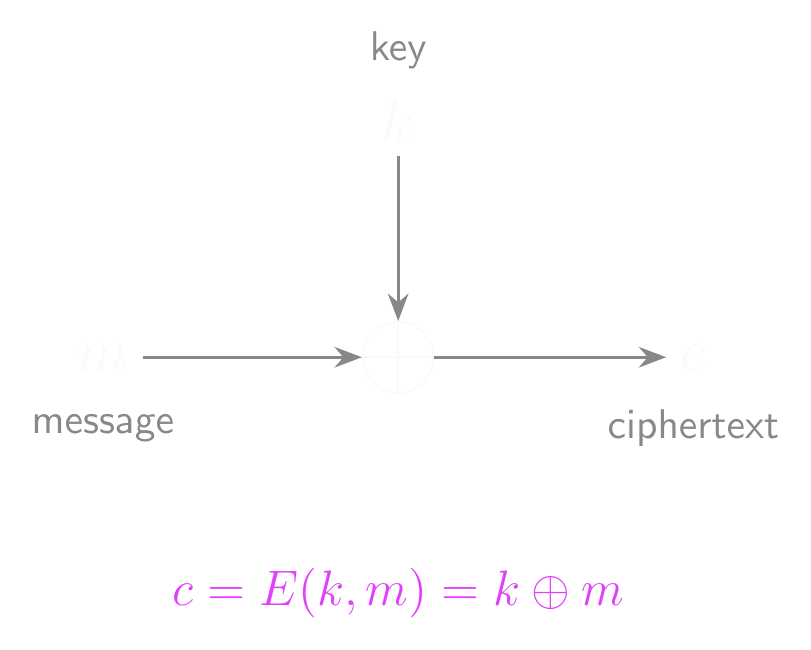
- To encrypt a message, XOR it with the key.
- \(E(k, m) = k \oplus m\)
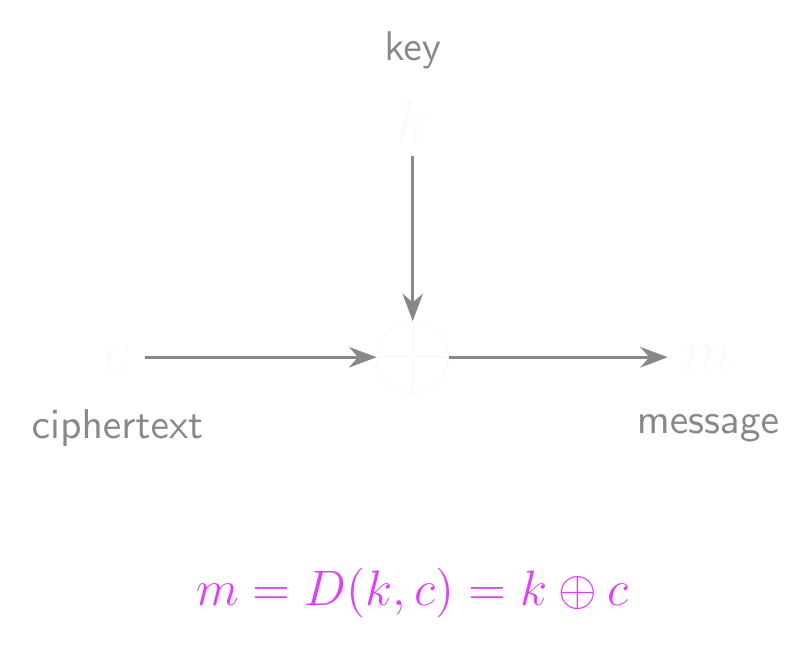
- To decrypt a ciphertext, XOR it with the key.
- \(D(k, c) = k \oplus c\)
- That’s not a typo, it’s actually that simple.
One-Time Pad: Encryption
One-Time Pad: Decryption
Correctness of the One-Time Pad
- Does this actually work as a cipher? Let’s look at the correctness property…
- \(D(k, E(k, m)) = m\)
- Let’s substitute in \(E(k, m) = k \oplus m\) and \(D(k, c) = k \oplus c\)
- \(D(k, k \oplus m) = m\)
- \(k \oplus (k \oplus m) = m\)
- Applying the properties of the XOR operator…
- \((k \oplus k) \oplus m = m\) [associative]
- \(0 \oplus m = m\) [self-inverse]
- \(m = m\) [identity]
Perfectly Secure?
- This probably sounds too good to be true, right?
- Say we have some message, key and ciphertext such that \(k \oplus m = c\)
- Flipping any bit of \(k\) will change the corresponding bit of \(c\)
- It follows that for a fixed \(m\) and \(c\), there’s exactly one \(k\) s.t. \(k \oplus m = c\)
- Given any fixed \(c \in \mathcal{C}\), there’s exactly one \(k\) that can encrypt a given \(m\) to that \(c\)
- So given any ciphertext, every possible message is equally likely!
- And any ciphertext can be decrypted into any possible message!
- So for all \(m_0, m_1 \in \mathcal{M}\), and all \(c \in \mathcal{C}\), we have:
- \(\Pr[E(\mathbf{k}, m_0) = c] = \Pr[E(\mathbf{k}, m_1) = c]\)
- Therefore, the one-time pad is perfectly secure
- And really easy to implement!
- Well, that’s it! Cryptography’s solved, see you next semester… right?
Beyond XOR
- We said XOR solves everything… but look at that proof again
- We only used three properties: associativity, an identity element (\(0\)), and every element being its own inverse (\(k \oplus k = 0\))
- These are the properties of a group: a set with an operation that is associative, has an identity, and where every element has an inverse
- XOR is just one group. The OTP works with any group operation!
- Addition mod 26 over letters: \(E(k, m) = (m + k) \bmod 26\), \(D(k, c) = (c - k) \bmod 26\)
- Identity is 0, inverse of \(k\) is \(26 - k\)
- Addition mod 256 over bytes: \(E(k, m) = (m + k) \bmod 256\), \(D(k, c) = (c - k) \bmod 256\)
- Addition mod \(p\) for a large prime: \(E(k, m) = (m + k) \bmod p\), \(D(k, c) = (c - k) \bmod p\)
- XOR is special because it’s self-inverse: encryption and decryption are the same function
- That’s elegant, but not required. Subtraction undoes addition just as well
The Flaw in the Plan
- The one-time pad is perfectly secure, and horrifically impractical.
- Why? You tell me!
- Think about the length of the key…
- The key must be as long as the message. What if you’re encrypting 1 GB of data? You need a 1 GB key!
- Worse, we can prove that this holds for ALL perfectly secure ciphers!
- Storing, sharing and managing a key that large is a nightmare
- And you need a new key for each message…
- But wait! Couldn’t we just reuse the key? Maybe call it the many-time pad instead?
The Many-Time Pad
- Reusing the key seems pretty tempting!
- Maybe for multiple messages, or repeated end-to-end for a long message.
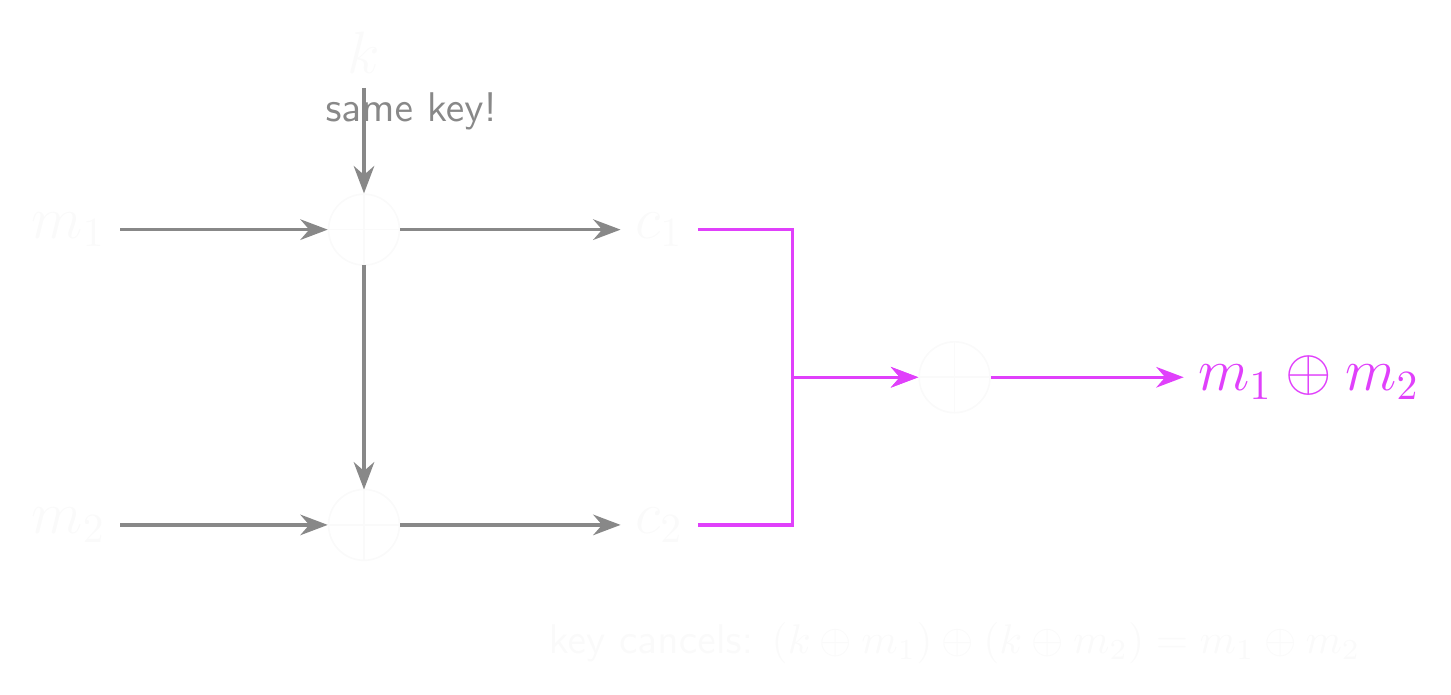
For example, we’d have:
- \(k \oplus m_1 = c_1\)
- \(k \oplus m_2 = c_2\)
So what’s the problem here? We (and Eve) still can’t read the ciphertexts…
- What happens if we XOR the ciphertexts together?
- \(c_1 \oplus c_2 = (k \oplus m_1) \oplus (k \oplus m_2)\)
- \(c_1 \oplus c_2 = (k \oplus k) \oplus (m_1 \oplus m_2)\)
- \(c_1 \oplus c_2 = 0 \oplus (m_1 \oplus m_2) = m_1 \oplus m_2\)
- The XOR of the ciphertexts is the XOR of the messages. That’s not good…
Many-Time Pad: Key Cancellation
Cracking the Many-Time Pad
- The XOR of the ciphertexts is the XOR of the messages.
- Reusing the key is enough to let us attack the cipher with ease!
- Correctly guessing just one of the plaintexts allows us to reveal the key!
- Guessing the whole message is pretty hard…
- …but guessing part of it isn’t!
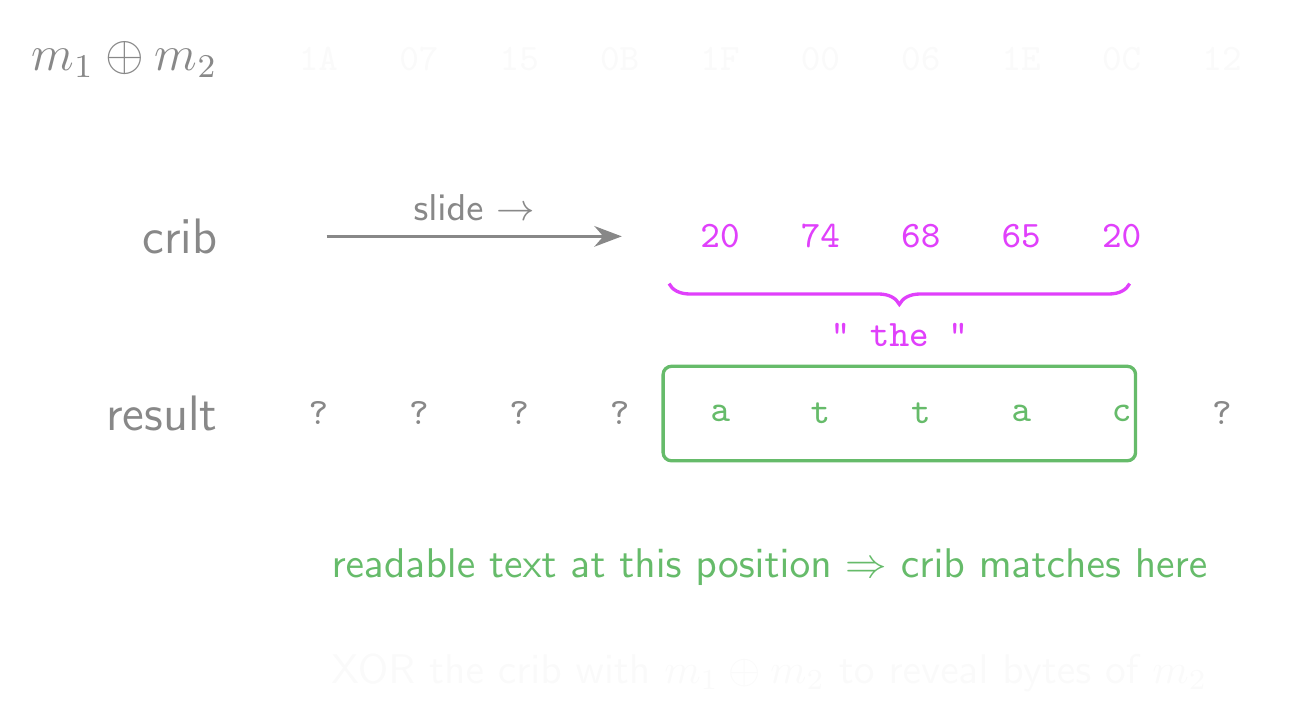
- We can verify guesses by decrypting the matching part of the other ciphertext.
- If it looks right, then we now have more bits of the key!
- This is called crib-dragging… guess a likely part of the message and drag it across the ciphertexts to see if it fits in that position.
- Practically, this should be automated (and it’s easy to automate!)
- We only need two messages encrypted with the same key to do this.
- The more the key is reused, the easier this gets!
Crib-Dragging Attack
What About Shorter Keys?
- We might also wonder if we can use a shorter key, repeated end-to-end.
- This is essentially the same as the many-time pad, and has the same weaknesses!
- By splitting the ciphertext into key-length chunks…
- We can XOR those and crib-drag same as before.
- Can we have perfect security with a key shorter than the message?
Short Keys Can’t Be Perfectly Secure
- Having a key shorter than the message implies that there are fewer possible keys than there are possible messages, so let’s tackle that case.
- Assume we have a Shannon cipher with \(|\mathcal{K}| < |\mathcal{M}|\)
- If this isn’t perfectly secure, then there exist \(m_0, m_1 \in \mathcal{M}\) and \(c \in \mathcal{C}\), such that:
- \(\Pr[E(\mathbf{k}, m_0) = c] > 0\) and
- \(\Pr[E(\mathbf{k}, m_1) = c] = 0\)
- Take any \(m_0 \in \mathcal{M}\) and any \(k_0 \in \mathcal{K}\), and let \(c = E(k_0, m_0)\)
- By definition, a) must be true!
- Now, let’s make a set of all the possible ways to decrypt that ciphertext
- \(S = \{ D(k_1, c) : k_1 \in \mathcal{K} \}\)
- Clearly, the size of that set is limited by the number of possible keys.
- \(|S| \leq |\mathcal{K}| < |\mathcal{M}|\)
- …so it must be possible to choose \(m_1 \in \mathcal{M}\) s.t. \(m_1 \notin S\)
- This means that b) must be true, and shows that this isn’t perfectly secure.
Problems with the One-Time Pad
- Key length: the key must be at least as long as the message. We just proved this!
- Key reuse: using the same key twice leaks the XOR of the plaintexts, and from there the game is over.
- Truly random keys: the key must be sampled uniformly at random. Pseudorandom keys weaken the security guarantees. Generating truly random keys at scale is hard!
- Malleability: an attacker can flip bits in the ciphertext and the corresponding bits in the plaintext will flip too.
- XOR a ciphertext with any bitstring \(\delta\) and you get \(D(k, c \oplus \delta) = m \oplus \delta\)
- The attacker doesn’t need to know the plaintext to change it in a predictable way!
- No integrity: there’s no way to tell if a ciphertext has been tampered with. The one-time pad provides confidentiality, not integrity.
- Confidentiality without integrity is dangerous in practice. We’ll come back to this!
So What Does That Tell Us?
- Sometimes, when it sounds too good to be true, it’s because it is.
- Perfect security is possible but not practical.
- No amount of maths and software testing can save a user from themselves if they don’t follow best practice, e.g. reusing the key with a one-time pad.
- Seemingly minor flaws can be utterly fatal in cryptography.
- But all is not lost!
- Instead, we’re going to focus on semantic security in practice.
- Similar to computational complexity in some ways.
- Not perfect, but good enough against a real-world adversary with realistic resources.
Semantic Security
Not perfect, but good enough?
The Problem
- Perfect security is achievable, but impractical! We’d like to encrypt large amounts of data:
- Documents and ebooks
- Music and voice calls
- Videos, livestreams and video calls
- Increasingly massive games
- But we’d like to do that with a relatively small key!
- Ideally smaller than 1000 bits for most applications
- 128-bit and 256-bit keys are standard for most symmetric ciphers
- The only way forward is to abandon the notion of perfect security in practice
- We need to weaken it slightly (and only slightly)
- We need to aim for practical rather than perfect
Computational Ciphers
- Shannon ciphers are all well and good, but let’s get more specific.
- A computational cipher \(\mathcal{E} = (E, D)\) is a pair of efficient algorithms, \(E\) and \(D\).
- Note how we’re requiring that they’re efficient algorithms this time!
- \(E\) can be probabilistic if you want!
- It’s allowed to randomly produce different ciphertexts for the same key and message…
- …so long as \(D\) can correctly decrypt all of them!
- If \(E\) isn’t probabilistic, then we can call it a deterministic cipher.
- All deterministic ciphers are Shannon ciphers
- A computational cipher isn’t necessarily a Shannon cipher
- Probabilistic computational ciphers aren’t Shannon ciphers
- Shannon ciphers aren’t necessarily computational ciphers either!
- Shannon ciphers don’t need to have efficient implementations
- The one-time pad is a deterministic cipher
What Makes an Algorithm “Efficient”?
- We just said computational ciphers must be efficient algorithms. What does that mean?
- Think about how the running time of an algorithm grows as the input gets bigger.
- A polynomial-time algorithm runs in time proportional to some fixed power of the input size
- \(n\), \(n^2\), \(n^3\), … these all grow, but they grow manageably
- Double the input? The work might quadruple (\(n^2\)), but it doesn’t explode
- An exponential-time algorithm runs in time proportional to some constant raised to the input size
- \(2^n\), \(3^n\), … these blow up fast
- Add one bit to the input? The work doubles (\(2^n\))
- Add ten bits? The work increases by a factor of 1,024
Probabilistic Polynomial Time
- In cryptography, “efficient” means probabilistic polynomial-time (PPT).
- Probabilistic: the algorithm can flip coins (use randomness)
- Polynomial-time: its running time is polynomial in the input size
- Encryption and decryption should be fast, polynomial in the key/message size
- Breaking the cipher should be hard, no polynomial-time attack exists
- This is the same idea as P vs NP, if you’ve seen that before!
- Why does this matter? Perfect security defends against all adversaries, even unbounded ones.
- An unbounded adversary can always try every key in the keyspace — brute force is always available to them
- That’s fundamentally why perfect security requires \(|\mathcal{K}| \geq |\mathcal{M}|\)
- But a PPT adversary can’t enumerate an exponential keyspace!
- Trying all \(2^{256}\) keys takes exponential time — not polynomial
- This is the key insight: restricting to efficient adversaries lets us use short keys
Attack Games
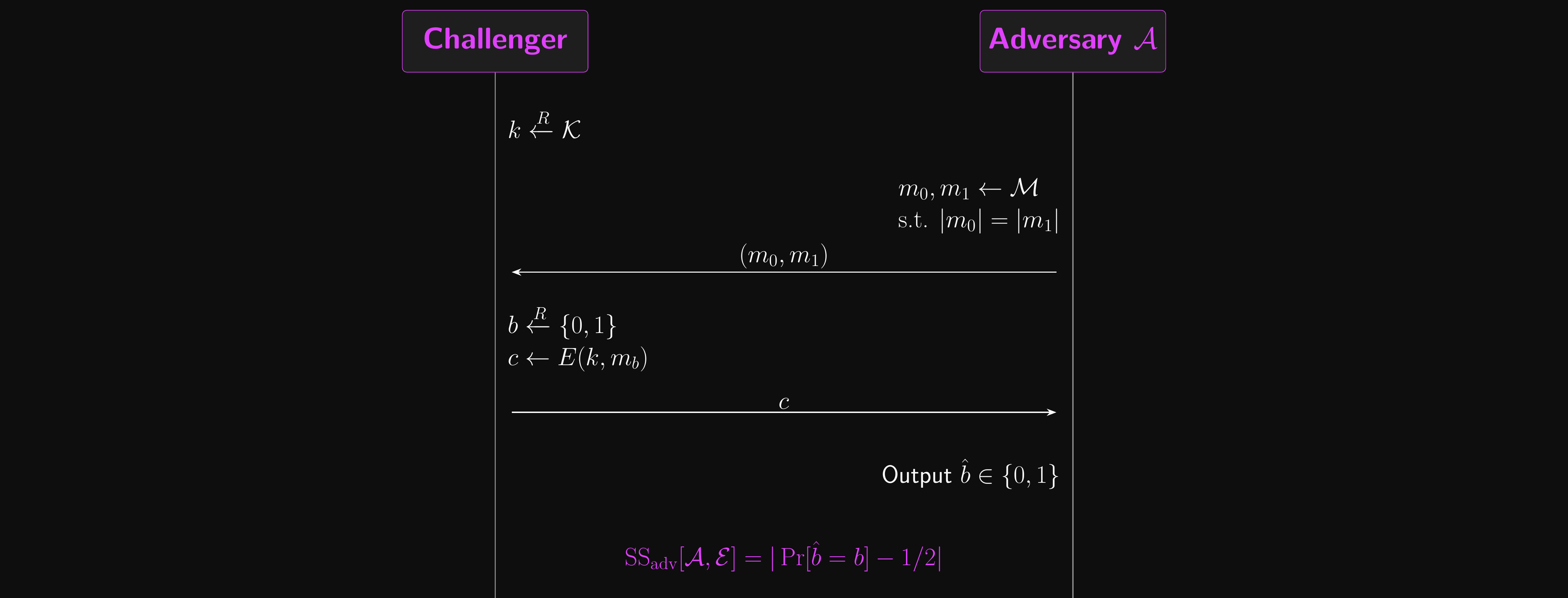
- The easiest way to think about semantic security is to build an attack game!
- There are two participants:
- The challenger sets up the game and defines the cipher to use
- The adversary will try to break the cipher using an arbitrary strategy
- The challenger generates a secret key and sets up the cipher
- The adversary generates two distinct messages of the same length
- Remember how length is the property we’re allowed to leak?
- These messages need to be generated by an efficient algorithm
- The messages are sent to the challenger
- The challenger randomly selects a message to encrypt (with equal probability)
- They encrypt the message with the secret key
- The ciphertext is sent to the adversary
- Using only the ciphertext, the adversary tries to guess which message was encrypted
Attack Games: Analysis
- If we play this game over many rounds with the one-time pad, how often would you expect the adversary to guess correctly?
- What’s the optimal strategy available to the adversary?
- If the adversary can guess correctly with probability greater than \(1/2\), the cipher isn’t perfectly secure!
- Of course, if they’re guessing correctly less than half the time, the cipher also isn’t perfectly secure. Think it through!
- Usually, this setup is used as part of a proof rather than actually being played
- Why does the adversary get to pick the messages?
- So they can exploit any weaknesses in the cipher!
Semantic Security: Attack Game
Semantic Security
- So that’s a lot of talk without actually getting to semantic security yet!
- We define the semantic security advantage of an adversary \(\mathcal{A}\) in the attack game against a cipher \(\mathcal{E}\) to be:
- \(\text{SS}_\text{adv}[\mathcal{A}, \mathcal{E}] = |\Pr[\text{correct guess}] - \Pr[\text{incorrect guess}]|\)
- Perfect security requires:
- \(\text{SS}_\text{adv}[\mathcal{A}, \mathcal{E}] = 0\)
- But we said we were going to weaken our notion of security slightly…
- For semantic security, we allow the value to be negligible instead!
- \(\text{SS}_\text{adv}[\mathcal{A}, \mathcal{E}]\) must be negligible for all efficient adversaries \(\mathcal{A}\)
- A function \(f(n)\) is negligible if it shrinks faster than the inverse of any polynomial
- Formally: for every \(c > 0\), there exists \(N\) such that \(f(n) < 1/n^c\) for all \(n > N\)
- \(1/2^n\) is negligible (shrinks exponentially) — \(1/n^{10}\) is not (still polynomial)
- The security parameter \(n\) is typically the key length, so with a 128-bit key, negligible means far smaller than \(1/2^{128}\)
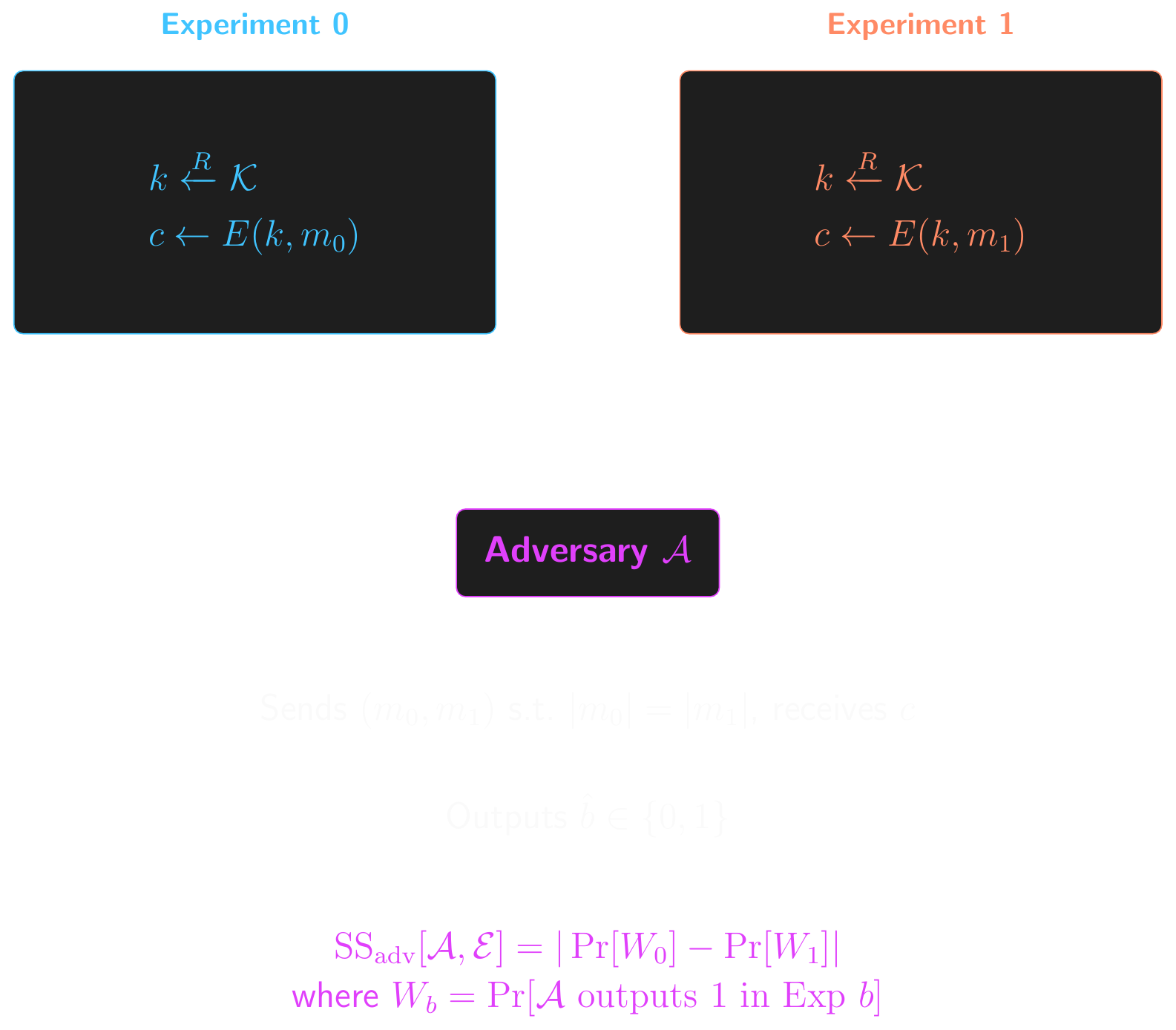
Semantic Security: Two-Experiment Form
Semantic Security in Practice
- What does this mean in practice?
- An adversary can’t gain any useful information about the message from the ciphertext, even when they can pick which messages get encrypted.
- We assume that adversaries have large but realistic resources.
- In general, attackers are much more patient and determined than you are!
- 10 seconds is a long time for an encryption function to take…
- …but an attacker might happily spend years trying to break it!
- 10,000 CPUs working in parallel for 10 years still shouldn’t be able to get a non-negligible advantage in the attack game
- 1 trillion CPUs working in parallel until the heat death of the universe is outside the scope of this course (thankfully)
Semantic Security and IND-CPA
- This is closely related to the notion of ciphertext indistinguishability under chosen-plaintext attack (IND-CPA)
- An attacker can’t distinguish between ciphertexts, even when they get to pick the plaintexts
- The equivalence is proved formally in Boneh & Shoup, Chapter 2
- We’ll meet other, stronger notions of security later on!
- Note that semantic security is a stronger guarantee than security against message recovery attacks
- If you can recover the plaintext from a ciphertext, then the cipher obviously isn’t semantically secure!
- Security against message recovery attacks is necessary but not sufficient for semantic security. We’ll see an example of this with block ciphers later!
- On the other hand, a semantically secure cipher is secure against message recovery attacks by definition.
Conclusion
What did we learn?
So, What Did We Learn?
- Shannon ciphers: formal definition of encryption/decryption with the correctness property \(D(k, E(k, m)) = m\)
- Entropy and uniformity: cryptographic keys must be sampled uniformly at random, and we measure unpredictability in bits of entropy
- Perfect security: the ciphertext leaks no information about the plaintext
- One-time pad: perfectly secure, but impractical — the key must be as long as the message
- Many-time pad: reusing keys is catastrophic — key cancellation leaks the XOR of plaintexts
- Semantic security: practical relaxation — no efficient adversary can gain a non-negligible advantage
Problems for Another Day…
- A symmetric key needs to be shared with the other party before it can be used.
- This clearly can’t be done in plaintext over an insecure channel!
- We’ll need a way to solve this problem…
- Even with a secure cipher, a malicious attacker can cause plenty of damage!
- Intercepting and replaying messages
- Altering the ciphertexts
- And more…
- We’ll need a way to stop this too!
- We need a way around the key length problem too.
- And we’ll need to know how to generate keys safely
- Good keys are hard to remember
- Passwords/passphrases are easy to remember
- But most passwords are bad keys…
For Next Time…
- Complete the challenges in this week’s lab and submit on Brightspace
- Show your workings! I expect you to submit runnable notebooks.
- I’ll randomly select
victimsstudents to explain their work to me next week - Can’t explain how you solved a challenge? You get a zero.
- Worth up to 4%, depending on how much and how well you solve the challenges!
- Complete some assigned reading for next week:
- Chapter 5 (XOR) of Crypto 101 and Appendix A on modular arithmetic
- It’s very short and it’ll help with the challenges!
- Chapter 2, section 1 & 2 of A Graduate Course in Applied Cryptography
- This is a more rigorous treatment of today’s subject
- You don’t need to go too deep into the maths
- Get used to the logic of the proofs and perfect vs semantic security
- Chapter 5 (XOR) of Crypto 101 and Appendix A on modular arithmetic
Questions?
Ask now, catch me after class, or email eoin@eoin.ai